

How Lunar Craters Record Solar-System History Explainer
Most lunar craters formed when asteroids, comets, or smaller fragments struck the surface at high speed. The impact compressed and heated the target, launched a shock wave, excavated rock, and threw ejecta around the site. Even a relatively small projectile can make a much larger crater because its kinetic energy is released in a fraction of a second.
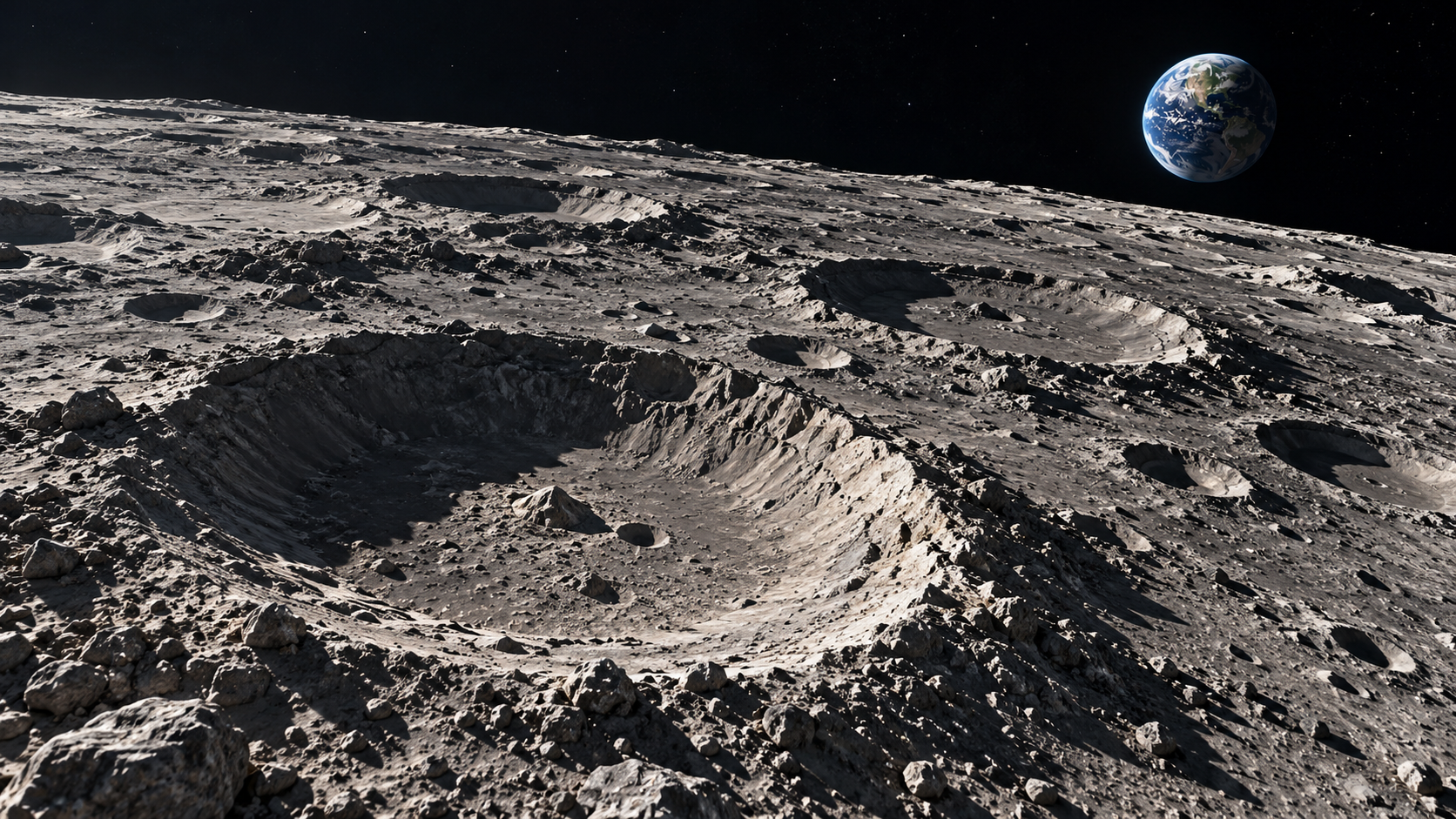
Small simple craters are bowl-shaped, while larger complex craters develop terraces, flat floors, and central peaks as the transient cavity collapses under gravity. Very large impacts form multi-ring basins. Bright rays mark relatively fresh ejecta spread over long distances. Secondary craters appear where large blocks thrown from a primary impact land elsewhere.
Earth also receives impacts, but weather, rivers, oceans, vegetation, volcanism, and plate tectonics erase or bury much of the evidence. The Moon has no substantial atmosphere or liquid-water erosion and little recent internal resurfacing. Micrometeorites and space weathering slowly soften features, yet craters can remain recognizable for billions of years.
Relative age follows superposition: a crater that cuts across another feature is younger than what it overlaps. Heavily cratered terrain is generally older because it has been exposed longer, while smooth volcanic plains called maria contain fewer craters. Geologists map ejecta, cross-cutting relationships, degradation, and density to reconstruct sequences of events.
Crater counting estimates the age of a surface by comparing the number and size of craters with a model of impact rates. Apollo and Luna samples provide radiometric ages for particular lunar units, anchoring that chronology. Scientists then apply calibrated crater statistics to Mars, Mercury, and other solid worlds where returned samples are limited or absent.
The record is not a perfect clock. Impact rates changed over time, secondary craters can inflate counts, lava can reset a surface, and saturation makes very old terrain difficult to separate. Researchers combine counts with mapping, sample ages, orbital images, and numerical models. The Moon remains invaluable because its quiet surface preserves a long archive of solar-system collisions.
Hypervelocity impacts excavate cavities, fracture rock, and spread ejecta far beyond the projectile's original size.
Crater form changes from simple bowls to terraced structures, central peaks, and multi-ring basins as size increases.
Minimal erosion and plate tectonics allow lunar craters to survive far longer than most craters on Earth.
Overlapping relationships and degradation reveal relative age, while crater density compares exposure time.
Radiometrically dated lunar samples calibrate crater-count chronologies used across the rocky solar system.
Changing impact rates, secondary craters, resurfacing, and saturation create uncertainty in the lunar clock.
Explore more "Explainers"
Discover additional explainers across politics, science, business, technology, and other fields. Each explainer breaks down a complex idea into clear, everyday language—helping you better understand how major concepts, systems, and debates shape the world around us.