

How the Doppler Effect Reveals Motion Explainer
The Doppler effect is a change in the frequency measured by an observer when a wave source and observer move relative to each other. A source approaching the observer sends successive wave crests from progressively closer positions, so the crests arrive more often. A receding source sends them from progressively farther positions, stretching their arrival spacing. The wave itself is not created faster or slower; motion changes how frequently its repeating pattern reaches the detector.
Sound makes the effect familiar. A passing siren seems higher in pitch while it approaches and lower after it passes. The speed of sound in the air remains set mainly by the air temperature, but the observed frequency changes. If the observer also moves, that motion changes the rate at which wavefronts are encountered. The precise formula depends on whether the source, observer, or medium is moving.
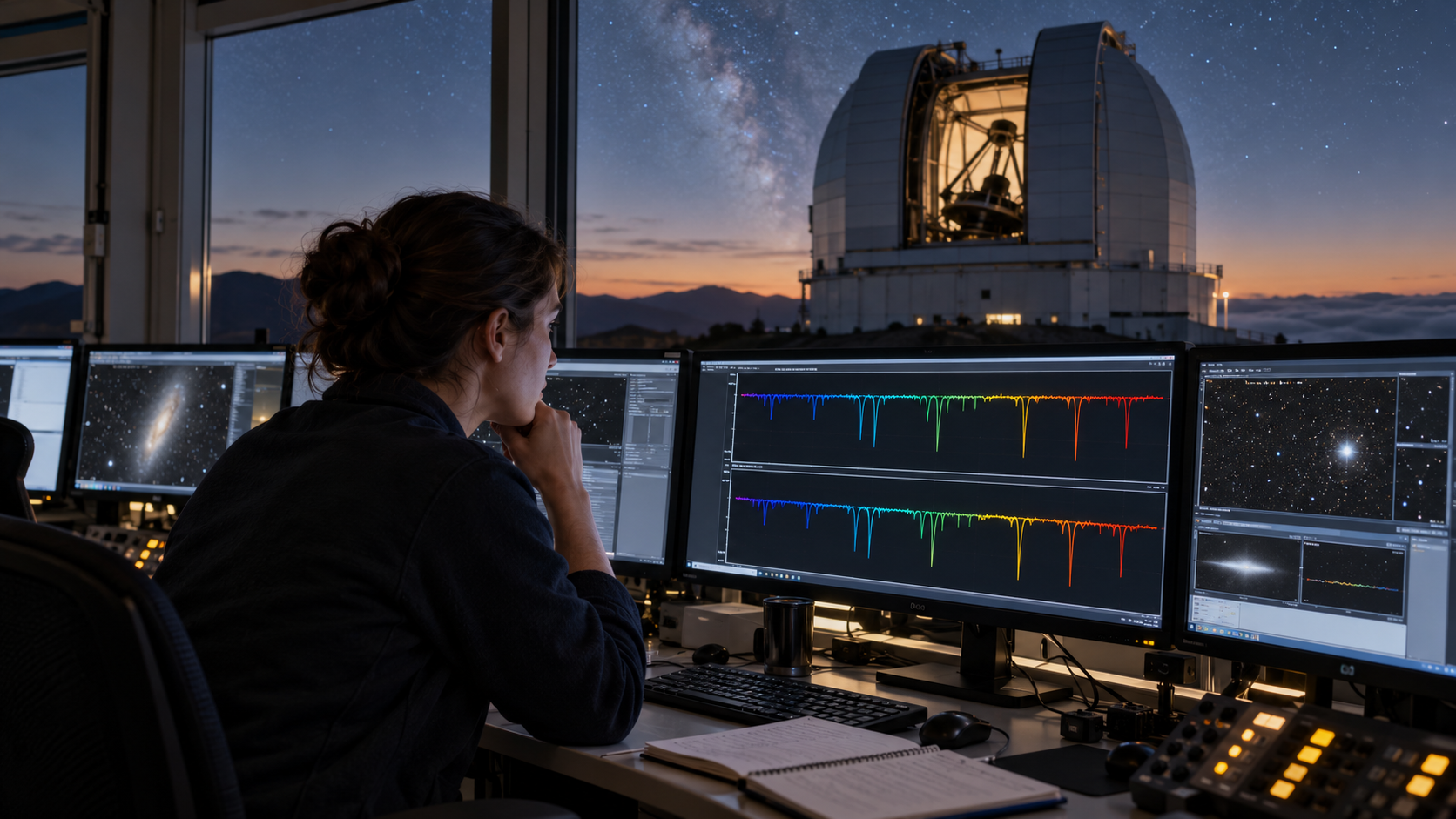
Light shows an analogous effect even though it does not need a material medium. Light from an approaching object is shifted toward shorter, bluer wavelengths, while light from a receding object is shifted toward longer, redder wavelengths. Astronomers compare known spectral lines from atoms with their measured positions in a star or galaxy. The displacement reveals the component of velocity directed toward or away from Earth.
The method measures radial motion rather than the full path across the sky. An object moving sideways can have a large speed but little Doppler shift. Astronomers therefore combine spectroscopy with changes in position, distance estimates, or orbital models. In exoplanet searches, the tiny alternating red and blue shifts of a star can reveal its gravitational motion around a shared center of mass with an unseen planet.
Radar sends radio waves toward an object and measures the frequency of the reflection. Weather radar uses Doppler shifts to estimate motion of raindrops and wind within storms. Police radar measures vehicle speed, and medical Doppler ultrasound estimates blood-flow direction and velocity. Each application requires accounting for geometry, instrument calibration, and the wave speed appropriate to the medium.
A frequency shift does not by itself identify what moved or why. Turbulence, several overlapping sources, broad spectral lines, and instrument drift can complicate interpretation. Even so, the Doppler effect turns a precisely measured change in pitch or color into a remote speed measurement. It is one of the most widely useful links between wave physics and motion.
Approaching motion crowds wavefronts together, increasing observed frequency; receding motion spreads them apart.
The wave speed can remain unchanged while the arrival rate of crests changes for the observer.
Spectral lines shift blueward for approach and redward for recession, revealing radial velocity.
Motion across the line of sight needs positional measurements because Doppler shift mainly captures toward-or-away motion.
Radar, ultrasound, and astronomical spectroscopy apply the same frequency-shift principle in different wave bands.
Geometry, overlapping signals, turbulence, and calibration determine how accurately velocity can be recovered.
Explore more "Explainers"
Discover additional explainers across politics, science, business, technology, and other fields. Each explainer breaks down a complex idea into clear, everyday language—helping you better understand how major concepts, systems, and debates shape the world around us.