

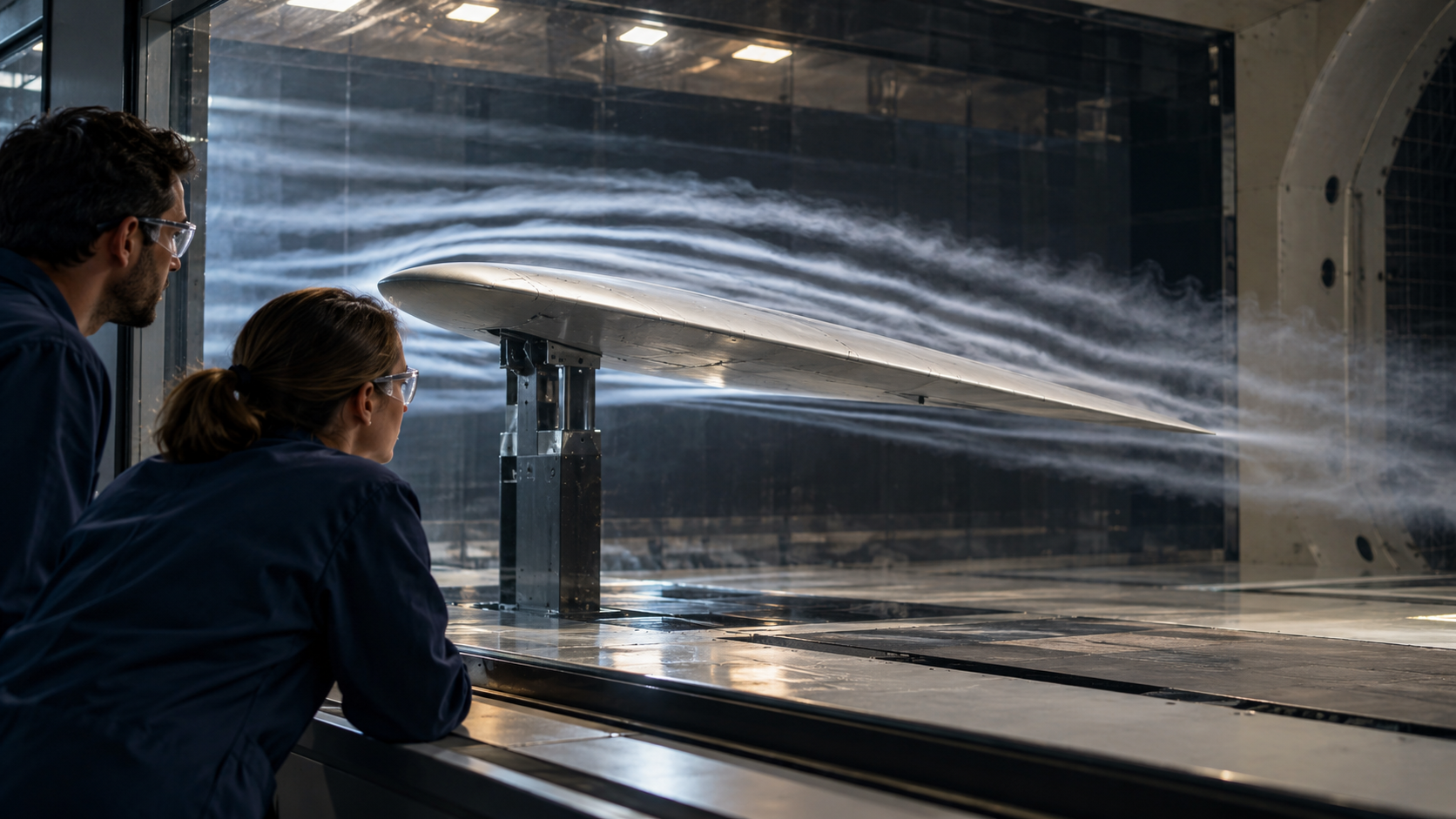
How Airplane Wings Generate Lift Explainer
Lift is an aerodynamic force perpendicular to the relative airflow around an aircraft. A wing’s shape and angle of attack organize the flow so pressure is generally lower over much of the upper surface and higher over parts of the lower surface. Integrating those pressure forces, along with a smaller contribution from skin friction, produces a net force that can balance the aircraft’s weight.
The wing also turns air downward. This change in the air’s momentum requires a force, and the air exerts an opposite force on the wing. Pressure distribution, circulation around the airfoil, and downward wake are connected descriptions of the same flow. Air parcels passing over and under the wing do not have to meet again at the trailing edge at the same time.
Lift depends on air density, wing area, the square of airspeed, and a lift coefficient that captures shape, angle, viscosity, and compressibility. Increasing speed can greatly increase lift. Raising angle of attack usually increases the lift coefficient up to a limit. Pilots and designers use flaps and slats to change wing shape and produce more lift at lower takeoff and landing speeds.
A finite wing creates swirling wingtip vortices because high-pressure air moves around the tip toward lower pressure. The resulting downwash tilts part of the aerodynamic force backward, producing induced drag. Longer, higher-aspect-ratio wings reduce this penalty for a given lift, which is one reason gliders have slender wings. Structural weight and operating needs limit how long a wing can be.
If angle of attack becomes too large, the boundary layer separates over much of the wing. Lift decreases and drag rises in a stall. A stall is defined by airflow and angle, not simply by low speed, although slow flight often requires higher angle of attack to support the same weight. Ice, roughness, damage, or abrupt maneuvers can change the stall margin.
Real aircraft balance lift with weight and thrust with drag only in steady, level flight. Turns, climbs, gusts, altitude, and acceleration change the required forces. Wind tunnels, computational fluid dynamics, flight tests, and pressure measurements determine performance. No single slogan explains every wing; lift is the combined result of three-dimensional viscous airflow and pressure around a moving body.
Pressure integrated over a wing produces a force perpendicular to the relative airflow.
The wing turns air downward, linking pressure, circulation, momentum change, and downwash.
Density, speed, area, shape, and angle of attack determine lift through the lift coefficient.
Flaps and slats raise low-speed lift, while wingtip vortices create induced drag.
Excessive angle of attack causes separation and stall regardless of the aircraft’s attitude.
Wind tunnels, computation, and flight tests capture the full three-dimensional viscous flow.
Explore more "Explainers"
Discover additional explainers across politics, science, business, technology, and other fields. Each explainer breaks down a complex idea into clear, everyday language—helping you better understand how major concepts, systems, and debates shape the world around us.