

How the Ear Converts Sound into Nerve Signals Explainer
Sound is a pattern of pressure changes in air. The outer ear gathers those changes and guides them down the ear canal to the eardrum. The vibrating eardrum moves three tiny middle-ear bones: the malleus, incus, and stapes. Their lever action and area difference transfer energy efficiently from air into the fluid-filled inner ear rather than simply making sound louder.
The stapes presses on the oval window of the cochlea and launches pressure waves through inner-ear fluid. Those waves move the basilar membrane, a flexible structure whose mechanical properties vary along the cochlear spiral. High frequencies cause the largest response near the stiff base, while lower frequencies peak farther toward the flexible apex. This creates an ordered frequency map.
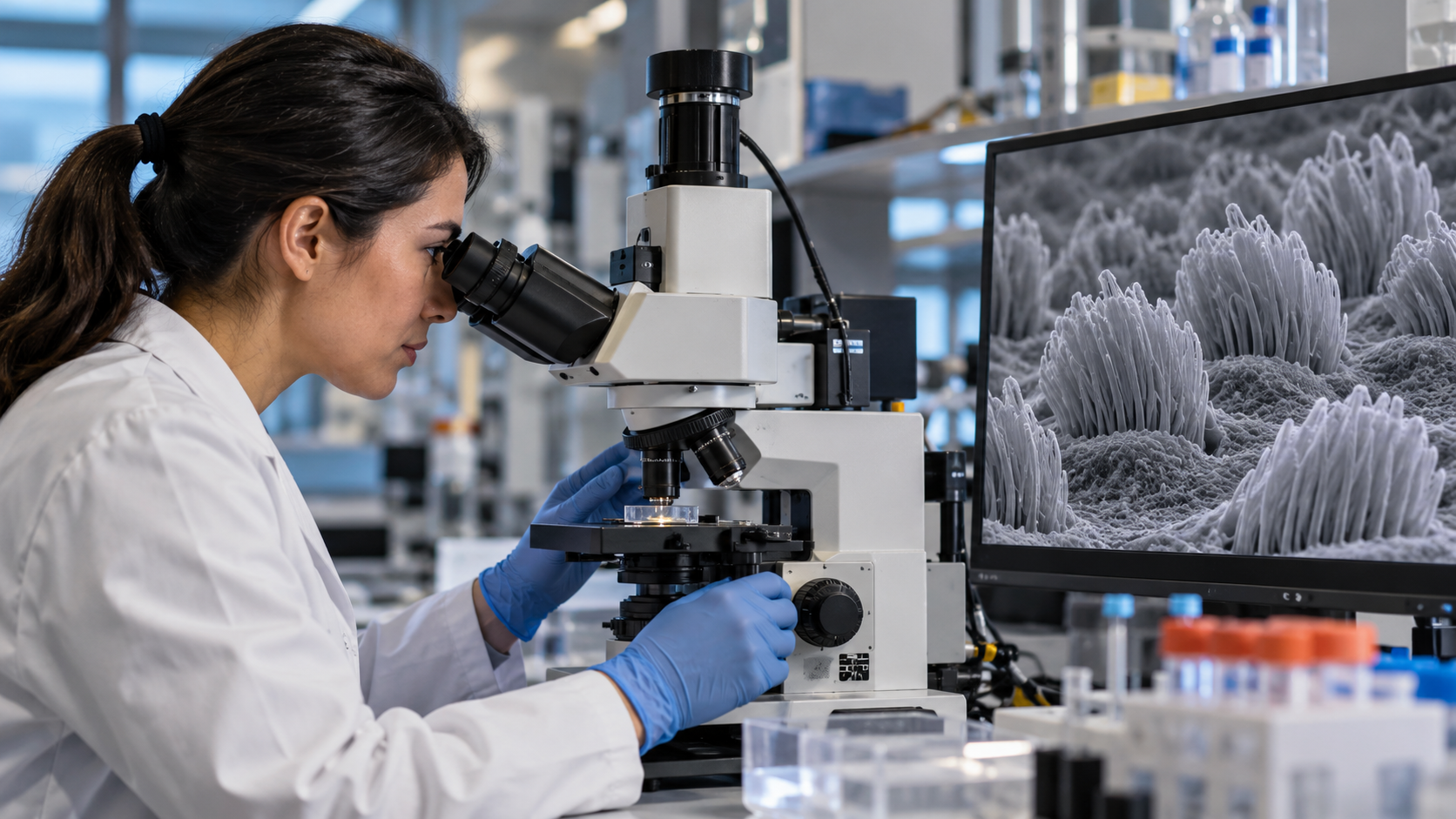
Hair cells sit in the organ of Corti on the basilar membrane. Movement shears their bundles of microscopic stereocilia. Fine links between stereocilia pull open mechanically gated ion channels. Ions enter, changing the hair cell’s voltage. The cell then releases neurotransmitter at specialized synapses onto auditory-nerve fibers, converting mechanical motion into an electrical neural code.
Inner hair cells provide most of the information sent to the brain. Outer hair cells change length in response to voltage and actively amplify basilar-membrane motion, sharpening sensitivity and frequency selectivity. This biological feedback lets the ear detect very faint sounds across a wide range, but it is also vulnerable to loud noise, some medicines, aging, and disease.
The auditory nerve carries patterns of activity into the brainstem and through several parallel pathways to the auditory cortex. Frequency, timing, intensity, and differences between the two ears help the brain identify speech, music, and location. The brain does not receive a recording of the waveform; it reconstructs a percept from the organized firing of many nerve fibers.
Damage can occur at different stages. Blockage or middle-ear problems reduce mechanical transfer, while hair-cell or nerve injury causes sensorineural loss. Human cochlear hair cells generally do not regenerate after destruction. Hearing protection reduces preventable damage, and hearing aids or cochlear implants help in different ways depending on which part of the pathway remains functional.
The outer and middle ear transfer airborne pressure changes into inner-ear fluid motion.
The basilar membrane separates frequencies by the location of maximum vibration.
Stereocilia bending opens ion channels and changes hair-cell voltage.
Inner hair cells signal the nerve, while outer hair cells amplify and sharpen cochlear motion.
The brain interprets timing and activity patterns across many auditory pathways.
Mechanical blockage, hair-cell damage, and nerve injury cause different forms of hearing loss.
Explore more "Explainers"
Discover additional explainers across politics, science, business, technology, and other fields. Each explainer breaks down a complex idea into clear, everyday language—helping you better understand how major concepts, systems, and debates shape the world around us.