

How Solar Flares Release Magnetic Energy Explainer
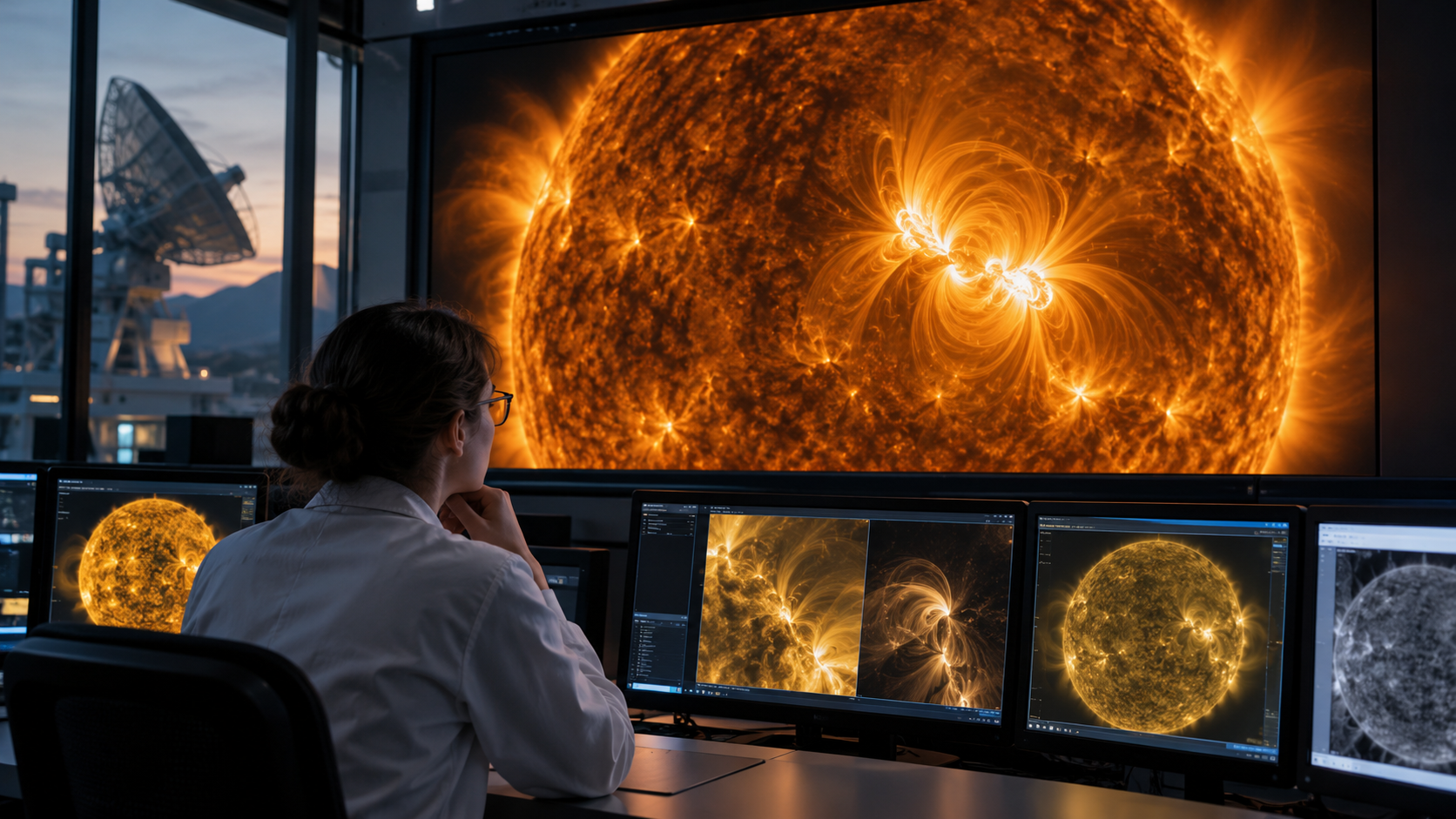
A solar flare is a sudden burst of electromagnetic radiation from the Sun’s atmosphere. Flares occur in active regions where strong magnetic fields emerge through the surface, often near sunspots. Motions in the rotating, convecting plasma shear and twist the fields, storing energy over hours or days. The visible brightening is the rapid release of part of that magnetic energy.
Magnetic reconnection is the leading mechanism. Oppositely directed field structures are pushed together in a thin current sheet, then change connectivity and relax into a lower-energy arrangement. The process accelerates electrons and ions and heats plasma to very high temperatures. Energy travels along magnetic loops into denser lower layers, producing intense ultraviolet, X-ray, radio, and visible emission.
Satellites classify many flares by peak X-ray brightness into A, B, C, M, and X categories. Each letter step represents a tenfold increase, with a number refining the level within a class. This scale measures radiation near Earth; it does not by itself describe every particle burst, eruption, location, duration, or impact.
A flare can occur with a coronal mass ejection, but the two are distinct. The flare is radiation and energized plasma in the solar atmosphere; a coronal mass ejection launches a huge magnetized cloud into space. Some strong flares have weak ejections, and some ejections occur with modest flares. Space-weather consequences depend on whether particles and magnetic structure are directed toward Earth.
Flare light reaches Earth in about eight minutes and can ionize the upper atmosphere, disrupting high-frequency radio and affecting satellite navigation. Energetic particles arrive later and can raise radiation risk for spacecraft, astronauts, and polar aviation. A geomagnetic storm mainly follows interaction between an Earth-directed ejection and the magnetosphere, not the flare’s light alone.
Observatories measure magnetic fields, ultraviolet and X-ray images, spectra, radio bursts, and energetic particles. Forecasting remains difficult because similar active regions do not always erupt, and reconnection begins on small scales. Solar physics can identify rising probability and monitor consequences, but it cannot yet predict the exact time and strength of every flare.
Plasma motions twist and shear magnetic fields, storing energy in solar active regions.
Magnetic reconnection changes field connectivity and converts energy into heat, particles, and radiation.
A through X flare classes describe measured X-ray brightness on a logarithmic scale.
Flares and coronal mass ejections are related but physically distinct solar events.
Radiation, particles, and magnetized ejecta reach Earth on different timescales and cause different effects.
Multiple observatories track active regions, but exact flare timing remains hard to forecast.
Explore more "Explainers"
Discover additional explainers across politics, science, business, technology, and other fields. Each explainer breaks down a complex idea into clear, everyday language—helping you better understand how major concepts, systems, and debates shape the world around us.