

How Soil Forms Explainer
Soil is a natural body of mineral particles, organic matter, water, air, and living organisms that has developed at Earth’s surface. It is not simply loose rock or accumulated dirt. Soil-forming processes transform parent material, add and remove substances, move material within the profile, and create horizons with physical, chemical, and biological properties unlike the starting deposit.
Parent material may be weathered bedrock, river sediment, volcanic ash, windblown dust, glacial deposits, or organic material. Physical weathering breaks particles into smaller pieces through temperature change, freezing, roots, abrasion, and stress. Chemical weathering dissolves or alters minerals through water, acids, oxidation, and hydrolysis, releasing ions and forming clays and other secondary minerals.
Climate controls available water, temperature, reaction rates, leaching, and biological productivity. Plants add litter and roots, while microbes and animals decompose material, cycle nutrients, create pores, and mix particles. Organic matter helps form aggregates and influences color, water retention, and nutrient exchange. Human cultivation, construction, contamination, and erosion can rapidly alter or reset parts of a profile.
Topography determines drainage, sun exposure, erosion, and deposition. Steep slopes often lose weathered material before thick horizons develop, while lower positions may accumulate sediment and water. Aspect changes temperature and vegetation. Time allows processes to leave clearer signatures, but an old landscape does not guarantee a deep soil if erosion, flooding, volcanism, glaciation, or disturbance repeatedly renews the surface.
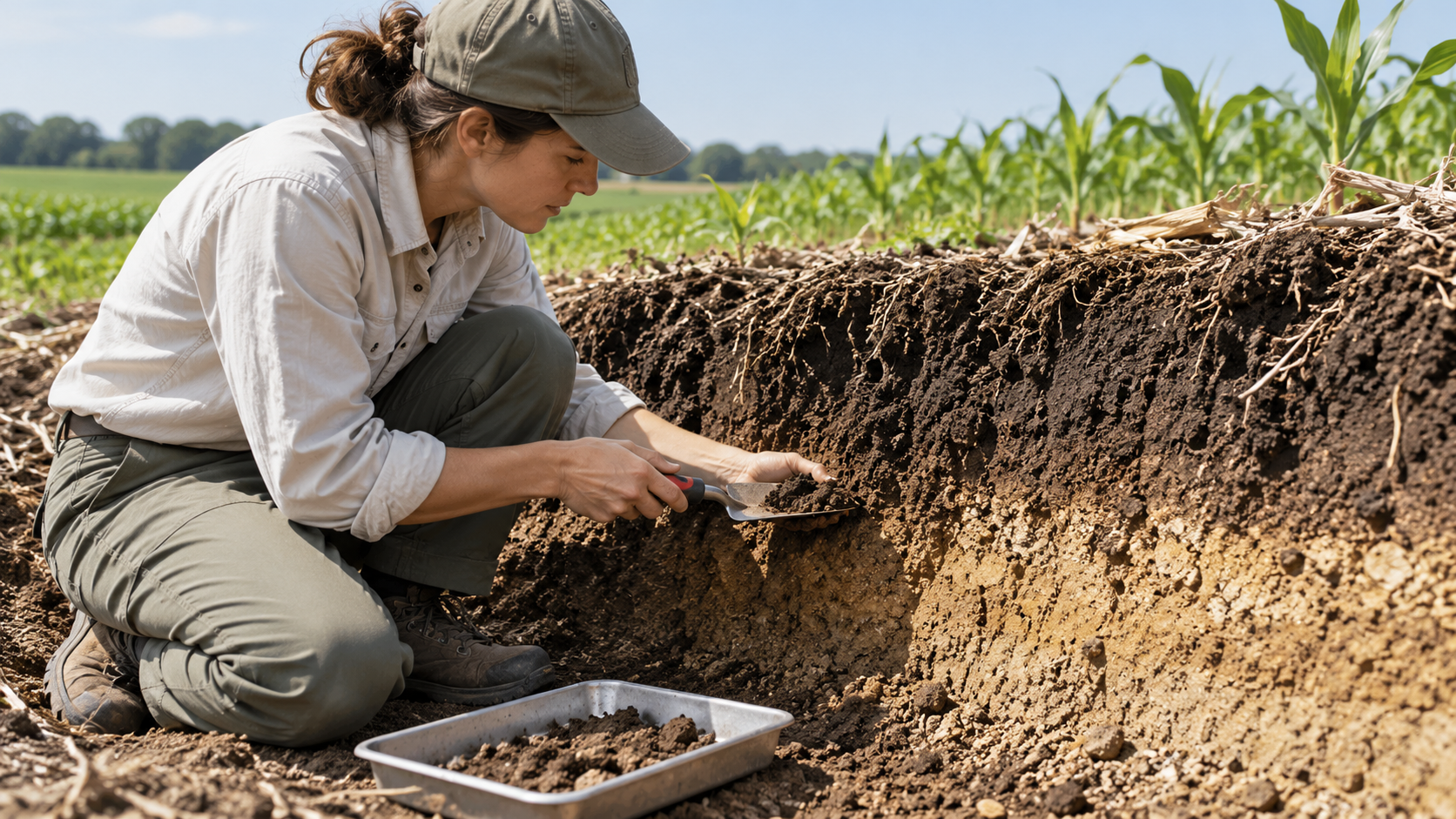
Water carries dissolved and suspended material downward or laterally. Surface horizons may lose clay, iron, carbonates, salts, or organic compounds, while deeper horizons accumulate some of them. The resulting profile can include organic, topsoil, subsoil, altered parent, and bedrock layers, but real soils do not all contain every textbook horizon or follow one universal sequence.
Soil can form slowly yet be degraded quickly. Its usefulness depends on structure, depth, texture, mineralogy, organic matter, chemistry, biology, and landscape context rather than age alone. Soil formation matters because it connects geology, water, climate, and life while supporting plants, filtering and storing water, cycling nutrients, holding carbon, and providing the physical foundation for ecosystems and agriculture.
Parent material supplies the initial mineral or organic framework for soil development.
Physical and chemical weathering break down and transform that material.
Climate controls water, heat, leaching, reaction rates, and biological activity.
Plants, microbes, animals, and people add, mix, and remove soil constituents.
Topography governs drainage, erosion, deposition, and local temperature.
Horizons record additions, losses, transfers, and transformations over time.
Explore more "Explainers"
Discover additional explainers across politics, science, business, technology, and other fields. Each explainer breaks down a complex idea into clear, everyday language—helping you better understand how major concepts, systems, and debates shape the world around us.