

How Limestone Caves Form Explainer
Most solution caves form in soluble rock such as limestone or dolomite. Rain and snowmelt absorb carbon dioxide from the air and especially from biologically active soil, producing weak carbonic acid. The water enters cracks, bedding planes, and faults. Although only mildly acidic, repeated flow can dissolve calcite and carry calcium and bicarbonate away in solution.
Dissolution initially widens tiny openings. Water routes with favorable fractures or chemistry carry more flow and enlarge faster, creating a feedback that focuses drainage. Much cave development occurs near or below a water table where passages are filled, although descending water above the water table also shapes shafts and channels. Regional uplift and stream erosion can later lower the water table and drain older levels.
Caves are not normally carved by huge underground rivers mechanically grinding solid limestone from the beginning. Chemical dissolution is the dominant opening process in many karst systems, though sediment abrasion, roof collapse, flooding, and frost can modify established passages. Some caves form by sulfuric acid rising from depth, lava flow, waves, ice, or tectonic opening, so limestone dissolution is not universal.
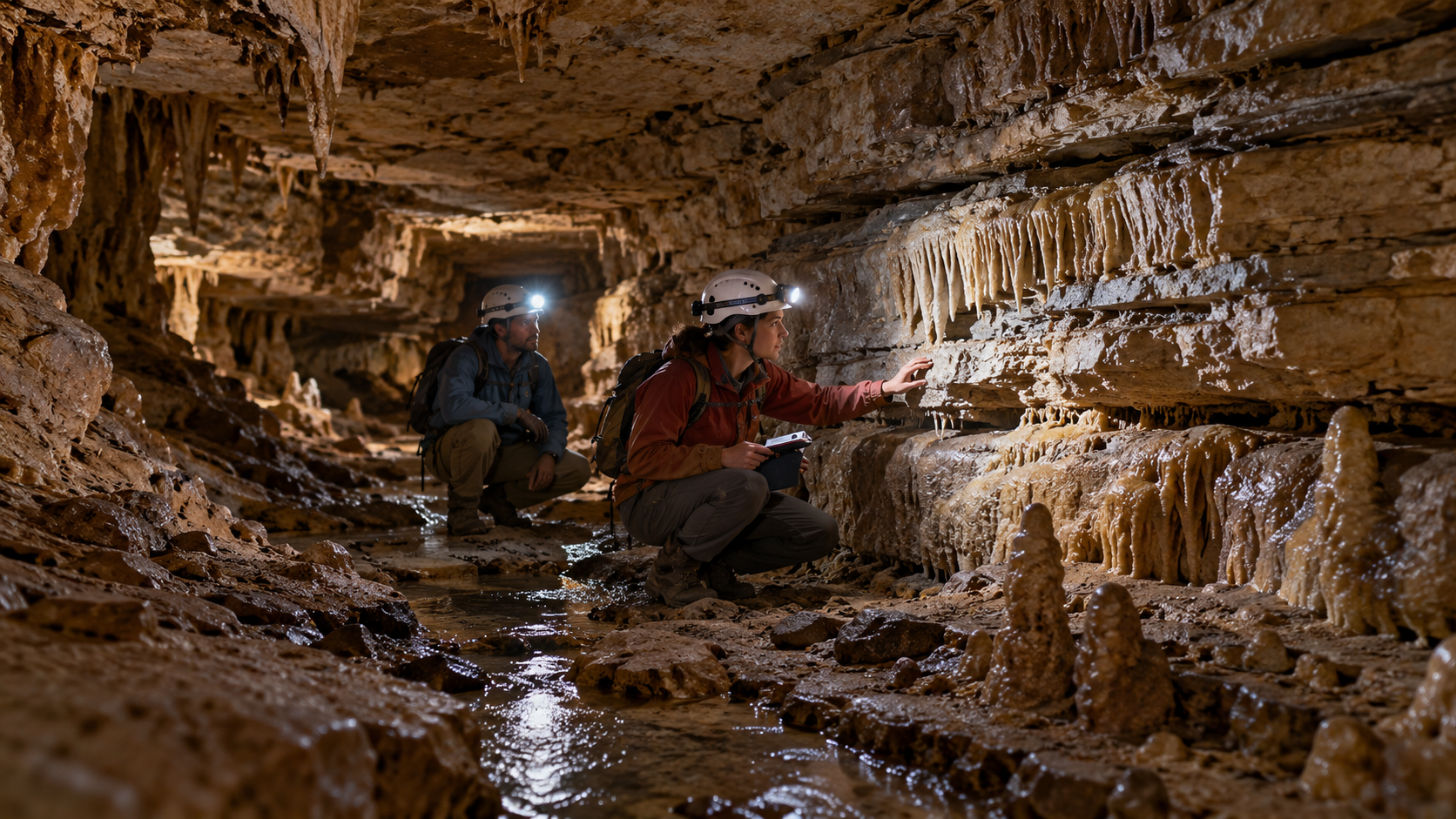
After a passage drains and contains air, mineral-rich water seeping from the ceiling may lose carbon dioxide or evaporate. Calcite is then deposited as stalactites, stalagmites, flowstone, and other speleothems. Growth is usually slow and irregular, controlled by drip rate, ventilation, temperature, chemistry, and climate. A formation’s size alone does not provide a simple age.
Karst landscapes connect surface and underground drainage through sinkholes, sinking streams, caves, and springs. Water can move quickly through large conduits with limited filtration, making aquifers productive but vulnerable to contamination. Changes in groundwater level or flow can flood passages, redirect dissolution, or destabilize ceilings. Cave geometry therefore records both rock structure and evolving hydrology.
Dating a cave is difficult because empty space cannot be sampled directly like a rock layer. Scientists combine deposited minerals, sediments, fossils, landforms, and regional river history. Cave formation matters because it shows how slow water-rock reactions build large landscapes, store and transmit groundwater, preserve climate records, and create specialized habitats while remaining sensitive to surface activity.
Water and soil carbon dioxide form weak carbonic acid that dissolves carbonate rock.
Fractures and bedding planes focus flow and widen through repeated dissolution.
Water-table change can leave stacked cave levels and redirect active passage growth.
Collapse and abrasion modify passages, but chemistry opens many solution caves.
Dripping mineral-rich water can redeposit calcite as speleothems after drainage.
Fast karst drainage makes cave aquifers productive and especially contamination-sensitive.
Explore more "Explainers"
Discover additional explainers across politics, science, business, technology, and other fields. Each explainer breaks down a complex idea into clear, everyday language—helping you better understand how major concepts, systems, and debates shape the world around us.