

How Computer Models Forecast the Weather Explainer
A numerical weather model is a computer representation of the atmosphere, land, ocean, and sometimes ice and chemistry. It begins from an estimated current state and applies equations for motion, pressure, temperature, moisture, radiation, and other processes. The model advances this state through short time steps, producing a forecast rather than finding future weather by matching one historical pattern.
The starting analysis combines observations from satellites, weather balloons, aircraft, ships, buoys, radar, and surface stations with a previous model estimate. Data assimilation accounts for measurement error, gaps, and the relationships among variables to build a physically consistent three-dimensional state. Small initial errors matter because atmospheric motion is chaotic and can amplify them over time.
The atmosphere is divided into horizontal and vertical grid cells. Finer grids can represent smaller features but require far more computation and do not remove all uncertainty. Equations calculate winds, heat, pressure, and moisture exchange between cells. The time step must be small enough for numerical stability and accuracy, creating a tradeoff among domain size, resolution, complexity, and forecast speed.
Cloud droplets, turbulence, surface exchange, and convection can occur below the grid scale. Models approximate their average effects with parameterizations based on theory and observations. Different models choose different grids, numerical methods, and physical schemes. Mountains and coastlines are also simplified. These choices create systematic biases and explain why higher resolution does not guarantee a better forecast in every situation.
Ensemble forecasting runs the model many times with slightly different initial conditions or physics. If solutions cluster, confidence is greater; if they spread, the forecast is more uncertain. Ensembles estimate probabilities rather than proving every possible outcome. Forecasters compare models, correct known biases, examine observations, and translate physical scenarios into warnings and local impacts.
Forecast skill generally declines with lead time because uncertainty grows, but the rate depends on the weather pattern, variable, location, and scale. A model can predict broad pressure patterns while missing the exact location of a thunderstorm. Numerical forecasting matters because it turns global observations and physical laws into repeatable guidance while keeping uncertainty visible for expert judgment and public decisions.
Data assimilation blends diverse observations with a previous forecast to estimate the current state.
Physical equations advance atmospheric variables across a three-dimensional grid and time steps.
Grid resolution trades finer detail for greater computing cost and does not remove uncertainty.
Parameterizations approximate clouds, turbulence, and other processes smaller than a grid cell.
Ensembles sample uncertainty by varying initial conditions and sometimes model physics.
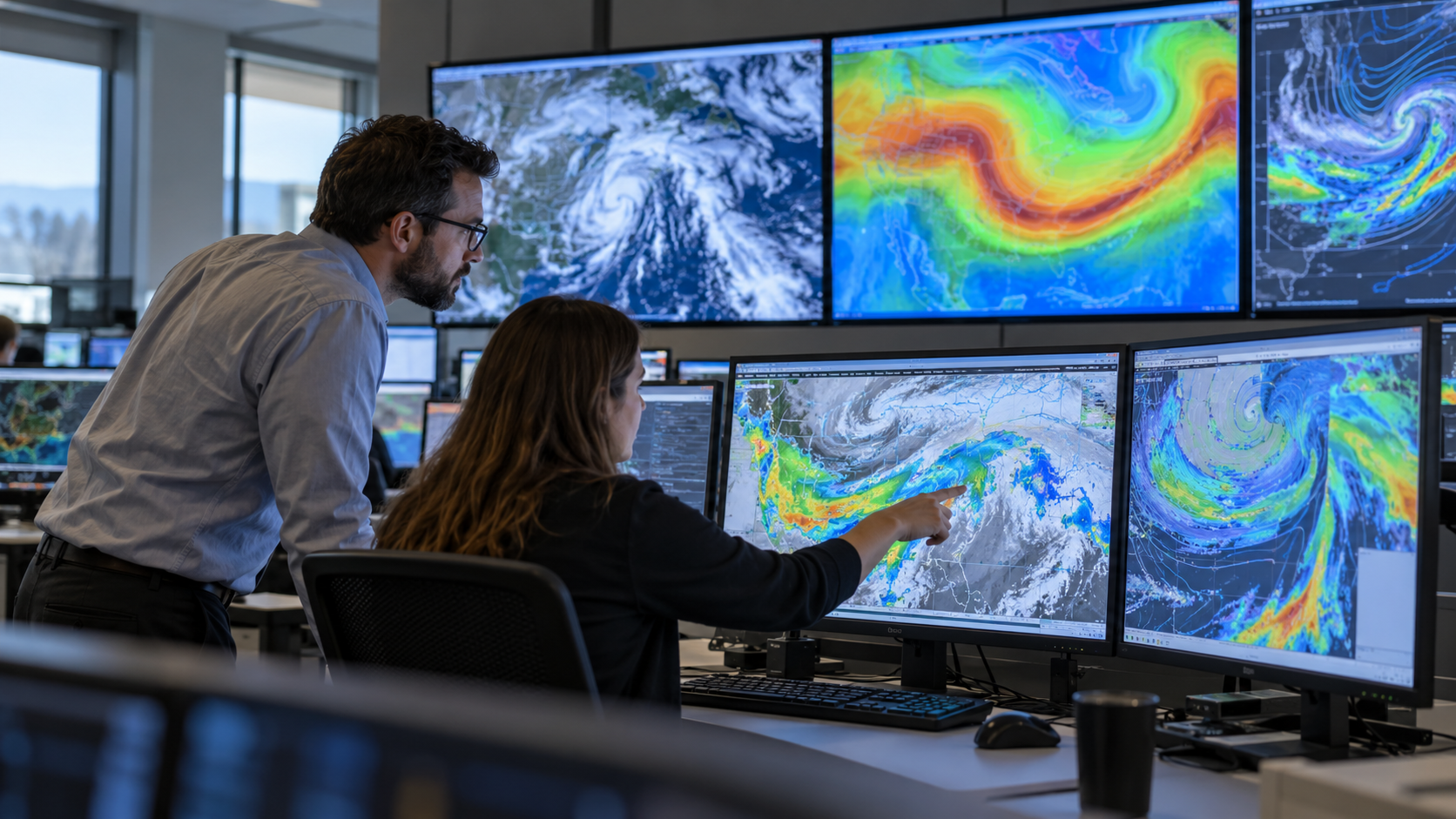
Meteorologists interpret model guidance, observations, biases, probabilities, and local impacts.
Explore more "Explainers"
Discover additional explainers across politics, science, business, technology, and other fields. Each explainer breaks down a complex idea into clear, everyday language—helping you better understand how major concepts, systems, and debates shape the world around us.