

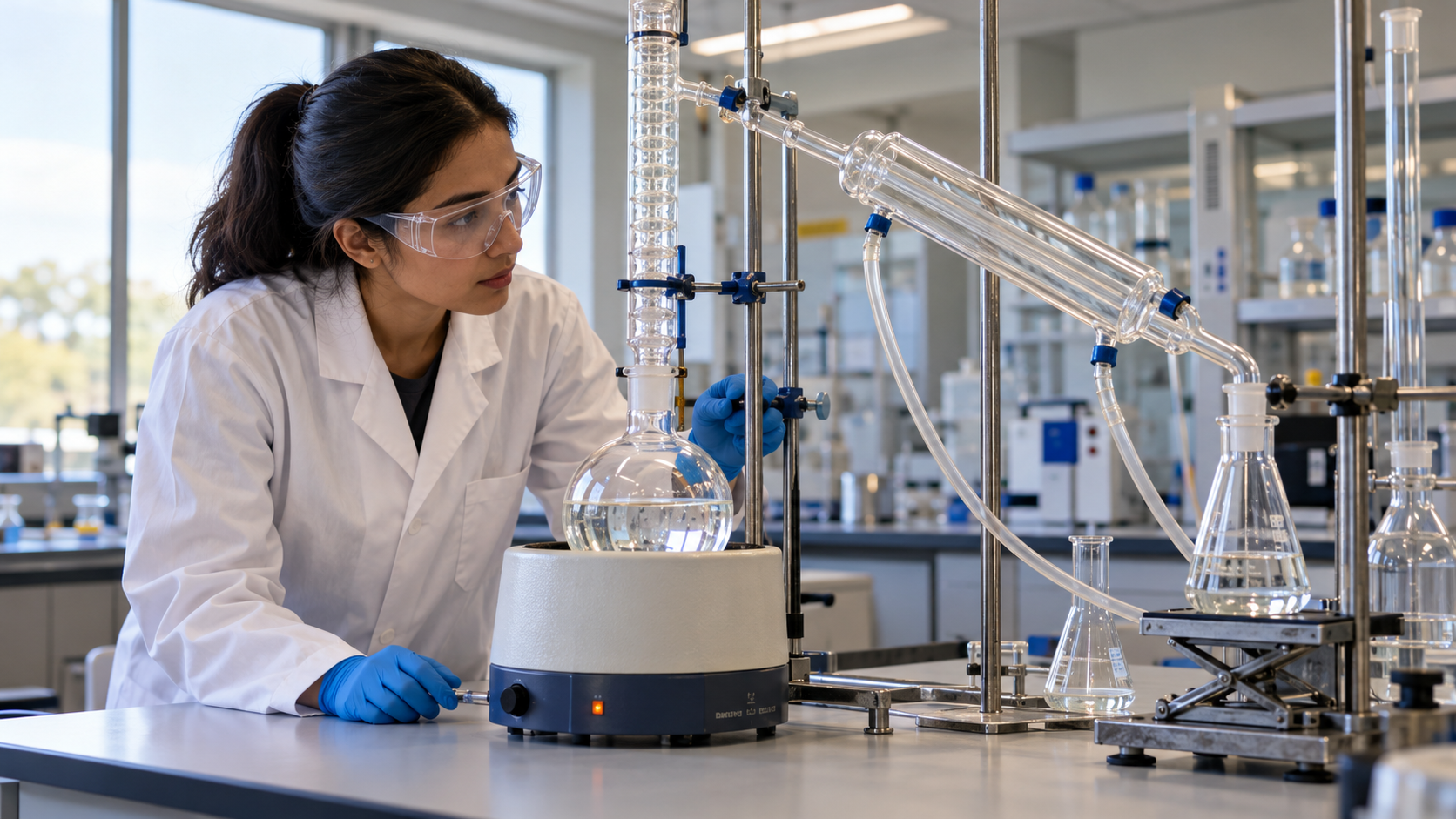
How Distillation Separates Liquids Explainer
Distillation exploits differences in volatility. In a liquid mixture, each component contributes to the vapor above it, and the vapor is often richer in the component that more readily escapes the liquid. Heating creates vapor, moving it to a cooler region allows condensation, and collecting that condensate changes the composition from the original mixture.
Boiling begins when the liquid’s total vapor pressure matches the surrounding pressure. A lower normal boiling point often signals greater volatility, but the behavior of a mixture depends on composition and intermolecular interactions. Simple distillation provides one main vaporization-condensation step and works best when volatilities differ greatly or when a volatile solvent is separated from nonvolatile material.
Fractional distillation uses a column that creates many repeated contacts between rising vapor and descending liquid. At each near-equilibrium stage, vapor becomes enriched in more volatile components while less volatile material tends to flow downward. Packing or trays provide surface area. A temperature profile develops along the column as composition and pressure change with height.
At the top, some condensed product may be returned as reflux. Greater reflux usually improves separation because material receives more repeated stages, but it reduces immediate product output and consumes more energy. Column height, pressure drop, heat input, feed position, and flow rates are designed together. Industrial columns operate continuously, while laboratory apparatus often runs in batches.
Some mixtures form azeotropes whose vapor and liquid have the same composition at a particular pressure. Ordinary distillation then cannot pass that composition. Vacuum distillation lowers boiling temperatures for heat-sensitive or very high-boiling materials. Steam, extractive, or pressure-swing methods can change the separation, but each adds equipment, another material, or new energy demands.
Distillation is used in fuels, chemicals, beverages, air separation, and water treatment. It does not automatically remove every contaminant: a volatile impurity may travel with the product, and droplets can be mechanically carried into the vapor stream. Reliable separation requires composition measurements, pressure and temperature control, suitable materials, and an energy balance that includes both boiling and condensation.
Distillation enriches vapor in components that are more volatile in the mixture.
Boiling depends on total vapor pressure, composition, and surrounding pressure.
A fractionating column repeats vapor-liquid contact across many effective stages.
Reflux trades product rate and energy use for improved separation.
Azeotropes and heat sensitivity can require modified distillation methods.
Volatile impurities and entrained droplets limit simple purity assumptions.
Explore more "Explainers"
Discover additional explainers across politics, science, business, technology, and other fields. Each explainer breaks down a complex idea into clear, everyday language—helping you better understand how major concepts, systems, and debates shape the world around us.