

How Glass Gets Its Amorphous Structure Explainer
Most solids are crystalline, with atoms arranged in a repeating lattice. Glass is different: it is an amorphous solid whose short-range bonding can be highly organized while long-range periodic order is absent. It usually forms when a liquid cools and becomes too viscous for its atoms or molecules to rearrange into a crystal before motion effectively freezes.
In common silicate glass, silicon atoms bond to oxygen in tetrahedral units that link into an irregular network. The local bonds are strong, but the network lacks a repeating pattern across long distances. Oxides containing sodium, calcium, boron, aluminum, and other elements modify connectivity, melting behavior, expansion, chemical durability, refractive index, and processing temperature.
As a glass-forming liquid cools, its viscosity rises dramatically. Instead of one sharp freezing point, it passes through a glass-transition range where structural relaxation becomes slower than the observation or cooling time. The measured transition temperature therefore depends partly on rate and history. Glass is not simply a frozen liquid in everyday behavior; below the transition it responds as a solid over practical timescales.
Crystallization competes with glass formation. Nuclei must appear and grow before the liquid becomes immobilized. Cooling quickly can suppress both processes, while certain compositions resist crystallization even at slower rates. Metallic glasses often require rapid cooling or specially chosen multicomponent alloys. Controlled partial crystallization instead produces glass-ceramics with tailored properties.
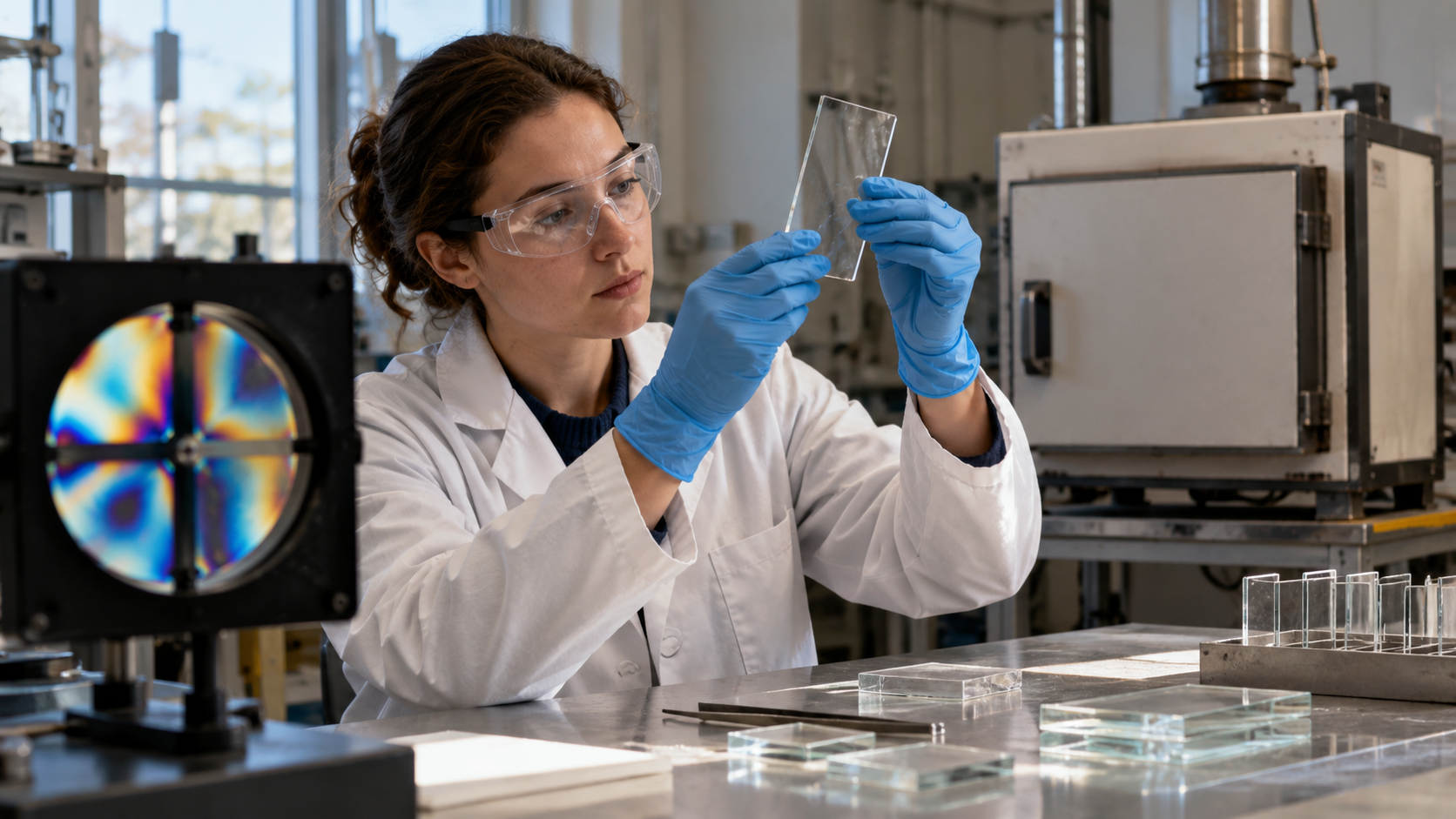
Uneven cooling creates internal stress because the exterior stiffens before the interior. Annealing holds or cools the object through a controlled temperature range so stresses can relax. Tempering deliberately creates compressive stress at the surface, improving resistance to crack growth. These treatments alter stress and microstructure but do not mean the material is unbreakable.
X-ray and neutron scattering, spectroscopy, microscopy, calorimetry, and viscosity measurements reveal glass structure and transition behavior. No single ideal random network describes every glass. Composition, thermal history, pressure, and aging all matter. That tunability explains applications from windows and optical fibers to laboratory vessels, displays, insulation, biomedical materials, and high-strength glass-ceramics.
Glass has local bonding order but lacks a repeating long-range crystal lattice.
Silicate tetrahedra form irregular networks modified by added elements.
The glass transition occurs across a range and depends on timescale.
Cooling can outrun the nucleation and growth needed for crystallization.
Annealing reduces residual stress, while tempering creates protective compression.
Composition and thermal history jointly determine optical and mechanical properties.
Explore more "Explainers"
Discover additional explainers across politics, science, business, technology, and other fields. Each explainer breaks down a complex idea into clear, everyday language—helping you better understand how major concepts, systems, and debates shape the world around us.