

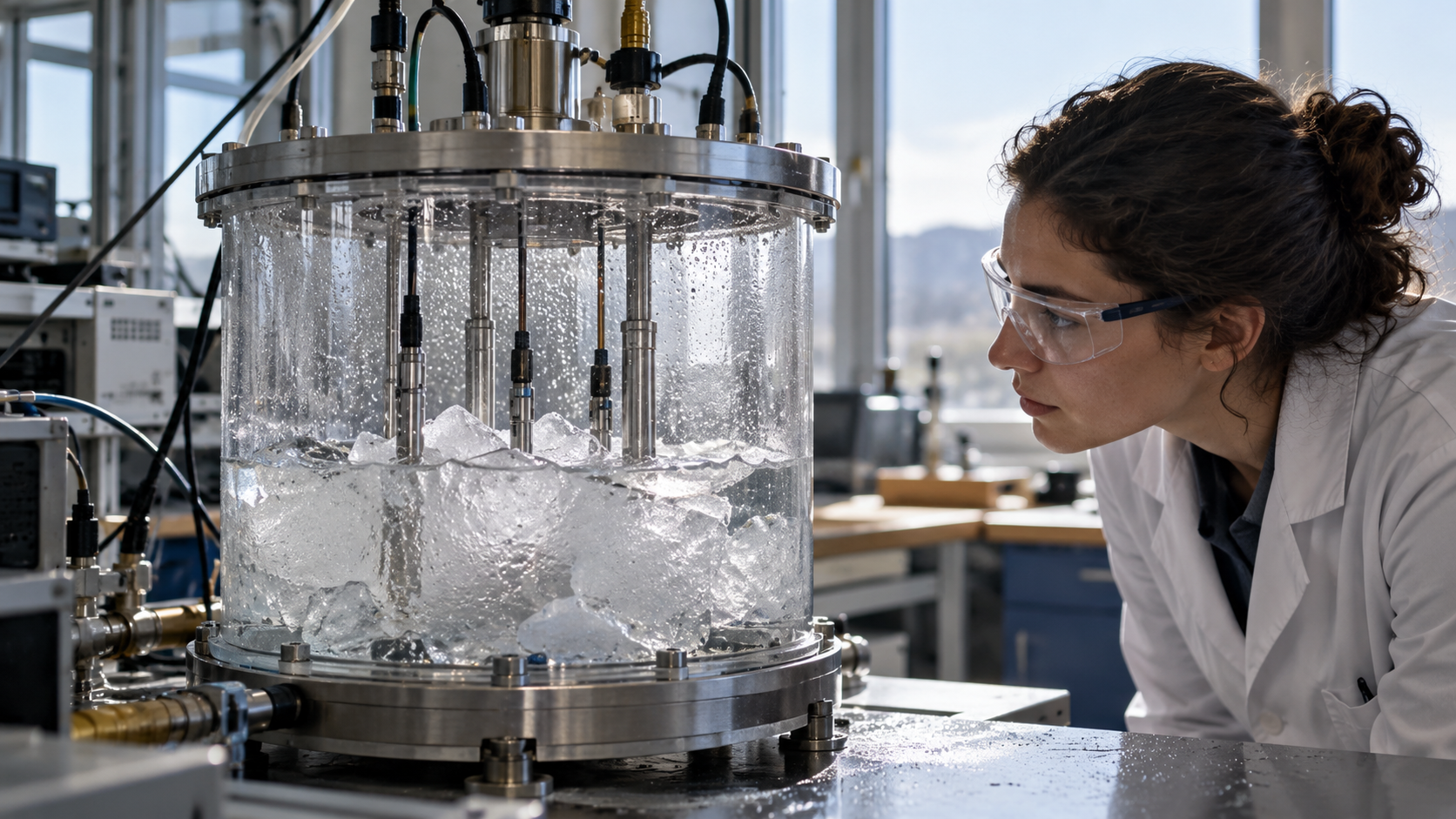
How Phase Changes Absorb and Release Heat Explainer
Heating usually raises temperature, but during a phase change energy can instead reorganize matter. At a fixed pressure, a pure material at its melting or boiling point can absorb substantial heat while its temperature remains nearly constant. That latent heat changes the balance of intermolecular attraction and molecular freedom rather than increasing average molecular kinetic energy.
When a solid melts, added energy loosens the ordered structure so particles can move more freely. Vaporization requires enough energy for molecules to enter the gas phase, overcoming attractions and doing expansion work against surrounding pressure. The reverse transitions release energy: freezing forms a more ordered solid, and condensation returns molecules from gas to liquid.
The required energy equals mass multiplied by the relevant latent heat under specified conditions. Water has a particularly large heat of vaporization, so evaporation removes substantial energy from a surface and condensation releases it into the atmosphere. This transfer drives sweating, refrigeration, cloud dynamics, storms, and much of Earth’s movement of heat from the surface upward.
Phase boundaries are equilibrium conditions, not absolute triggers. Liquid can supercool below its usual freezing point if no suitable nucleus forms, and a clean liquid can briefly superheat. Bubbles and crystals need initial interfaces whose creation costs energy. Dust, rough surfaces, dissolved gas, agitation, and added seed material can lower that nucleation barrier.
Pressure changes transition temperatures by favoring phases with different volume. Lower pressure reduces the boiling temperature, while a pressure cooker raises it. Many substances expand on melting, but water is unusual because ordinary ice occupies more volume than liquid water. Real mixtures also change phase across a temperature range rather than at one sharp point.
Engineered phase-change materials store and release heat near a chosen transition, smoothing temperature swings in spacecraft, buildings, packaging, or electronics. They need containment, good thermal contact, stable cycling, and safe composition. The concept does not create or destroy energy; it temporarily stores energy in molecular arrangement and returns it when the phase reverses.
Latent heat changes molecular organization while temperature may remain steady.
Melting and vaporization absorb energy; freezing and condensation release it.
Water phase changes move large quantities of heat through weather and life.
Nucleation barriers permit supercooling or superheating beyond equilibrium points.
Pressure and composition shift transition temperatures and broaden transitions.
Phase-change materials store thermal energy but still require effective heat transfer.
Explore more "Explainers"
Discover additional explainers across politics, science, business, technology, and other fields. Each explainer breaks down a complex idea into clear, everyday language—helping you better understand how major concepts, systems, and debates shape the world around us.