

How Adhesives Bond Surfaces Explainer
An adhesive joint works only if the adhesive makes intimate contact with both surfaces and then develops enough internal strength to carry a load. Bonding can involve van der Waals forces, hydrogen bonding, acid-base interactions, chemical bonds, electrostatic effects, and mechanical interlocking with surface texture. No single mechanism explains every adhesive and material pair.
Before curing, the liquid or softened adhesive must wet the surface rather than bead up. Wetting depends on surface energy, viscosity, temperature, and contamination. Oil, dust, weak oxide, moisture, or mold-release residue can create a fragile boundary layer. Cleaning, abrasion, plasma treatment, primers, or controlled oxidation may expose a stable, higher-energy surface and improve reproducibility.
The adhesive then hardens by cooling, solvent loss, water loss, or chemical reaction. Epoxies cross-link when resin and hardener react; cyanoacrylates polymerize rapidly in the presence of trace moisture; pressure-sensitive adhesives remain viscoelastic and bond under contact pressure. Cure temperature, component ratio, mixing, time, and humidity influence network structure and residual stress.
Joint geometry is as important as chemistry. Adhesives distribute load well over broad areas but are usually more vulnerable to peel or cleavage concentrated at an edge. Lap joints emphasize shear, while fillets and tapered adherends can reduce stress peaks. A layer that is too thin may not accommodate roughness, while a thick layer can deform or contain more defects.
Failure may occur cohesively through the adhesive, adhesively at an interface, or within the bonded material. Water, heat, ultraviolet light, solvents, repeated loading, and thermal expansion mismatch can slowly weaken a joint. An apparently clean separation does not automatically identify the cause; microscopic residue and chemical analysis are often needed to locate the true failure path.
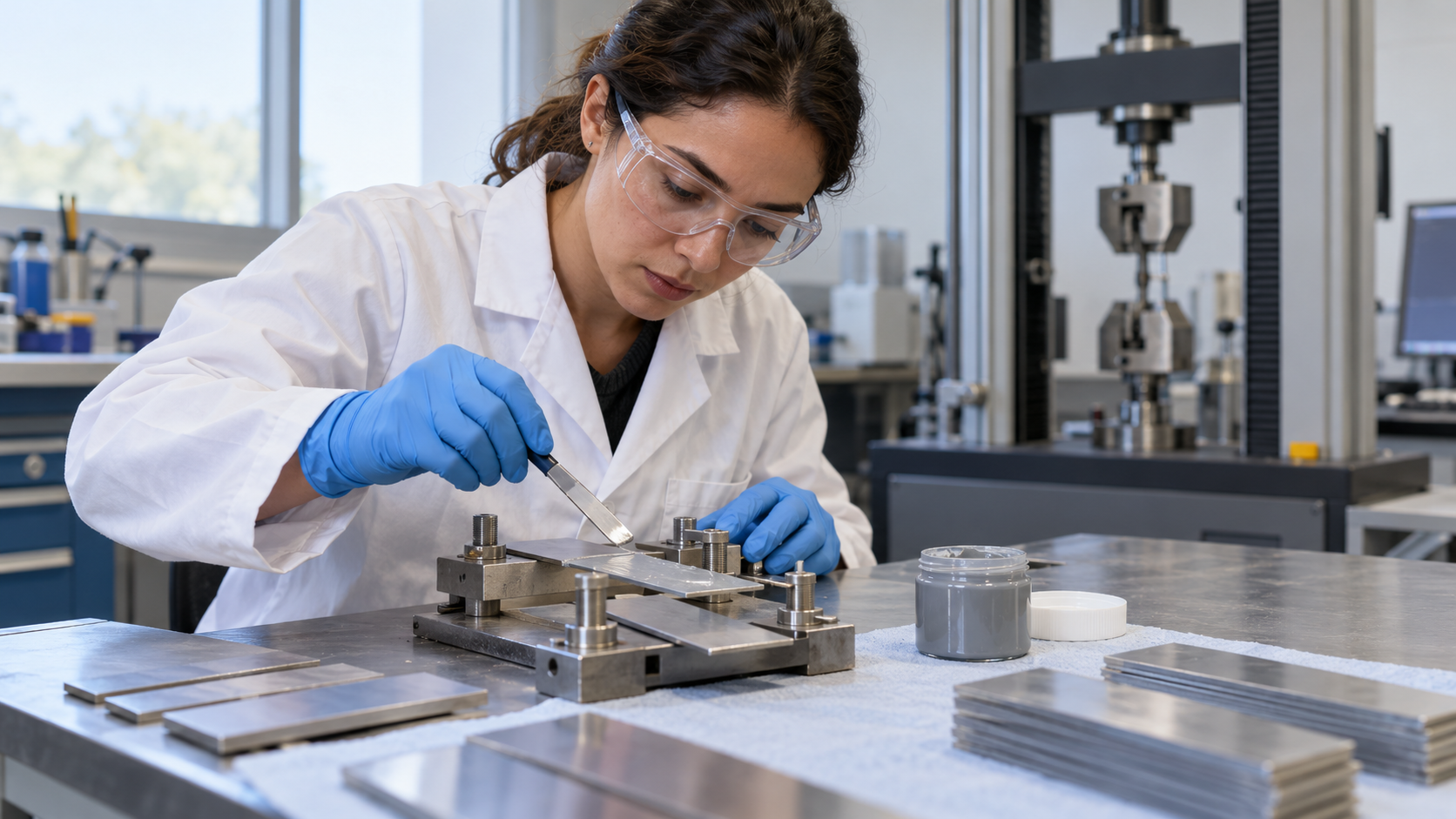
Engineers test prepared specimens under controlled temperature, humidity, loading rate, and aging, then apply safety factors for real service. Strong initial pull tests can miss long-term creep or environmental damage. Adhesive bonding enables lightweight structures and dissimilar-material assemblies, but dependable use requires surface control, cure verification, joint design, inspection, and realistic durability evidence.
An adhesive must wet both surfaces to create close molecular contact.
Cleaning and surface treatment remove weak boundary layers and raise reliability.
Cooling, evaporation, or chemical cross-linking gives the bond internal strength.
Joint geometry controls whether loads create favorable shear or damaging peel.
Heat, moisture, fatigue, and expansion mismatch can cause delayed failure.
Durability tests matter more than one impressive short-term strength value.
Explore more "Explainers"
Discover additional explainers across politics, science, business, technology, and other fields. Each explainer breaks down a complex idea into clear, everyday language—helping you better understand how major concepts, systems, and debates shape the world around us.