

How Sound Waves Interfere Explainer
Sound in air is a moving pattern of pressure and particle motion. When two sound waves occupy the same region, the air does not choose one over the other. Their instantaneous pressure changes add according to superposition. Positive changes can reinforce one another, while a positive change and a negative change can partly or nearly completely cancel.
For two steady tones of the same frequency, relative phase determines the result. In phase, their peaks and troughs align and amplitude grows. Half a cycle out of phase, one wave’s compression meets the other’s rarefaction. Perfect cancellation requires equal amplitude and opposite phase at the same point, conditions that are difficult to maintain throughout a three-dimensional room.
Path length changes phase. Two speakers driven together may reinforce at one seat and weaken at another because their sounds travel different distances. Reflections from walls, ceilings, floors, and objects create additional copies with delays and altered amplitude. The resulting spatial pattern explains why moving a short distance can dramatically change a low-frequency tone.
Two frequencies that are close but not identical drift repeatedly in and out of phase, producing beats. The heard amplitude rises and falls at the difference frequency. Musicians use beats while tuning, and instruments can intentionally combine nearby modes. When incident and reflected waves share a frequency, their interference can also create a standing wave with stable nodes and antinodes.
Interference does not destroy energy in a general sense. Where pressure amplitude is reduced, energy flow has been redirected or appears elsewhere in the field, and sources may exchange energy with the wave. Decibels are logarithmic, so adding two equally intense uncorrelated sounds does not simply double the decibel reading. Human perception adds frequency sensitivity and masking to the physical pattern.
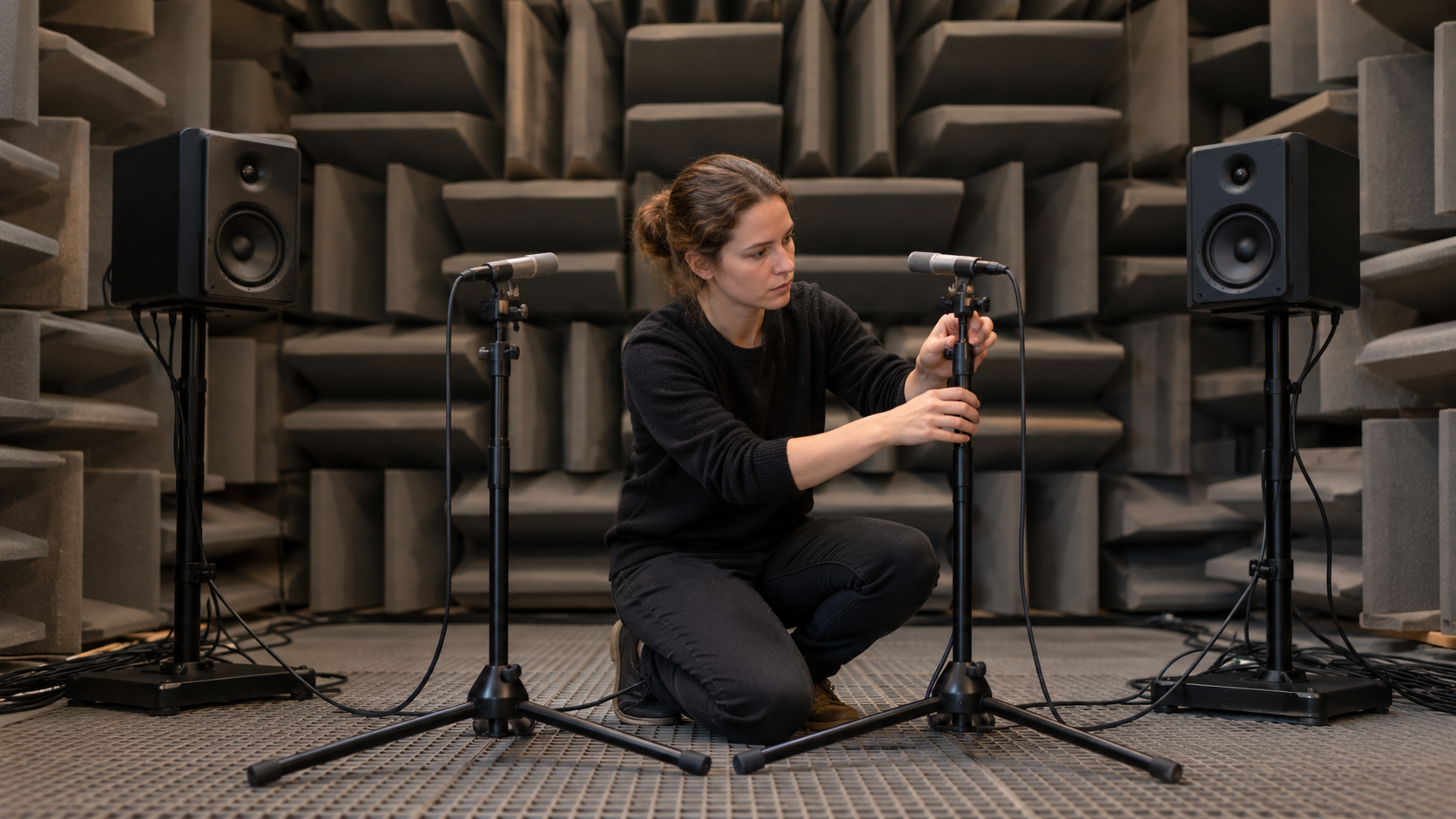
Microphones, phase-controlled sources, room measurements, and numerical models reveal interference. Applications include concert-hall design, mufflers, ultrasound, audio arrays, and active noise control. The central limitation is geometry: a phase setting that cancels one frequency at one location may reinforce another frequency or a different location, especially as listeners and sources move.
Overlapping pressure changes add according to the superposition principle.
Matching phase reinforces sound; opposite phase can reduce it locally.
Path length and reflections create strong spatial variations in rooms.
Nearby frequencies produce beats as their relative phase continually changes.
Incident and reflected waves can form standing-wave nodes and antinodes.
Cancellation at one point does not imply that acoustic energy vanished everywhere.
Explore more "Explainers"
Discover additional explainers across politics, science, business, technology, and other fields. Each explainer breaks down a complex idea into clear, everyday language—helping you better understand how major concepts, systems, and debates shape the world around us.