

How Noise-Canceling Headphones Reduce Sound Explainer
Noise-canceling headphones combine passive isolation with active control. Cushions and earcups physically block or absorb some sound, especially at higher frequencies. Microphones also measure noise outside, inside, or on both sides of the earcup. Electronics estimate the sound that will reach the ear and drive the headphone speaker with a signal designed to oppose it.
The controlled speaker does not emit a magical negative sound. It creates ordinary pressure variations timed so that unwanted pressure and the new wave sum to a smaller value near the eardrum. Feedforward systems use an exterior microphone, feedback systems monitor sound inside the cup, and hybrid designs use both. Adaptive digital filters update the anti-noise as conditions change.
Low, steady sounds such as engine rumble are relatively predictable and have long wavelengths, giving the system time and spatial tolerance. Rapid high-frequency sounds change over very short distances and periods. Microphone placement, processor delay, speaker response, and earcup leakage then make accurate opposing pressure harder, so passive sealing does more of the work at high frequencies.
The desired music or speech is combined with the control signal, and the algorithm must avoid treating it as noise. Wind striking a microphone, bumps to the earcup, jaw movement, or a changing seal can confuse the estimate. Poor control can amplify a band of sound or become unstable, so practical systems limit gain and monitor feedback paths.
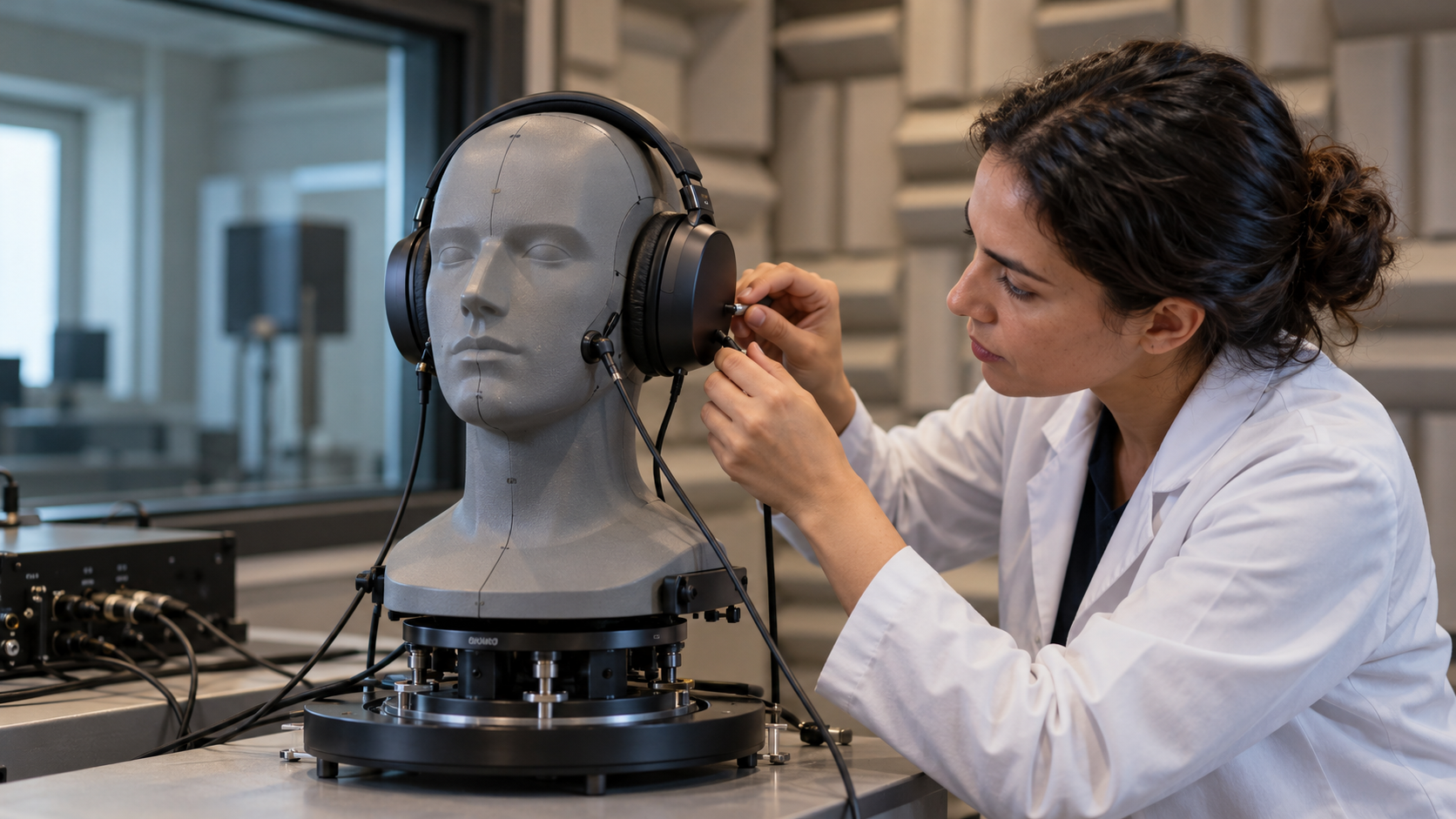
Active cancellation is local. The pressure can be reduced near the ear even though the broader surrounding field remains. Different head shapes, eyeglass arms, hair, and fit change both passive leakage and acoustic transfer. A laboratory result on a standardized measurement head therefore does not predict identical attenuation for every person or every motion.
Noise cancellation improves comfort and can reduce the urge to raise listening volume, but it is not automatically certified hearing protection. Very loud workplaces require rated protectors and an exposure program. The technology is best understood as real-time acoustic control constrained by causality, latency, geometry, transducer limits, and the quality of the physical seal.
Passive cushions isolate sound while microphones measure remaining noise.
The speaker creates ordinary sound timed to reduce pressure near the ear.
Adaptive filters continually estimate the changing acoustic path.
Slow low-frequency noise is easier to cancel than brief high-frequency sound.
Fit, leakage, wind, motion, and processor delay limit performance.
Consumer cancellation is not a substitute for rated occupational hearing protection.
Explore more "Explainers"
Discover additional explainers across politics, science, business, technology, and other fields. Each explainer breaks down a complex idea into clear, everyday language—helping you better understand how major concepts, systems, and debates shape the world around us.