

How Fluids Become Turbulent Explainer
Laminar flow moves in smooth, organized layers, while turbulent flow contains irregular velocity fluctuations and eddies across many sizes. A fluid does not become turbulent at one universal speed. The transition depends on geometry, surface roughness, disturbances, density, viscosity, and a characteristic length as well as velocity.
The Reynolds number compares inertial effects that carry disturbances with viscous effects that smooth them. Low values tend to support laminar flow; high values make instability and turbulence more likely. Critical values differ for a pipe, boundary layer, wake, or rotating flow, and the history of disturbances can make transition occur earlier or later.
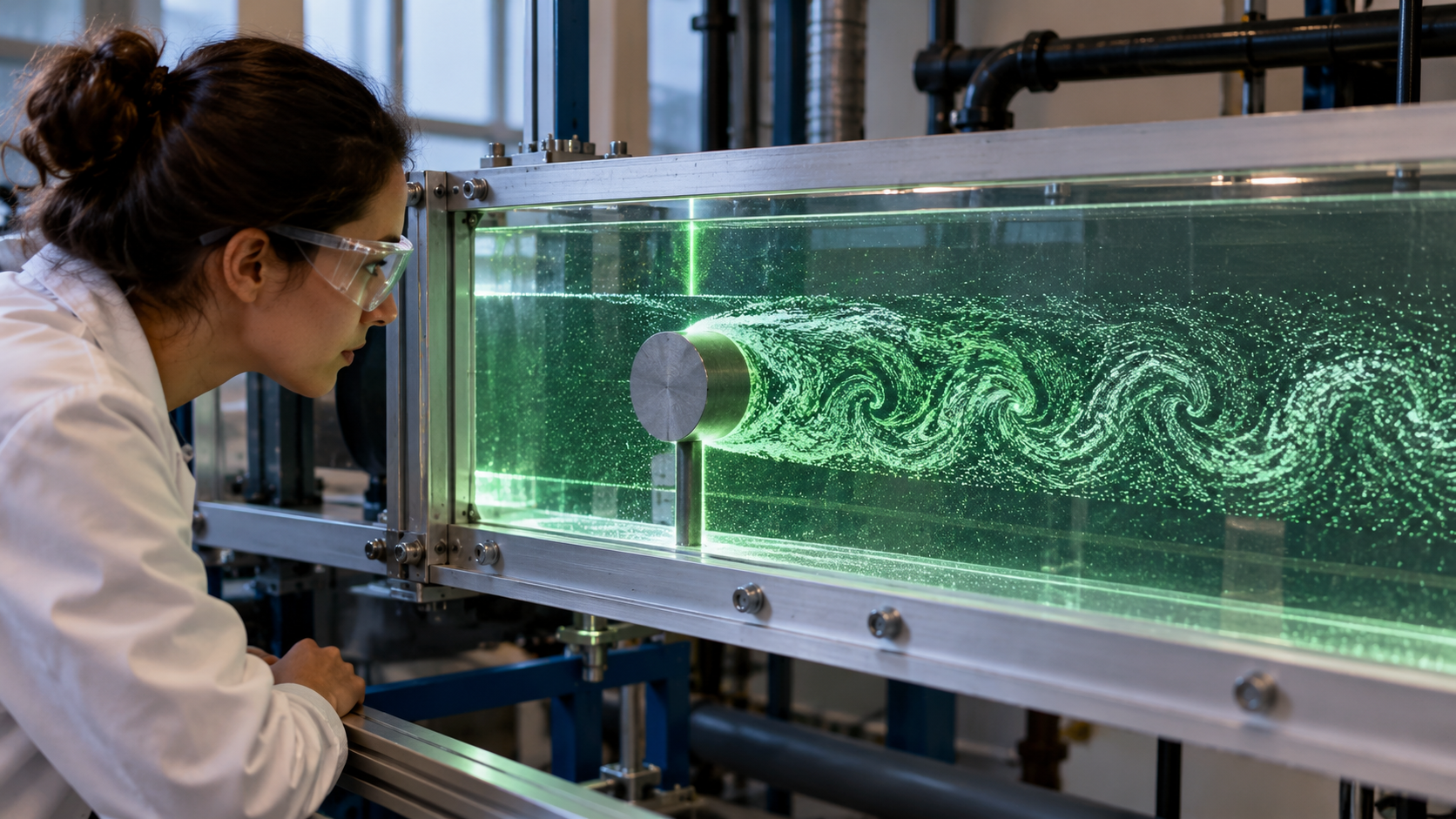
Small perturbations may initially decay. Under susceptible conditions, waves in velocity or pressure extract energy from the mean flow, grow, interact, and break into more complex motion. In a boundary layer, localized turbulent spots can expand until they merge. Separation behind an obstacle creates shear layers and wakes that are especially prone to rolling into vortices.
Large eddies draw energy from the mean flow and transfer it through a cascade to smaller eddies. At the smallest scales, viscosity converts organized kinetic energy into heat. This wide range of coupled scales makes direct calculation expensive. Turbulence models approximate effects of unresolved motion, and their reliability depends on the flow and data used for validation.
Turbulence greatly enhances mixing of momentum, heat, dissolved substances, and suspended particles. That can improve combustion or chemical processing but increase drag and energy loss in pipes and vehicles. It also creates fluctuating forces, sound, and vibration. Engineers sometimes delay transition for efficiency and sometimes deliberately promote it to prevent separation or improve mixing.
Wind tunnels, water channels, laser-based velocity measurements, pressure sensors, and computation reveal statistical patterns even when exact eddy motion becomes unpredictable. Turbulence is deterministic under fluid equations, yet tiny differences grow and detailed long-term prediction becomes impractical. Useful forecasts therefore focus on averages, distributions, coherent structures, and bounded uncertainty rather than tracing every swirl.
Turbulence contains irregular, interacting eddies across a wide range of scales.
Reynolds number compares destabilizing inertia with smoothing viscosity.
Geometry, roughness, and initial disturbances shift the transition threshold.
Energy passes from large eddies to small scales and is dissipated as heat.
Turbulence improves mixing but often increases drag, noise, and fluctuating load.
Models predict statistics because resolving every moving scale is often impractical.
Explore more "Explainers"
Discover additional explainers across politics, science, business, technology, and other fields. Each explainer breaks down a complex idea into clear, everyday language—helping you better understand how major concepts, systems, and debates shape the world around us.