

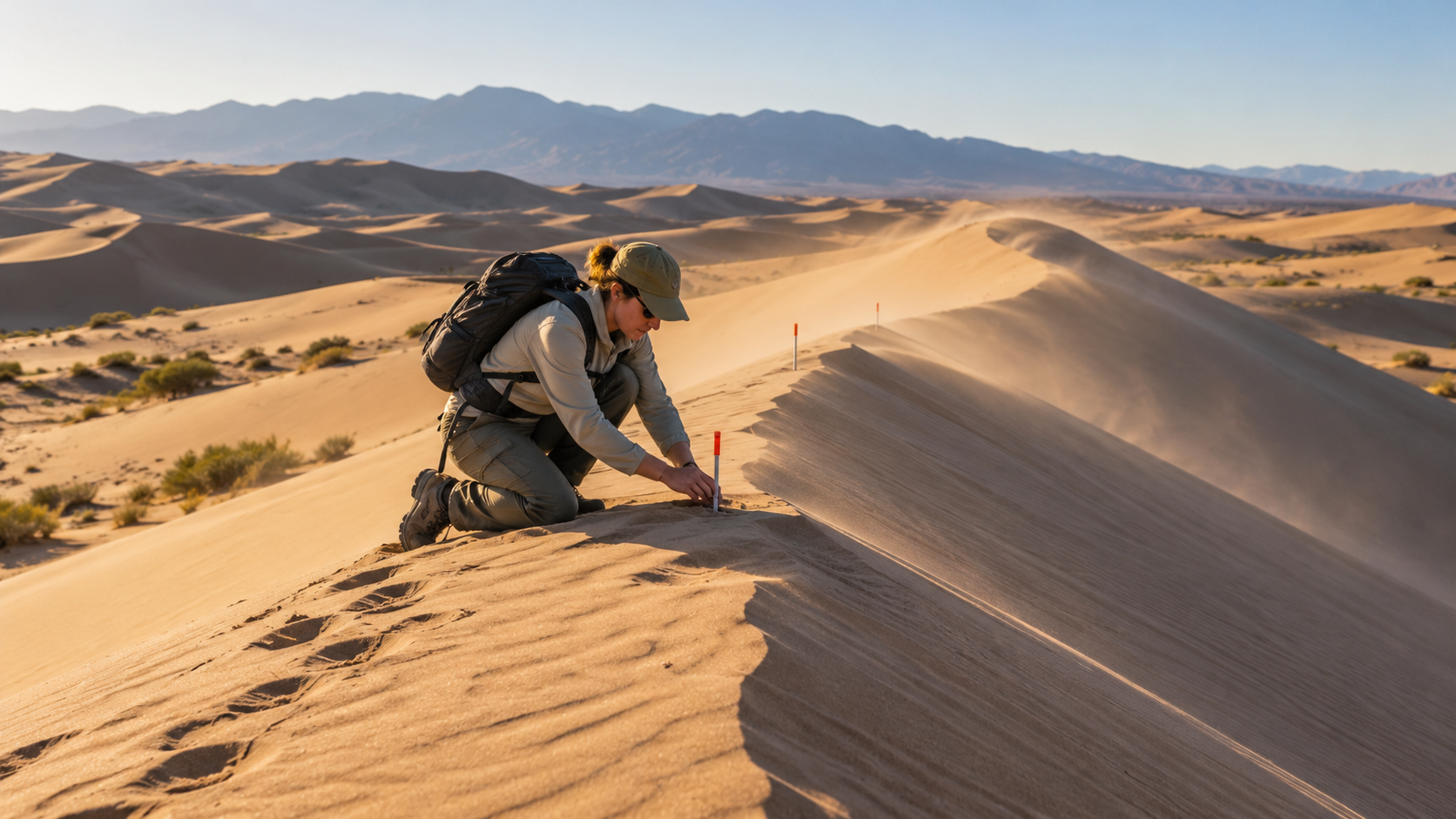
How Sand Dunes Migrate Explainer
A sand dune migrates when wind removes grains from one part and deposits them on another. Wind blowing across loose sand first lifts or rolls a few grains. Many then move in short bouncing hops called saltation. Their impacts eject additional grains and drive slower surface creep, producing a mobile layer concentrated close to the ground.
On a simple dune, grains climb the gently sloping windward side. Wind speed changes near the crest, and grains fall into a sheltered region on the lee side. Deposition steepens the slip face until small avalanches carry sand downslope. Repeated erosion, transport, deposition, and avalanching shift the entire form downwind while preserving a recognizable shape.
Migration speed depends on wind strength and persistence, grain size, moisture, vegetation, and sand supply. Smaller dunes often move faster because a similar transport rate is distributed through less sand. A wet crust or plant roots can stabilize the surface. Obstacles may anchor a dune or create a new one by slowing wind and trapping grains.
Dune shape records the wind regime and available sand. Crescent-shaped barchans form under a dominant wind and limited supply; transverse ridges develop with more abundant sand; longitudinal and star dunes reflect multiple wind directions. These categories overlap, and real dune fields exchange sand, merge, split, and respond to seasonal winds.
The wind above a dune is three-dimensional and turbulent. Flow separates at the crest, creates recirculation on the lee side, and interacts with nearby dunes. Individual grains may leave a dune field, while the visible landform advances at a much slower rate. Migration therefore cannot be inferred from one windy day or one grain path.
Researchers compare satellite and aerial images, survey crest positions, use ground markers and lidar, and measure winds and sediment flux. Dunes can threaten roads and buildings, but they also store sand, create habitat, and protect coasts. Management must consider sediment supply and vegetation because simply removing one dune can redirect transport elsewhere.
Saltating grains bounce near the surface and knock other grains into motion.
Windward erosion and lee-side deposition move a simple dune downwind.
Avalanches maintain a slip face near the stable angle for loose sand.
Wind regime, sand supply, moisture, and vegetation control dune form and speed.
Turbulent flow and neighboring dunes create complex three-dimensional transport.
Repeated surveys distinguish real migration from short-lived surface change.
Explore more "Explainers"
Discover additional explainers across politics, science, business, technology, and other fields. Each explainer breaks down a complex idea into clear, everyday language—helping you better understand how major concepts, systems, and debates shape the world around us.