

How Ocean Tides Are Generated Explainer
Ocean tides are long waves driven mainly by the changing gravitational influence of the Moon and, secondarily, the Sun. What matters is not simply the Moon pulling ocean water upward. The tide-generating force comes from differences in gravity across Earth combined with the motion of the Earth-Moon system, producing two broad equilibrium bulges in an idealized global ocean.
As Earth rotates beneath the astronomical forcing, a location moves through changing sea level. The lunar day is about 24 hours 50 minutes, so many places experience two high and two low tides that arrive roughly 50 minutes later each solar day. Other coasts have one dominant cycle or unequal highs because real oceans do not behave like an unrestricted, uniform shell.
The Sun also creates tides. Near new and full moon, lunar and solar effects reinforce one another, producing larger spring tidal ranges. Near first and third quarter, they partly oppose, producing smaller neap ranges. Spring refers to the tide springing higher, not the season. Changing lunar distance and solar distance add further variation.
Continents block the ideal bulges. Tidal waves instead travel through ocean basins, turn under Earth’s rotation, reflect, and interact. Depth controls wave speed, while basin shape can amplify or reduce a tidal constituent through resonance. Around amphidromic points, the tidal range can be small while the timing rotates around the point.
Shallow water, narrowing bays, friction, river flow, winds, and atmospheric pressure reshape the signal near shore. Some bays funnel and amplify tides; nearby locations can differ greatly in range and timing. Storm surge is not a tide, although it can coincide with high tide and raise total water level. Tsunamis are also generated by different processes.
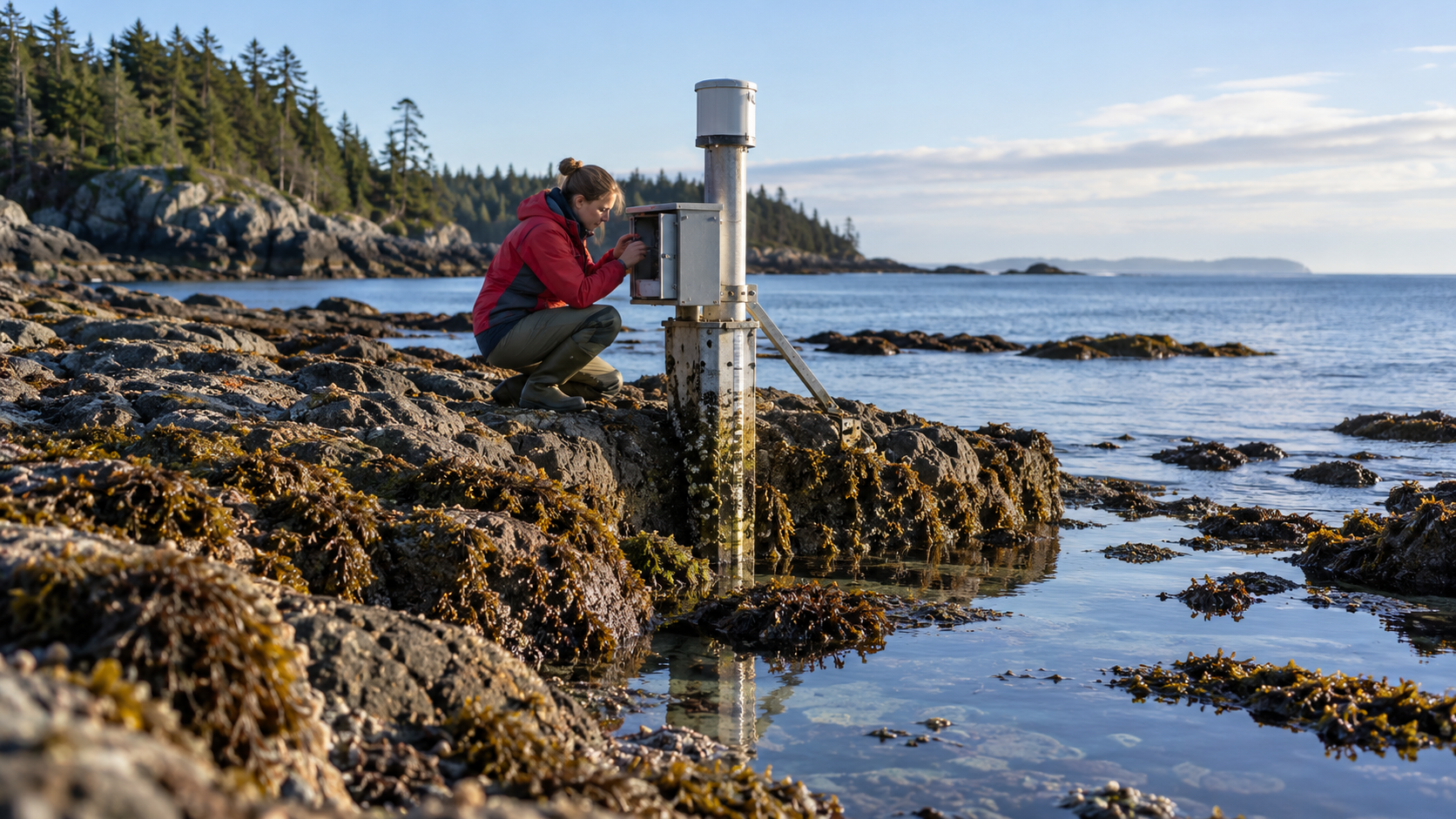
Tide gauges, satellite altimetry, precise astronomy, and numerical models allow accurate predictions of astronomical tides. Weather-driven departures remain uncertain, so coastal forecasts combine tide and meteorology. Tides move sediment and nutrients, expose habitats, affect navigation, and dissipate energy that gradually alters Earth’s rotation and the Moon’s orbit over very long times.
Tidal force comes from gravitational differences across Earth, not one uniform pull.
Earth’s rotation carries locations through a repeating set of tidal constituents.
Sun and Moon align for spring tides and partly offset for neap tides.
Continents, depth, rotation, and resonance reshape the ideal global response.
Local bays, rivers, friction, and weather change coastal height and timing.
Astronomical tides are predictable, while storm-driven water levels add uncertainty.
Explore more "Explainers"
Discover additional explainers across politics, science, business, technology, and other fields. Each explainer breaks down a complex idea into clear, everyday language—helping you better understand how major concepts, systems, and debates shape the world around us.