

How the Coriolis Effect Deflects Motion Explainer
The Coriolis effect is an apparent deflection seen when motion is described from a rotating frame such as Earth’s surface. An object moving freely follows a path determined by real forces and inertia, but the coordinate grid turns underneath it. To an observer attached to that grid, the path curves even without a sideways contact force.
Earth’s eastward surface speed is greatest at the equator and smaller toward the poles. Air moving north or south carries its existing eastward momentum into regions with a different surface speed. A complete rotating-frame treatment gives an apparent acceleration perpendicular to velocity: to the right in the Northern Hemisphere and to the left in the Southern Hemisphere.
The effect is zero at the equator in the simple horizontal formula and grows with latitude and speed. It changes direction rather than directly increasing or decreasing the object’s speed. Because deflection accumulates with travel time, it is important for large, long-lived motions but negligible for most sinks, toilets, baseballs, and ordinary indoor events.
In the atmosphere, pressure-gradient force starts air moving. On broad scales, Coriolis deflection can balance that force, producing winds roughly parallel to pressure contours in geostrophic flow. Friction near the surface weakens the wind and changes the balance, causing flow to cross contours. Curvature and changing wind add further terms around cyclones and anticyclones.
Oceans show the same rotating dynamics, modified by density, coastlines, depth, and turbulent mixing. Wind-driven surface layers form Ekman transport, while basin-scale pressure gradients and Coriolis effects help organize currents and gyres. Near the equator and at small scales, other forces can dominate, so not every curved current is “caused by Coriolis” alone.
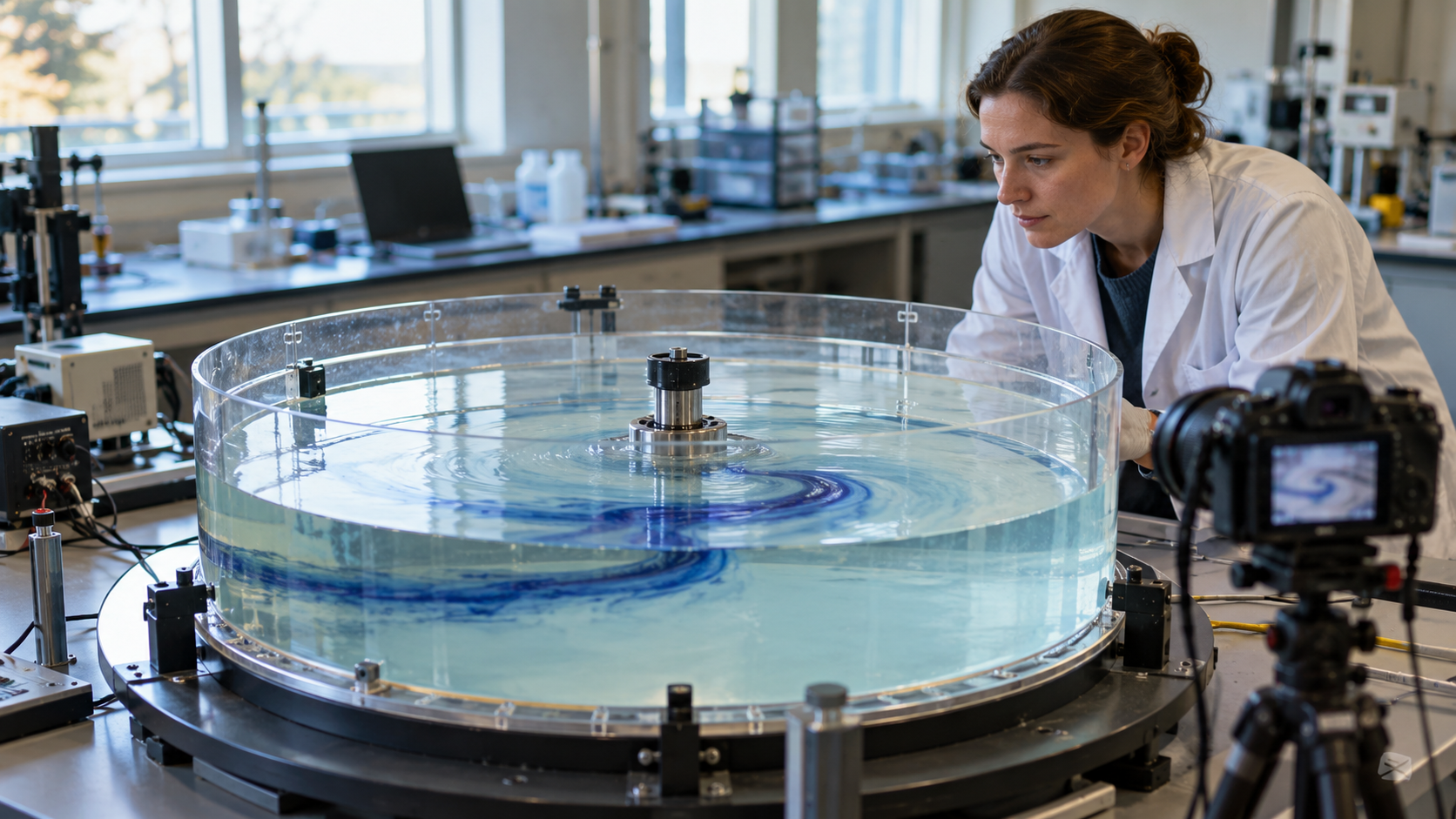
Rotating tanks, drifting buoys, balloons, radar, satellites, and numerical models demonstrate these balances. The concept is easiest when reference frames are kept explicit: Earth does not apply a mysterious push to the right. Coriolis terms let equations used by rotating observers correctly describe how inertia looks on a turning planet.
Coriolis deflection appears when motion is described in a rotating frame.
The apparent acceleration is perpendicular to velocity, not along it.
Deflection is rightward north of the equator and leftward south of it.
Latitude, speed, and travel time determine its importance.
Pressure, friction, buoyancy, and boundaries act together with rotation.
Small household flows are dominated by geometry and initial conditions.
Explore more "Explainers"
Discover additional explainers across politics, science, business, technology, and other fields. Each explainer breaks down a complex idea into clear, everyday language—helping you better understand how major concepts, systems, and debates shape the world around us.