

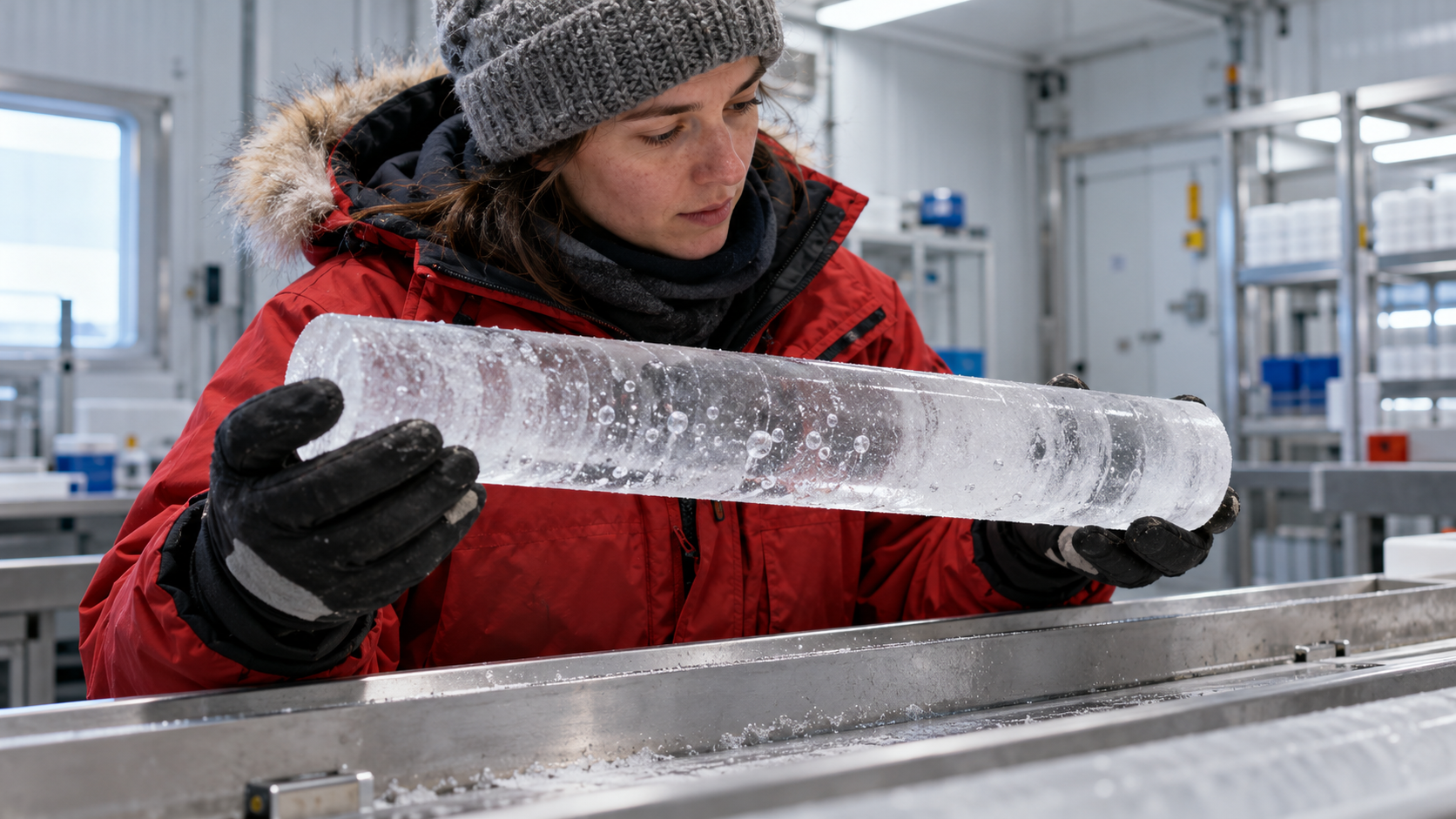
How Ice Cores Record Ancient Atmospheres Explainer
On large ice sheets and some glaciers, each year’s snowfall can survive summer and accumulate beneath later layers. Pressure gradually compacts snow into porous firn and then solid ice. The sequence preserves physical and chemical evidence deposited at the surface, creating a vertical archive that can extend hundreds of thousands of years in favorable locations.
Air initially circulates through connected firn pores. At depth, compression closes those pores into isolated bubbles that trap samples of the atmosphere. Researchers crush or melt carefully selected ice under vacuum and measure gases such as carbon dioxide, methane, and nitrous oxide. Because closure occurs below the surface, trapped air is younger than the surrounding ice.
The ice itself records additional clues. Ratios of stable oxygen and hydrogen isotopes vary with condensation history and relate to temperature and moisture source. Dust, sea salt, sulfate, soot, pollen, and trace elements reveal winds, aridity, ocean influence, fires, or eruptions. Electrical and optical properties help identify annual or event layers.
Dating is easiest where seasonal bands remain distinct. Deeper sections are compressed and may require volcanic markers, known gas changes, flow models, and comparisons among cores. Ice can fold, melt, or mix near bedrock. Researchers report age models and uncertainty rather than assigning every depth an exact uncontested calendar year.
Drilling, transport, and storage must prevent warming and contamination. Cores are logged in the field, shipped frozen, and cut in cold laboratories. Different teams may use adjacent sections for chemistry, gases, particles, isotopes, or structure. A single sample is limited, so archives preserve material for future instruments and independent checks.
Ice cores directly sample old air while many other climate indicators are proxies. They show associations among greenhouse gases, temperature, circulation, and events, but correlation in a core alone does not specify every cause. Scientists combine cores from multiple sites with oceans, caves, trees, corals, physics, and models to reconstruct past climates and test predictions.
Annual snowfall compacts from snow to firn and eventually solid ice.
Closing firn pores trap small samples of ancient atmosphere.
Air bubbles are younger than the ice enclosing them.
Isotopes, dust, salts, soot, and volcanic chemicals provide additional proxies.
Layer counting, markers, and flow models create age estimates with uncertainty.
Cold handling and multiple independent archives protect the scientific record.
Explore more "Explainers"
Discover additional explainers across politics, science, business, technology, and other fields. Each explainer breaks down a complex idea into clear, everyday language—helping you better understand how major concepts, systems, and debates shape the world around us.