

How Ocean Dead Zones Form Explainer
A dead zone is a region of very low dissolved oxygen, or hypoxia, where many animals cannot survive or remain. The process often begins when rivers or runoff deliver excess nitrogen and phosphorus to productive coastal water. The mechanism links local conditions to larger circulation, chemistry, or geologic structure. Season, location, and prior conditions can change the outcome without changing the underlying physics.
Those nutrients stimulate algal and plankton growth. When organisms die or release organic matter, bacteria decompose it and consume oxygen through respiration, increasing the biological demand within deeper water. Water, heat, rock, and air move along gradients, but terrain and timing shape the route.
Warm surface water and freshwater input can create density layers that resist vertical mixing. If oxygen from the atmosphere and photosynthesis cannot reach the bottom layer quickly enough, respiration drives concentrations downward and hypoxia expands. Feedbacks can strengthen or weaken the process, which is why similar settings do not produce identical outcomes.
Mobile fish may leave, while bottom-dwelling animals can be stressed or killed. Food webs, habitat, nutrient chemistry, and fisheries are affected, but the exact threshold and response differ among species and across the season. Observations must cover enough space and time to distinguish a persistent pattern from a brief event.
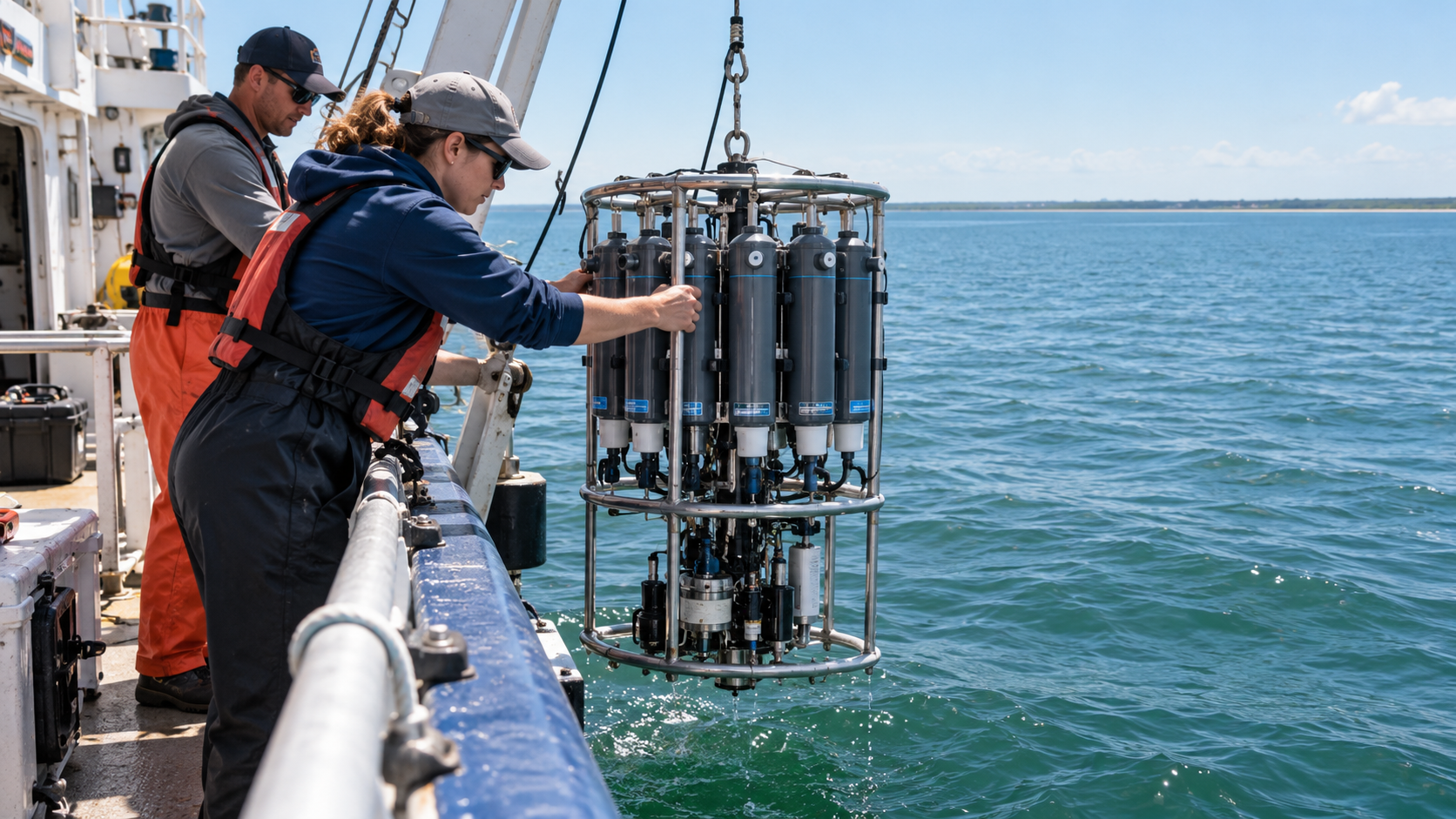
Ships deploy oxygen sensors through the water column, autonomous instruments record changes, and satellites track surface conditions such as temperature and chlorophyll. Models combine nutrient loads, circulation, weather, and biology to map extent and test causes. Researchers combine field instruments, remote sensing, samples, and models because no single view captures every stage.
Reducing nutrient input addresses a major driver, yet recovery also depends on rainfall, temperature, winds, and circulation. The phrase dead zone does not mean all life is absent; microbes often remain active, and boundaries move as conditions change. The explanation is strongest when those independent lines of evidence agree within measured uncertainty.
Nutrient-rich runoff stimulates unusually high algal production.
Dead organic matter sinks and is decomposed by microbes.
Microbial respiration consumes dissolved oxygen.
Density layering limits replacement from oxygen-rich surface water.
Low oxygen displaces or kills many marine animals.
Weather and circulation alter the zone from year to year.
Explore more "Explainers"
Discover additional explainers across politics, science, business, technology, and other fields. Each explainer breaks down a complex idea into clear, everyday language—helping you better understand how major concepts, systems, and debates shape the world around us.