

How Chemotaxis Guides Bacterial Movement Explainer
Chemotaxis lets motile bacteria bias their movement in response to chemical gradients. Because a single cell is usually too small to compare its front and back, many species compare recent concentrations with those sensed moments earlier. Cells regulate the pathway in context, so the outcome reflects both molecular recognition and cellular state. This distinction prevents a regulated pathway from being mistaken for a single all-or-nothing switch.
Membrane chemoreceptors detect attractants or repellents and control the histidine kinase CheA through adaptor proteins. CheA transfers phosphate to the messenger CheY, whose phosphorylated form interacts with the flagellar motor and changes rotation. Location matters because membranes and molecular partners determine which reactions can occur together. Measurements of rate and location are as important as detecting a component at all.
In familiar peritrichous bacteria, one rotational state bundles flagella for a relatively straight run. The opposite state disrupts the bundle and produces a tumble that reorients the cell before another run begins. The sequence is coordinated rather than automatic, and checkpoints can redirect or stop it.
An attractant commonly lowers the probability of tumbling, lengthening runs when conditions are improving. Adaptation proteins modify receptors so the system resets its baseline and remains sensitive across a wide range of background concentrations. Different organisms tune the same core machinery to suit their structure, metabolism, and surroundings.
The resulting path is still noisy and does not aim like a compass needle. A population gradually drifts up a favorable gradient because runs in improving directions last longer on average than runs in worsening directions. Researchers separate cause from correlation with imaging, molecular perturbations, and measurements over time.
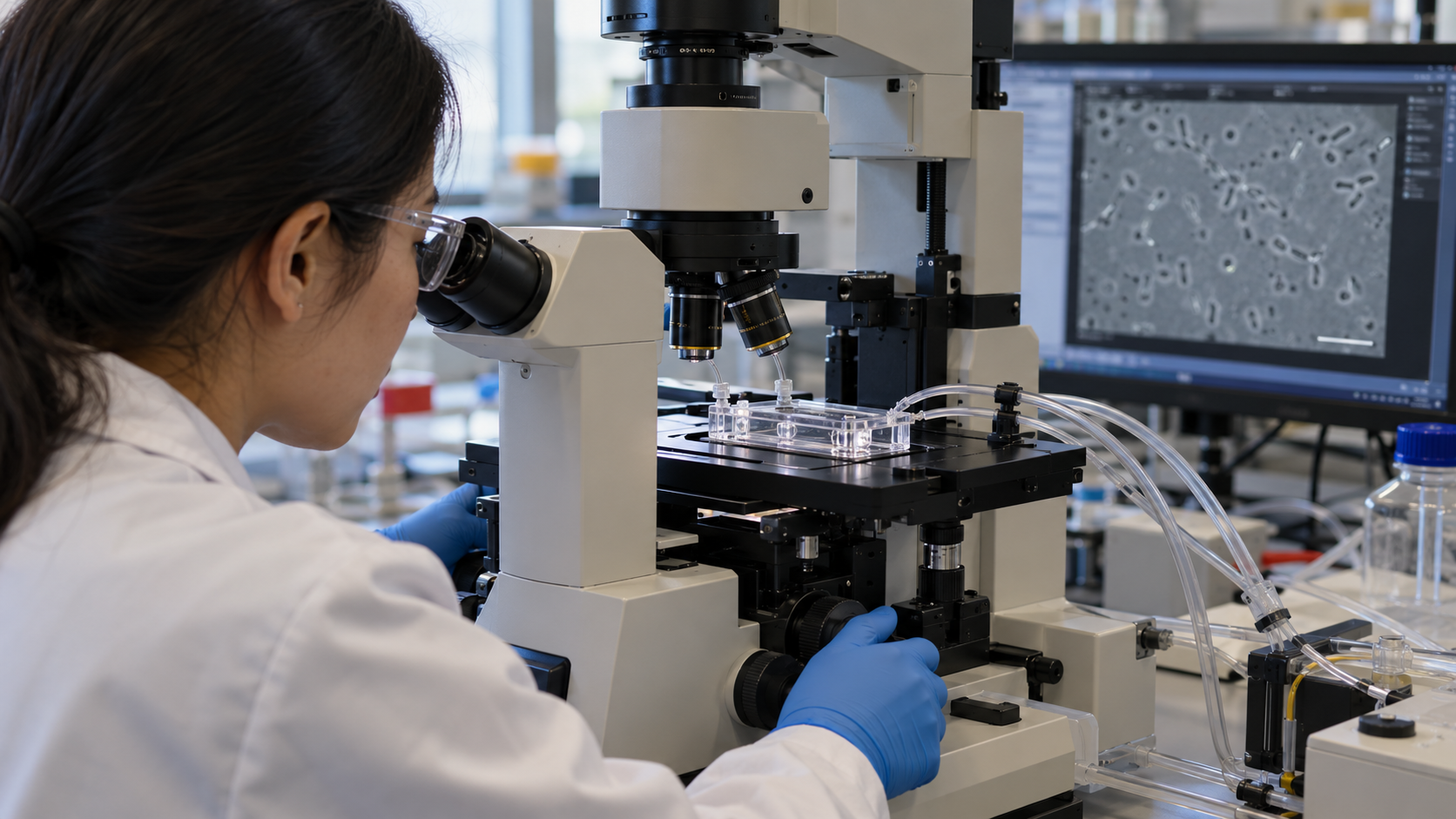
Researchers create controlled microfluidic gradients, track thousands of cells, and perturb receptors or Che proteins. Swimming speed alone is not chemotaxis; the defining evidence is a reproducible directional bias tied to sensing and adaptation. That evidence supports a general mechanism while leaving room for variation among species and conditions.
Chemoreceptors sample attractants and repellents.
CheA and CheY relay the signal by phosphorylation.
Flagellar rotation alternates runs with reorienting tumbles.
Improving conditions lengthen runs in favorable directions.
Receptor adaptation resets sensitivity to the current background.
Population tracking reveals the net directional bias.
Explore more "Explainers"
Discover additional explainers across politics, science, business, technology, and other fields. Each explainer breaks down a complex idea into clear, everyday language—helping you better understand how major concepts, systems, and debates shape the world around us.