

How Interferometers Measure Tiny Distances Explainer
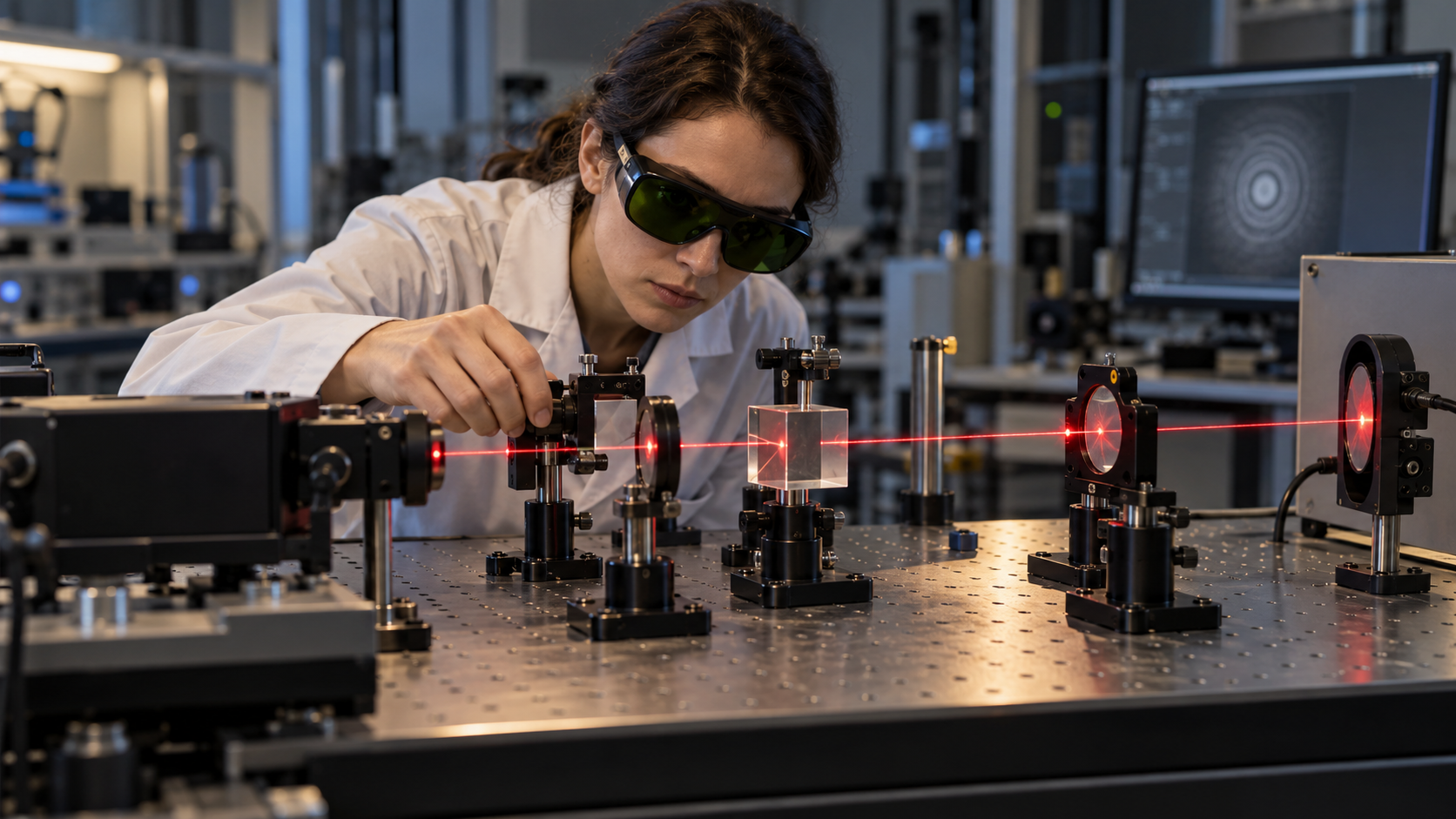
An optical interferometer measures displacement by comparing the phase of light that traveled along two paths. A beam splitter sends coherent light toward a reference path and a measurement path before recombining the beams at a detector. The useful explanation follows energy, matter, and fields while respecting material properties at each boundary. Keeping track of losses explains why practical performance falls short of an ideal limit.
If the waves return in step, their electric fields add and the signal brightens; if peaks meet troughs, they cancel and the signal darkens. Intermediate phase differences produce intermediate intensity or quadrature signals. Geometry and composition set the available pathways, so small design changes can alter the response. Scale changes the balance among surface effects, bulk behavior, and heat flow.
Moving a mirror changes the round-trip path length and shifts the interference pattern. Counting complete fringes measures multiples of the wavelength, while phase interpolation resolves fractions far smaller than one fringe period. The process continues only while a driving difference overcomes losses, resistance, or competing motion.
Fabry-Perot interferometers use repeated reflections between mirrors to create sharp resonances that respond strongly to cavity-length changes. Frequency-stabilized lasers and optical frequency references link the measurement to SI length standards. Real systems add interfaces and imperfections that idealized diagrams usually leave out.
Air refractive index, mirror tilt, polarization, vibration, thermal expansion, and electronic nonlinearity can imitate displacement. Precision systems isolate the apparatus and measure environmental conditions rather than treating the wavelength in air as fixed. Scientists test the model by changing one condition and measuring the predicted thermal, optical, or electrical signal.
Interferometry supports dimensional metrology, gravitational sensing, semiconductor fabrication, and small-force measurements. Extraordinary resolution does not guarantee equal accuracy because calibration, geometry, and systematic error still limit the result. The core physics is dependable, but efficiency and scale depend on operating conditions and experimental uncertainty.
A beam splitter creates reference and measurement paths.
Mirrors return the beams to a common detector.
Recombined waves interfere according to phase difference.
Mirror motion changes optical path length.
Fringe counting and interpolation convert phase to distance.
Environmental and alignment corrections establish accuracy.
Explore more "Explainers"
Discover additional explainers across politics, science, business, technology, and other fields. Each explainer breaks down a complex idea into clear, everyday language—helping you better understand how major concepts, systems, and debates shape the world around us.