

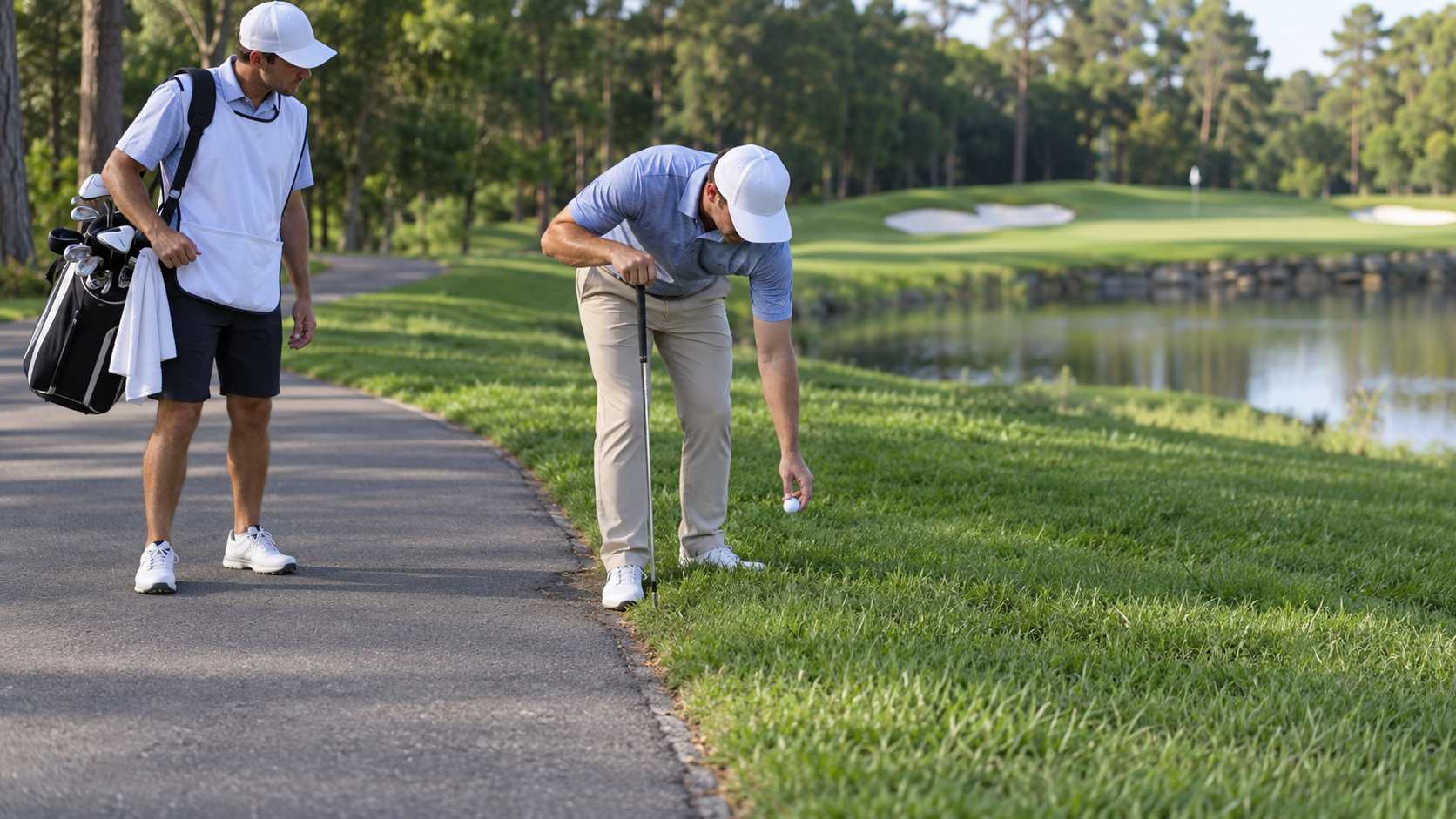
How Golf Relief from Cart Paths Works Explainer
A paved or artificial cart path is an immovable obstruction, so a golfer normally receives free relief when the ball touches the path or the path interferes with the intended stance or swing. Relief is not automatic merely because the path lies on the line of play.
The player identifies the nearest point of complete relief in the same area of the course, no nearer the hole, then drops within one club-length of that reference point. The chosen club for measuring is the longest club in the bag other than the putter.
Nearest does not mean nicest. The correct point may place the player in rough, behind a tree, or on an awkward side of the path. The player may decide to play the ball as it lies instead. Free relief can be denied when the stroke is clearly unreasonable for another reason.
After dropping, the ball must come to rest in the relief area. If it rolls outside after a proper second drop, the placement procedure applies. To follow the ruling, watch the player simulate the intended stance and swing, mark the nearest complete relief point, then measure.
When an artificial path interferes with the ball, the player's normal stance, or the area of intended swing.
No. It is the geometrically nearest point of complete relief and may be in a difficult position.
One club-length from the reference point, no nearer the hole and in the required area of the course.
Explore more "Explainers"
Discover additional explainers across politics, science, business, technology, and other fields. Each explainer breaks down a complex idea into clear, everyday language—helping you better understand how major concepts, systems, and debates shape the world around us.