

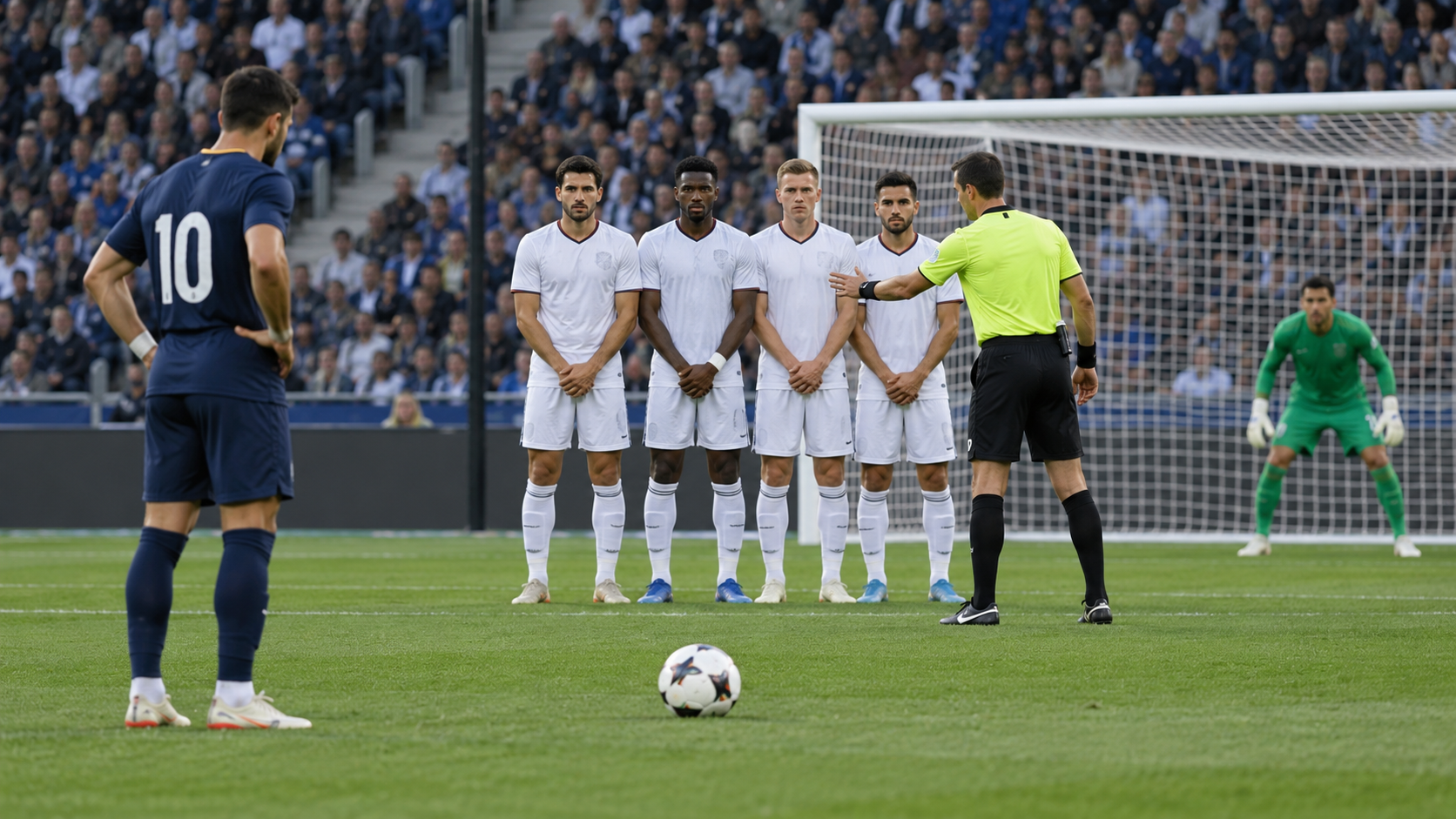
How Soccer Free-Kick Walls Work Explainer
At a soccer free kick, opponents normally must remain at least 9.15 metres, or 10 yards, from the stationary ball until it is kicked and clearly moves. Defenders may stand on their own goal line between the posts when an indirect free kick is taken closer than that distance.
When three or more defenders stand closely together as a wall, every attacking player must remain at least one metre, or one yard, away from that wall until the ball is in play. An attacker who starts too close when the kick is taken concedes an indirect free kick.
The team awarded the kick may restart quickly before the referee manages the distance. If a nearby opponent merely intercepts that quick kick, play can continue because the kicker accepted the risk. An opponent who deliberately prevents the restart or fails to retreat while interfering can be cautioned.
Once the referee has clearly made the restart ceremonial and instructed the kicker to wait, the kick cannot be taken until the whistle. Officials then position the wall, manage the required distances, and watch for early movement. The rules balance a prompt restart with a fair, enforceable barrier.
Normally at least 9.15 metres, or 10 yards, until the ball is in play.
It applies when three or more defenders form a wall; attackers must stay at least one metre away until the kick is taken.
Yes, unless the referee has required the kicker to wait for a whistle.
Explore more "Explainers"
Discover additional explainers across politics, science, business, technology, and other fields. Each explainer breaks down a complex idea into clear, everyday language—helping you better understand how major concepts, systems, and debates shape the world around us.