

How Tennis Racket and String Specifications Work Explainer
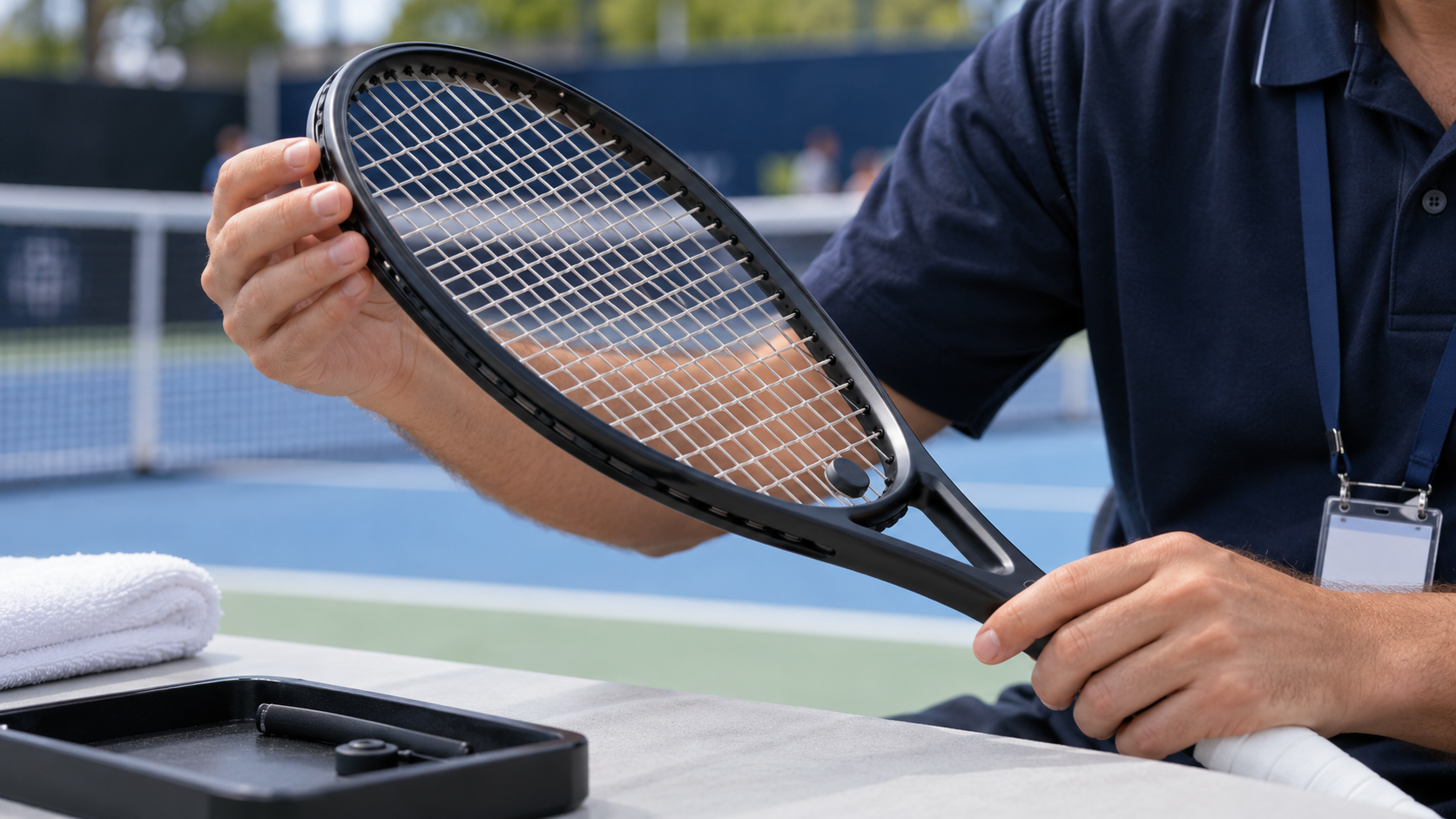
The ITF limits a tennis racket to 73.7 centimetres in overall length and 31.7 centimetres in overall width. The hitting surface has its own maximum dimensions. These measurements keep equipment within a common competitive envelope while allowing manufacturers freedom in shape, balance, and materials.
The hitting surface must be flat and use one pattern of crossed strings. The strings must be generally uniform and cannot be less dense in the center than elsewhere. The racket must be designed so its playing characteristics are the same on both faces.
Vibration dampers are permitted, but only outside the pattern of crossed strings. Objects used to limit wear, reduce vibration, or distribute weight may be attached when reasonable in size and placement. Player-analysis technology can be approved under the equipment rules.
No built-in or attached energy source may alter the racket's playing characteristics. A player also cannot use more than one racket at the same time. The ITF can examine a racket or prototype and issue a formal ruling when a design's compliance is uncertain.
The ITF limit is 73.7 centimetres, or 29 inches.
No. The hitting surface must use one generally uniform pattern of crossed strings.
Only outside the pattern of the crossed strings.
Explore more "Explainers"
Discover additional explainers across politics, science, business, technology, and other fields. Each explainer breaks down a complex idea into clear, everyday language—helping you better understand how major concepts, systems, and debates shape the world around us.