

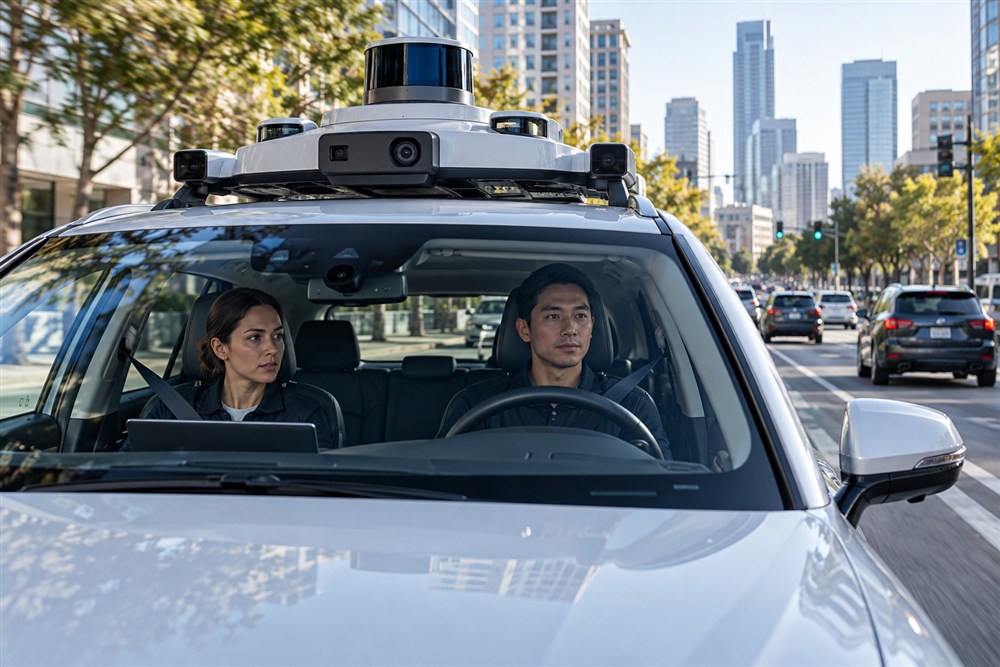
Autonomous Vehicles Explainer
Autonomous vehicles—often called self-driving cars—aim to shift the primary driving task from humans to software. Instead of a person constantly steering, braking, and reacting, an onboard computer system uses sensors and algorithms to perceive the environment and decide what to do next. The industry typically uses a scale from Level 0 to Level 5 to describe how much of this task is automated. Today’s advanced driver-assistance systems (like lane keeping and adaptive cruise control) sit at the lower end of that spectrum, while fully driverless robo-taxis and delivery pods are pushing toward higher levels, where human oversight can be minimal or even unnecessary in defined conditions.
To operate, autonomous vehicles blend multiple sensing technologies. Cameras detect lane markings, traffic lights, and signs; radar measures the speed and distance of nearby objects; lidar builds a detailed 3D map of surroundings using laser pulses; and GPS with high-definition maps provides global positioning and road layout. These data streams feed into machine-learning models that identify objects such as pedestrians, cyclists, and other vehicles, predict how they’re likely to move, and generate a safe driving plan. The vehicle’s control systems then translate that plan into steering, acceleration, and braking, all while continuously updating as new information comes in.
Proponents argue that autonomous vehicles could significantly reduce crashes caused by human error, which makes up the majority of road accidents. They could improve mobility for people who cannot drive, such as older adults or those with certain disabilities, and potentially ease congestion through smoother, more predictable driving and coordinated traffic flows. Fleet-based models—like robo-taxis or autonomous shuttles—could also change how people think about car ownership, with more trips provided as on-demand services rather than through privately owned vehicles.
However, the road to widespread deployment is complex. Rare but high-stakes edge cases—unusual road layouts, extreme weather, or unpredictable human behavior—remain hard for autonomous systems to handle with the same adaptability as experienced human drivers. Questions about legal liability, data privacy, and cybersecurity are still evolving: if a self-driving car crashes, responsibility may involve automakers, software providers, and operators as well as vehicle owners. There are also broader social impacts to consider, from the potential reshaping of professional driving jobs to the effects on urban design and public transit. As regulators, companies, and communities experiment with pilot programs and safety standards, autonomous vehicles are moving gradually from controlled tests to real-world service—one carefully monitored mile at a time.
Autonomous vehicles, also known as self-driving cars, are designed to perform the driving task traditionally handled by humans. Their development is driven by advances in sensors, high-definition mapping, and artificial intelligence, especially machine-learning systems that interpret road conditions in real time.
The automated driving scale ranges from Level 0 (no automation) to Level 5 (full automation in all conditions). As companies and researchers push these boundaries, autonomous vehicles are transitioning from controlled trials to limited commercial service such as delivery robots and robo-taxis in select cities.
Self-driving systems rely on a suite of sensors—cameras to detect signs and lanes, radar for motion tracking, lidar for 3D mapping, and GPS with detailed road data. These inputs are processed by onboard computers that classify objects, predict movements, and decide how the vehicle should respond.
The vehicle’s software continuously evaluates thousands of scenarios each second, issuing commands to steer, accelerate, or brake. Advanced simulations and real-world testing help improve decision-making for challenging conditions like poor weather, complex intersections, and unpredictable human behavior.
Supporters believe autonomous vehicles can reduce crashes caused by human error, expand mobility for people who cannot drive, and improve traffic efficiency. Industry experts also anticipate economic shifts as transportation models move from personal ownership to shared, automated services.
Concerns remain about reliability during edge-case scenarios, cybersecurity, job displacement, and liability when accidents occur. Policymakers are establishing safety frameworks and testing standards to ensure widespread use is introduced carefully—one monitored mile at a time.
Explore more "Explainers"
Discover additional explainers across politics, science, business, technology, and other fields. Each explainer breaks down a complex idea into clear, everyday language—helping you better understand how major concepts, systems, and debates shape the world around us.