

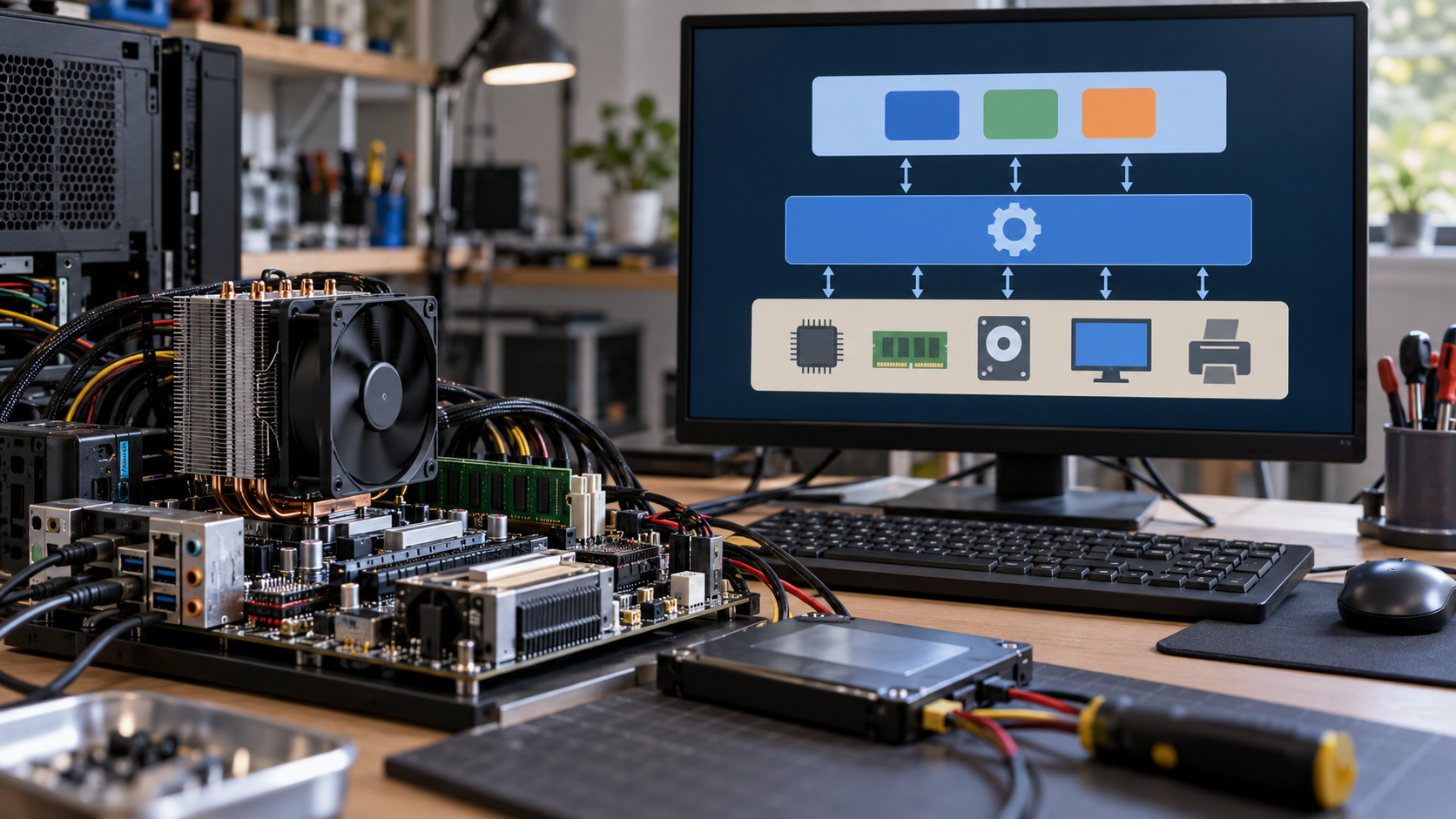
An operating system kernel is the core software that manages a computer’s hardware and provides controlled services to applications. It starts early in the boot process and remains active while the system runs. Programs normally execute in a restricted user mode rather than manipulating processors, memory, storage, or devices directly. When an application needs a protected operation, such as reading a file or sending network data, it asks the kernel through a defined system-call interface. The kernel validates the request, coordinates the necessary resources, and returns a result.
Processor scheduling is one central job. A modern computer may run hundreds of threads even though only a limited number can execute at the same instant. The kernel decides which runnable thread receives processor time, pauses it when necessary, and resumes another. It handles hardware interrupts that announce events such as completed disk operations or incoming network packets. Timers and priorities help balance responsiveness, fairness, and throughput. On multicore systems, the scheduler also distributes work among cores while considering cache behavior, power use, and specialized processor capabilities.
Memory management gives each process a private virtual address space. The kernel maps those virtual addresses to physical memory, enforces access permissions, and may move inactive pages to storage when memory pressure rises. Isolation keeps one ordinary application from reading or overwriting another application’s memory or the kernel’s protected data. Shared-memory mechanisms allow deliberate cooperation under explicit rules. The kernel also tracks executable code, mapped files, and caches. A flaw in privileged memory handling can be especially serious because kernel code operates with access that normal applications do not have.
Device drivers translate general operating-system requests into operations understood by particular hardware. Depending on the system, many drivers run in kernel mode, while some components can run with fewer privileges. The kernel’s input/output subsystem queues work, transfers data, and reports completion to applications. File-system code turns storage blocks into files, directories, permissions, and metadata. Networking code assembles and routes packets through interfaces. These subsystems let applications use consistent abstractions instead of implementing separate control logic for every processor, disk, keyboard, display, or network adapter.
Kernel designs organize these responsibilities differently. A monolithic kernel keeps many services and drivers in one privileged address space for efficient communication. A microkernel aims to move more services into separate user-space processes, leaving a smaller privileged core. Real operating systems often use hybrid choices rather than fitting a pure category. Modules can add functionality without rebuilding the whole kernel, but privileged modules must be trusted. Because a kernel failure can halt the system, developers use code review, testing, memory protections, signing policies, and carefully controlled interfaces to reduce risk.
The kernel is not the entire operating system. Command shells, graphical desktops, system utilities, libraries, background services, and applications run around it and provide most visible user experiences. Containers share the host kernel while isolating process views and resources; virtual machines usually run separate guest kernels on virtualized hardware. Kernel updates can fix security flaws, add hardware support, or improve scheduling and power management, sometimes requiring a restart because the core is continuously in use. Understanding the kernel clarifies where software meets hardware and why privileged code receives stricter protection. Bootloaders verify and place the kernel into memory before transferring control to it. The kernel then initializes memory management, interrupt handling, processors, and drivers before starting the first user-space services. Secure-boot mechanisms can check approved signatures during this chain, but they do not prove that every allowed component is bug-free. Some systems support live kernel patching for selected fixes, yet major architectural or driver changes still commonly require a restart to replace core code safely.
No. The kernel is the privileged core; user interfaces, libraries, utilities, services, and applications form the rest of the operating system.
They use defined system calls, usually through operating-system libraries that package requests and transfer control across the user-to-kernel boundary.
Kernel-mode code shares broad access to system memory and hardware, so a serious fault can damage critical state that all processes depend on.
Explore more "Explainers"
Discover additional explainers across politics, science, business, technology, and other fields. Each explainer breaks down a complex idea into clear, everyday language—helping you better understand how major concepts, systems, and debates shape the world around us.