

Side-Channel Attack Explainer
A side-channel attack learns secrets from the way a system performs a computation rather than by defeating the underlying mathematics directly. A cryptographic algorithm can be correct on paper and still reveal information through execution time, electrical power use, electromagnetic radiation, sound, memory-cache behavior, or other observable effects. Those signals are side channels: unintended outputs that can vary with secret data, such as a password or encryption key. The attacker’s task is to measure a useful pattern and connect it to the protected computation.
Timing is an accessible example. If software takes slightly different paths for correct and incorrect values, repeated measurements may reveal how much of a guess matched. Power analysis looks at changes in current as transistors switch, while electromagnetic analysis senses fields near a processor or circuit trace. Acoustic and thermal behavior can sometimes expose patterns too. Microarchitectural attacks observe shared resources such as caches, branch predictors, or speculative-execution effects. These techniques have different equipment and access requirements, so “side-channel attack” describes a broad class rather than a single exploit.
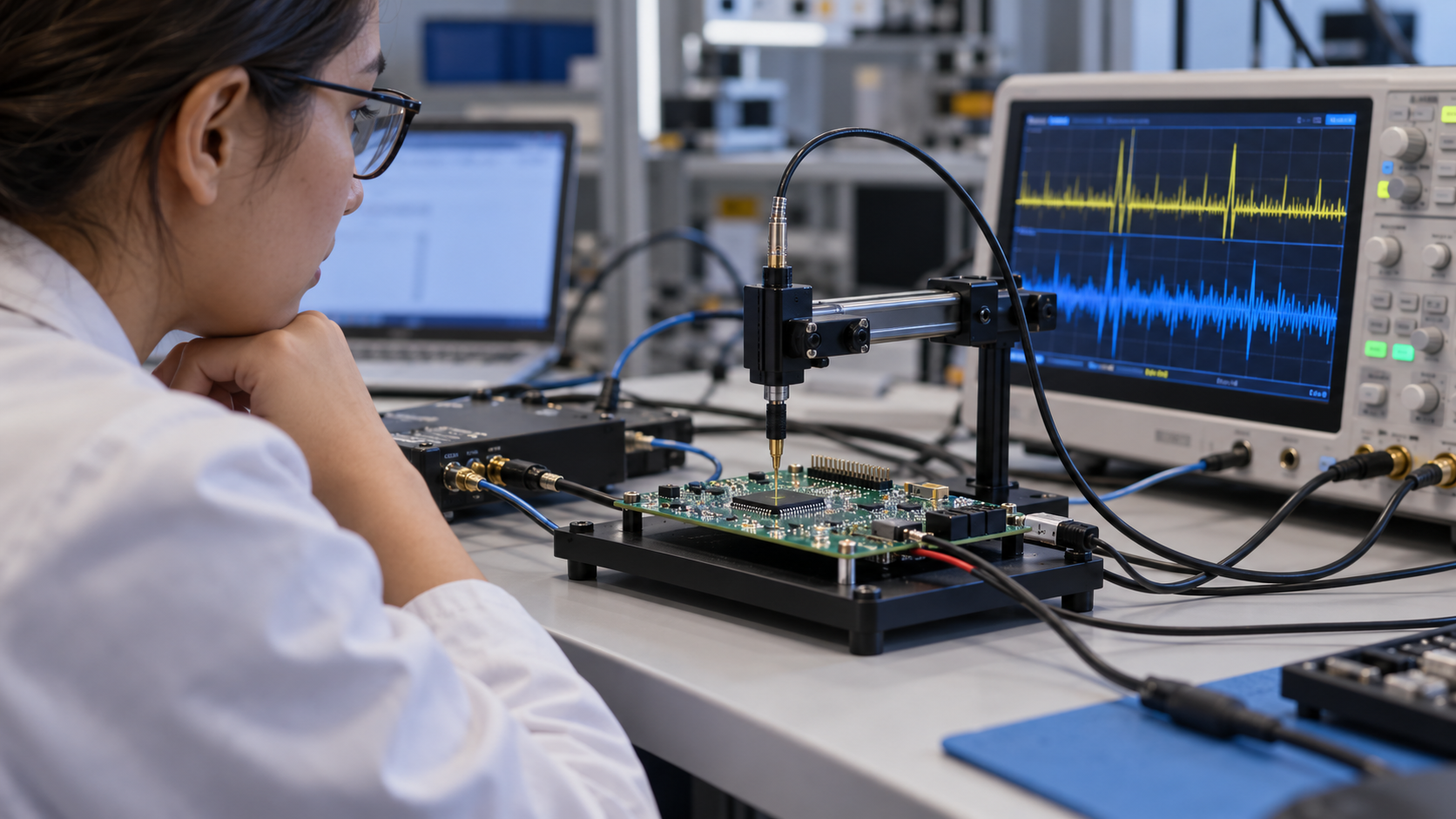
In a laboratory power-analysis setup, a target board performs the same cryptographic operation many times with controlled inputs. A capture device or oscilloscope records power traces and aligns them with a trigger. Analysts compare the traces statistically to models of the processor’s intermediate activity. A tiny relationship that is invisible in one measurement can become clear across many samples and may reveal portions of a key. Electromagnetic probes can perform a similar job near selected components, sometimes separating activity that a whole-board power measurement blends together.
Not every side channel requires physical possession. Network timing can sometimes be measured remotely if the signal is large and consistent enough, and software sharing a processor may observe cache effects across isolation boundaries. Other attacks demand close probes, modified hardware, or repeated access to a device. A realistic assessment therefore considers distance, privileges, measurement noise, number of attempts, ability to choose inputs, and the value and lifetime of the secret. A laboratory demonstration is evidence of leakage, but it does not automatically describe the risk of every deployed product.
Defenses aim to remove the relationship between secrets and observable behavior or make reliable measurement harder. Constant-time software avoids secret-dependent branches and memory access patterns. Masking combines sensitive values with randomness so intermediate operations do not directly expose the secret. Blinding randomizes cryptographic inputs, while balanced hardware, filtered power, shielding, isolation, and noise can reduce physical leakage. These controls have limits: compiler changes, processor features, unexpected interactions, or higher-order statistical methods can reintroduce useful patterns. Independent testing is needed on the actual hardware and software build.
Side-channel security is therefore a system property. Designers choose algorithms and libraries built for constant-time operation, restrict high-resolution timers and shared resources where appropriate, protect debugging interfaces, and control physical access. They also decide how many failed operations a device will allow and whether a key can be rotated if exposure is suspected. Testing should cover different temperatures, clock rates, compiler settings, workloads, and production boards rather than one ideal sample. The important lesson is that secrets can escape through implementation details even when no conventional output contains them. Protecting cryptographic systems requires attention to physics, hardware architecture, operating systems, and code together. Risk management also separates public demonstrations from operational claims: teams document the assumed attacker, required access, equipment cost, collection time, and repeatability before deciding on controls. Products that handle long-lived identity or payment keys may justify stronger countermeasures than devices holding short-lived session material. Even then, update mechanisms and incident response remain essential, because a future measurement technique may expose leakage that was not practical when the product shipped.
Timing, power draw, electromagnetic emissions, sound, temperature, and shared processor resources can all become side channels when their behavior depends on a secret.
The signal does not need to reveal the secret directly. Repeated measurements and statistical comparison can turn small correlations into useful evidence.
A laboratory may use a capture board, oscilloscope, current shunt, or electromagnetic probe synchronized with a target operation. Analysts align many traces and compare them with models of internal activity.
Remote timing and software cache attacks use different observations, but the principle is similar: find a repeatable effect that changes with protected data.
Constant-time code, masking, blinding, resource isolation, shielding, balanced circuits, and careful key lifecycles address different channels. No single measure covers every source of leakage.
Teams test real builds and production hardware because compilers, processors, board layouts, and operating conditions can change the signal. Findings should feed back into both hardware and software design.
Explore more "Explainers"
Discover additional explainers across politics, science, business, technology, and other fields. Each explainer breaks down a complex idea into clear, everyday language—helping you better understand how major concepts, systems, and debates shape the world around us.