

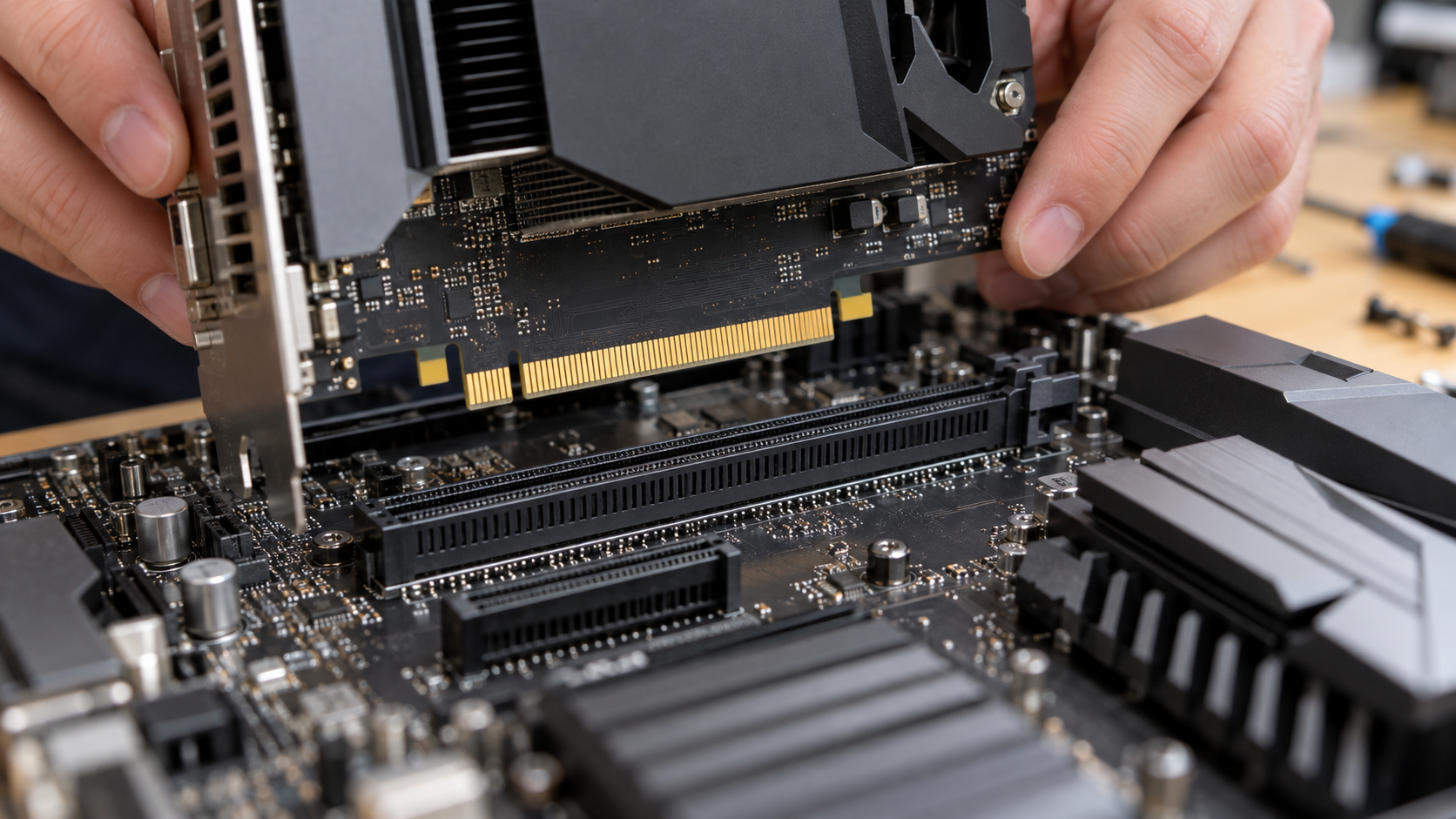
PCI Express Data Transfer Explainer
PCI Express, commonly shortened to PCIe, is the point-to-point serial interconnect that links high-speed devices to a computer’s processor and memory system. Graphics cards, solid-state drives, network adapters, and accelerator cards commonly use it. Unlike the older parallel PCI bus, PCIe does not make many devices take turns on one shared set of data wires. Each endpoint receives a dedicated logical link to a root complex in the processor or chipset, sometimes through a PCIe switch. Data moves across that link as packets, allowing the architecture to scale from small embedded devices to servers with many expansion cards.
A PCIe lane contains separate differential signal pairs for transmitting and receiving, so traffic can move in both directions at the same time. Links combine lanes in widths such as x1, x4, x8, or x16. A wider link can carry more data per unit of time, while each newer PCIe generation raises the signaling rate or improves how efficiently signals represent data. During link training, the two ends detect one another, test the connection, and negotiate a speed and width they both support. A card and slot with different capabilities can usually communicate at the fastest common configuration rather than failing simply because their maximums differ.
The protocol organizes communication into layers. The transaction layer creates packets for operations such as memory reads, memory writes, configuration access, and messages. The data-link layer adds sequence information and integrity checks used to detect transmission errors and support link-level recovery. The physical layer encodes and transmits the packet across one or more lanes, distributing symbols when a link is wider than x1 and reconstructing the packet at the receiver. This layered design lets software use a consistent programming model while electrical details evolve between PCIe generations.
Flow control prevents a sender from overwhelming the receiver. The receiving side advertises credits representing available buffer capacity, and the sender tracks those credits before transmitting packets that consume them. A write can often be posted, allowing progress without waiting for an immediate completion, while a read request needs a completion packet carrying the requested data. Link-level checks can catch corruption and arrange retransmission on the link, but they do not replace every higher-level reliability mechanism. Devices and drivers still need to handle timeouts, resets, malformed traffic, and failures beyond one physical connection.
When a computer starts, firmware and the operating system enumerate the PCIe hierarchy, identify devices, assign address ranges, and load suitable drivers. A device exposes configuration information and memory regions that software can map into the system’s address space. High-performance devices often use direct memory access to move data between their buffers and system memory without making the CPU copy every byte. Message-signaled interrupts let the device notify software about completed work or errors through normal memory-write transactions. Security features such as an input-output memory management unit can restrict which memory a device is allowed to access.
The connector’s physical size does not tell the whole performance story. A long x16 slot may be electrically wired for fewer lanes, and some motherboard slots share lanes with storage controllers or other devices. Actual throughput is lower than the raw signaling figure because packets include headers, integrity information, encoding, and flow-control overhead. Performance also depends on the device, workload, driver, processor, switch topology, and thermal or power limits. PCIe’s importance comes from combining packetized communication, negotiated compatibility, and scalable lane width in one standard interface. The card, platform, and software cooperate to turn those electrical lanes into reliable movement of commands and data. That cooperation is why compatibility depends on more than whether a card physically fits the slot.
A lane uses separate differential signal pairs for transmit and receive, allowing full-duplex serial communication between two ends of a link.
Links aggregate lanes into widths such as x1, x4, x8, or x16 to scale the available bandwidth.
During link training, the device and platform detect supported speeds and widths and settle on a common configuration.
A newer card can often operate in an older-compatible slot, but the link is limited by the slower end and the lanes actually wired.
Packets carry headers, integrity information, and control traffic in addition to application data.
Device speed, drivers, lane sharing, switch topology, memory access, power, and heat can also limit performance before the link’s theoretical maximum is reached.
Explore more "Explainers"
Discover additional explainers across politics, science, business, technology, and other fields. Each explainer breaks down a complex idea into clear, everyday language—helping you better understand how major concepts, systems, and debates shape the world around us.