

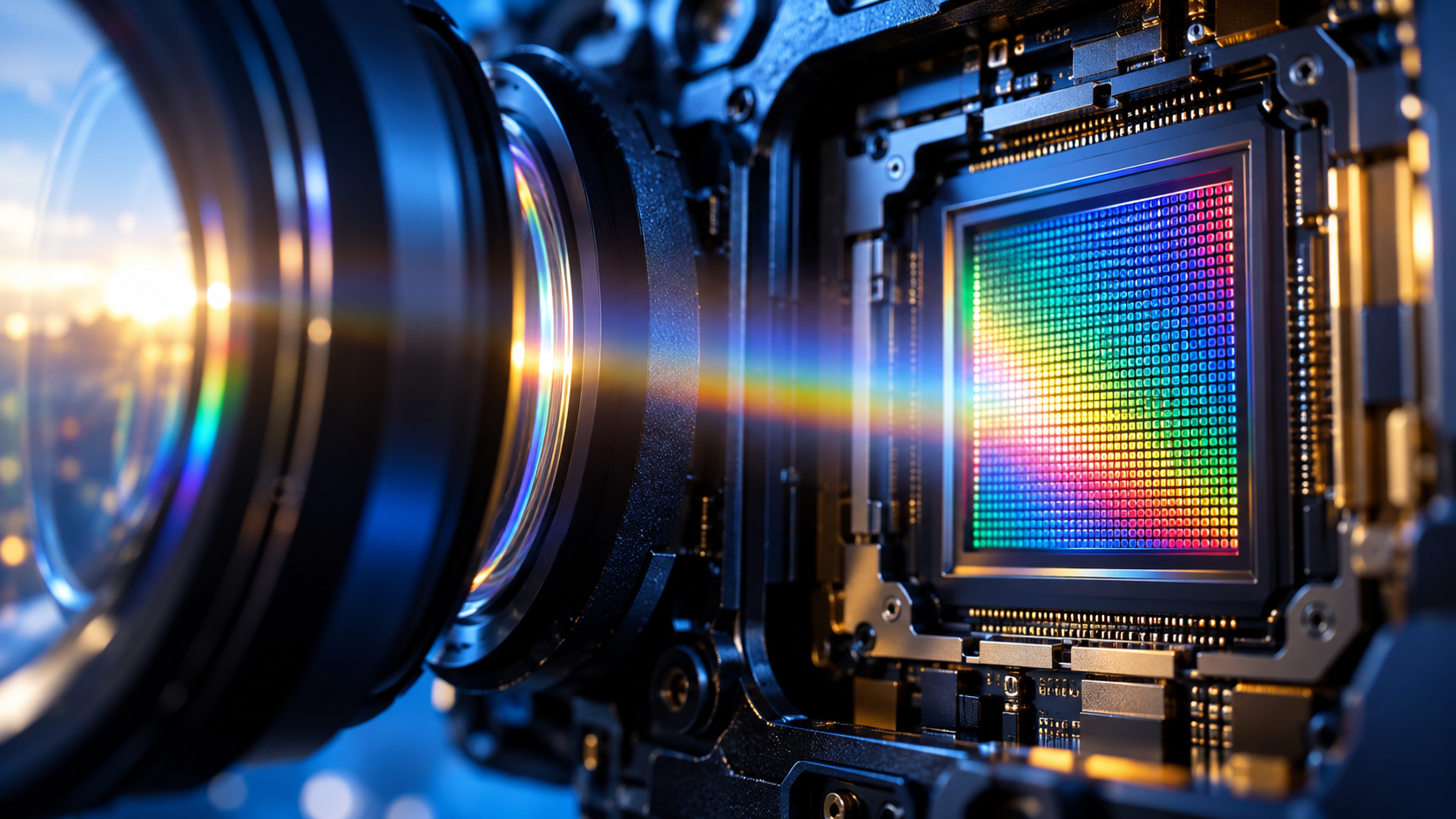
Image Sensor Pixels Explainer
A digital image sensor converts incoming light into electrical measurements arranged across a grid. A camera lens focuses a scene onto millions of photosites on a CMOS or CCD sensor. During exposure, photons reaching a photosensitive region generate charge carriers, and the amount of collected charge broadly corresponds to the light received. When exposure ends, sensor electronics measure each site’s signal, convert it into a digital value, and pass the data to an image-processing pipeline.
A photosite is not automatically a complete color pixel. Most consumer sensors place a color filter array above the photosites so each location primarily measures one portion of the spectrum, commonly red, green, or blue. Microlenses guide more light toward the active area beneath wiring and transistors. The processor estimates the missing color components at each output pixel from neighboring samples, a step called demosaicing. Alternative filter patterns and sensors that separate color differently exist, but all must turn limited physical measurements into the color values used by an image.
The collected signal competes with noise. Photons arrive statistically, producing shot noise that is most visible when little light is available. Sensor readout adds electronic noise, and heat can generate unwanted charge. A photosite can hold only a finite number of electrons before saturating, which sets one limit on highlight detail. At the dark end, read noise and quantization determine whether a small signal is distinguishable. Dynamic range describes how widely the system can separate useful shadows from clipped highlights under specified conditions.
CMOS sensors usually include amplifiers and addressing circuitry that allow rows or regions to be read efficiently. Analog gain can raise a weak signal before conversion, while an analog-to-digital converter assigns numeric levels. Higher ISO settings do not create extra photons; they change amplification and processing, affecting noise, highlight headroom, and output brightness. Modern sensors may use backside illumination to reduce obstruction above the photodiode, stacked circuitry for faster readout, dual-gain paths, and on-chip phase-detection sites.
Raw sensor data still needs correction and interpretation. The camera compensates for defective pixels, lens shading, black level, and varying color response. White balance maps the scene’s illumination toward a chosen neutral, while tone curves and color matrices translate wide sensor measurements into a viewable color space. Noise reduction, sharpening, lens correction, and compression can change fine detail. A raw file preserves more of the pre-rendered measurements, but it is not untouched reality; sensor calibration and metadata already shape how software interprets it.
Pixel count alone does not determine image quality. Lens sharpness, sensor area, photosite size, exposure, readout speed, stabilization, processing, and display conditions all matter. Smaller photosites can capture fine spatial detail in strong light but collect fewer photons individually, while larger sensors can gather more total light for the same framing and exposure settings. The physical chain is the important part: optics distribute photons, photosites accumulate charge, readout circuits measure and digitize it, and processing reconstructs color and tone. A finished photograph is therefore a carefully calibrated estimate built from millions of light-sensitive electrical samples.
Exposure is controlled by the light admitted through the aperture, the time each photosite collects it, and the scene’s brightness. If too few photons arrive, amplification cannot recreate missing detail; if a photosite saturates, highlight differences are lost. Multiple exposures or dual-conversion-gain readouts can extend usable range when subjects permit. Calibration maps electrical values to predictable color and brightness across manufacturing variation. This is why image quality emerges from the whole camera system: the sensor measures light, but optics, timing, electronics, signal processing, and the chosen output encoding determine how faithfully those measurements become visible pixels.
Each stage contributes error and opportunity.
Image-sensor photosites convert photons into electrical charge, which readout circuits amplify and digitize before processing forms color pixels. Key terms include photosite, photodiode, microlens, color filter array, demosaicing, shot noise, read noise, saturation, dynamic range, gain, and raw data.
Usually not. A color filter array lets each photosite emphasize one color component, and demosaicing estimates the missing components from neighboring measurements. Other sensor designs use different color-sampling methods.
ISO settings change sensor gain and processing rather than the number of photons captured. More gain can make the output brighter but may reveal noise or reduce available highlight headroom, depending on the sensor design.
Explore more "Explainers"
Discover additional explainers across politics, science, business, technology, and other fields. Each explainer breaks down a complex idea into clear, everyday language—helping you better understand how major concepts, systems, and debates shape the world around us.