

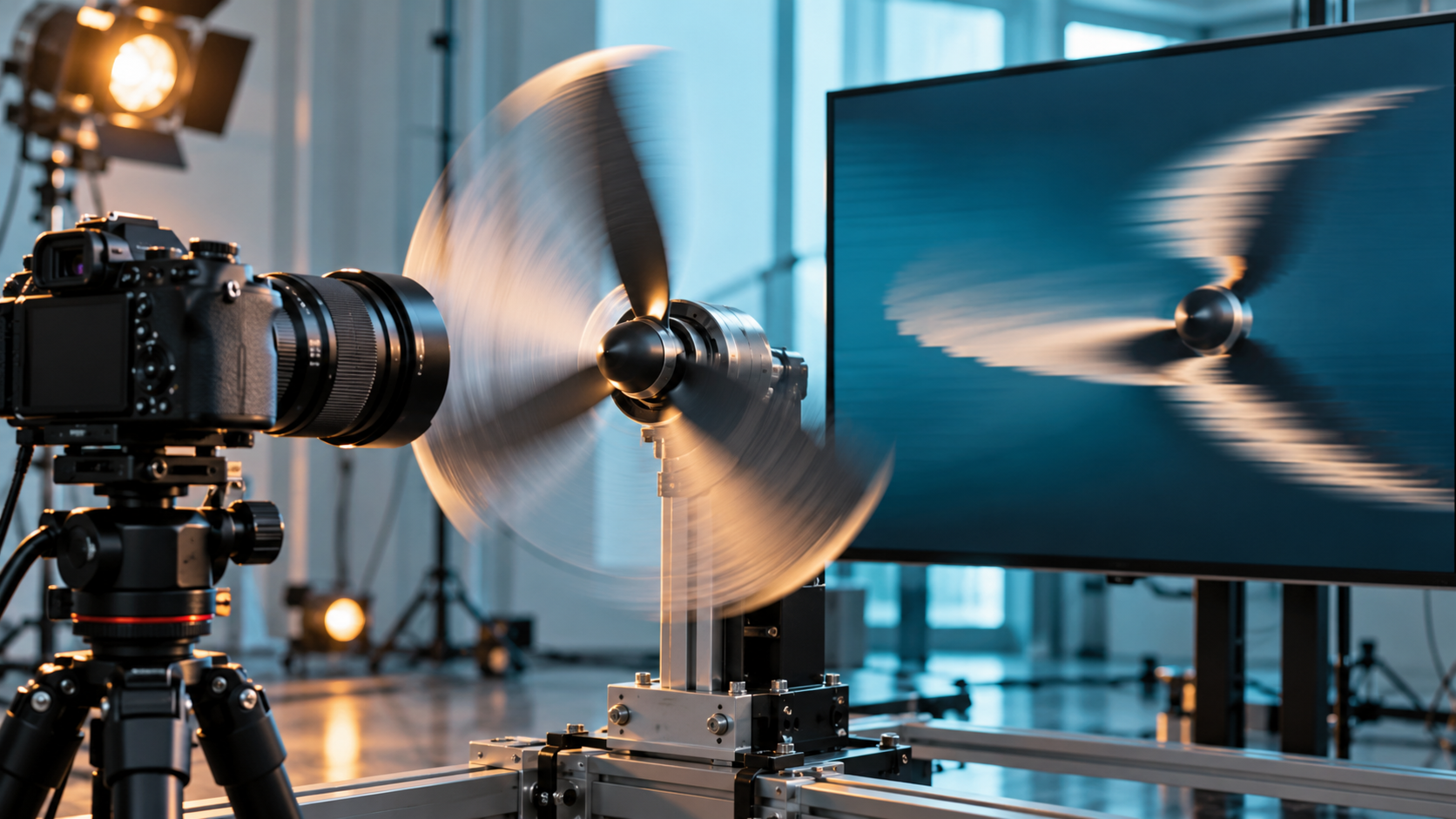
Rolling Shutter Distortion Explainer
Rolling shutter distortion occurs because many electronic image sensors do not capture every row at exactly the same instant. Exposure and readout progress across the sensor in a sequence, often from top to bottom. Each row may use the same exposure duration, but its time window begins and ends slightly later than the previous row’s. A still scene looks normal because nothing changes during the scan. Fast subject motion, vibration, or camera rotation can place different parts of one recorded frame at meaningfully different moments.
The total difference between the first and last row is the sensor’s readout or scan time. It is separate from shutter speed. A short exposure can make each row sharp while the full frame still spans several milliseconds or more. When the camera pans horizontally during that span, vertical objects can lean because lower rows record them after they have shifted. A spinning propeller may appear bent, and a rapidly moving object may stretch or compress. Flashes or flickering lights can create partial bands because illumination changes while rows are sampled.
Readout direction and motion determine the shape of the artifact. Movement parallel to the scan can alter apparent size, movement across it can create skew, and rotation can produce a wobbling or gelatin-like image. Video often makes the effect more noticeable because frame-to-frame camera shake changes the distortion continuously. Electronic stabilization can correct some global motion, but it cannot perfectly reconstruct geometry when different rows observed genuinely different subject positions.
A global shutter exposes all photosites over the same time interval and then stores or transfers their values, greatly reducing these time-offset distortions. That design needs additional sensor circuitry or storage and can trade cost, noise, dynamic range, pixel area, or power. Some rolling-shutter sensors use very fast readout so the temporal difference is small enough for most scenes. Stacked sensor architectures move processing and memory into additional layers, allowing rows to be read more quickly without requiring a true global shutter.
Photographers and filmmakers can reduce artifacts by avoiding rapid pans, stabilizing the camera, using wider framing, choosing a higher-readout mode, or orienting motion favorably. Shutter speed helps motion blur but does not by itself shorten the top-to-bottom scan. Lighting should avoid frequencies that produce bands with the selected frame and shutter settings. Specialized software can estimate camera motion and correct skew, but complex moving subjects and occlusions limit reconstruction.
Rolling shutter is not inherently a defect; it is an engineering choice that enables efficient, high-quality sensors. The severity depends on readout time, resolution, frame mode, subject speed, focal length, stabilization, and the intended output. Manufacturers may publish scan measurements only indirectly, so practical camera tests can matter. The key insight is temporal: one photograph appears to be a single instant, but a rolling-shutter frame is a sequence of narrow observations assembled into one rectangle. When the scene changes during that sequence, spatial distortion records the timing difference.
Frame rate does not reveal scan time by itself. Two cameras can both record sixty frames per second while one finishes reading each frame much sooner and leaves a longer idle interval. Cropped or lower-resolution modes may scan fewer rows and reduce distortion, but some modes instead change processing without improving readout. Reviewers often measure skew by filming a known moving target or flashing light. A useful specification reports the elapsed time from first row to last for the exact resolution and mode, because that directly describes the temporal spread responsible for rolling-shutter artifacts.
The best mitigation follows from that measurement: choose the faster mode, reduce camera motion, change the shot, or select global-shutter equipment when geometry must remain exact.
Rolling shutter exposes or reads sensor rows at different times, so movement during the scan can distort one frame. Key terms include row readout, scan time, exposure time, skew, wobble, banding, pan, global shutter, stacked sensor, and motion correction.
It can reduce motion blur within each row, but it does not necessarily shorten the delay between the first and last rows. A sharp moving object can still look bent if full-sensor readout remains slow.
A global shutter gives all pixels the same exposure interval, so the frame represents one common time slice. Extra sensor circuitry and storage can introduce other cost, power, or image-quality tradeoffs.
Explore more "Explainers"
Discover additional explainers across politics, science, business, technology, and other fields. Each explainer breaks down a complex idea into clear, everyday language—helping you better understand how major concepts, systems, and debates shape the world around us.