

USB-C Power Delivery Explainer
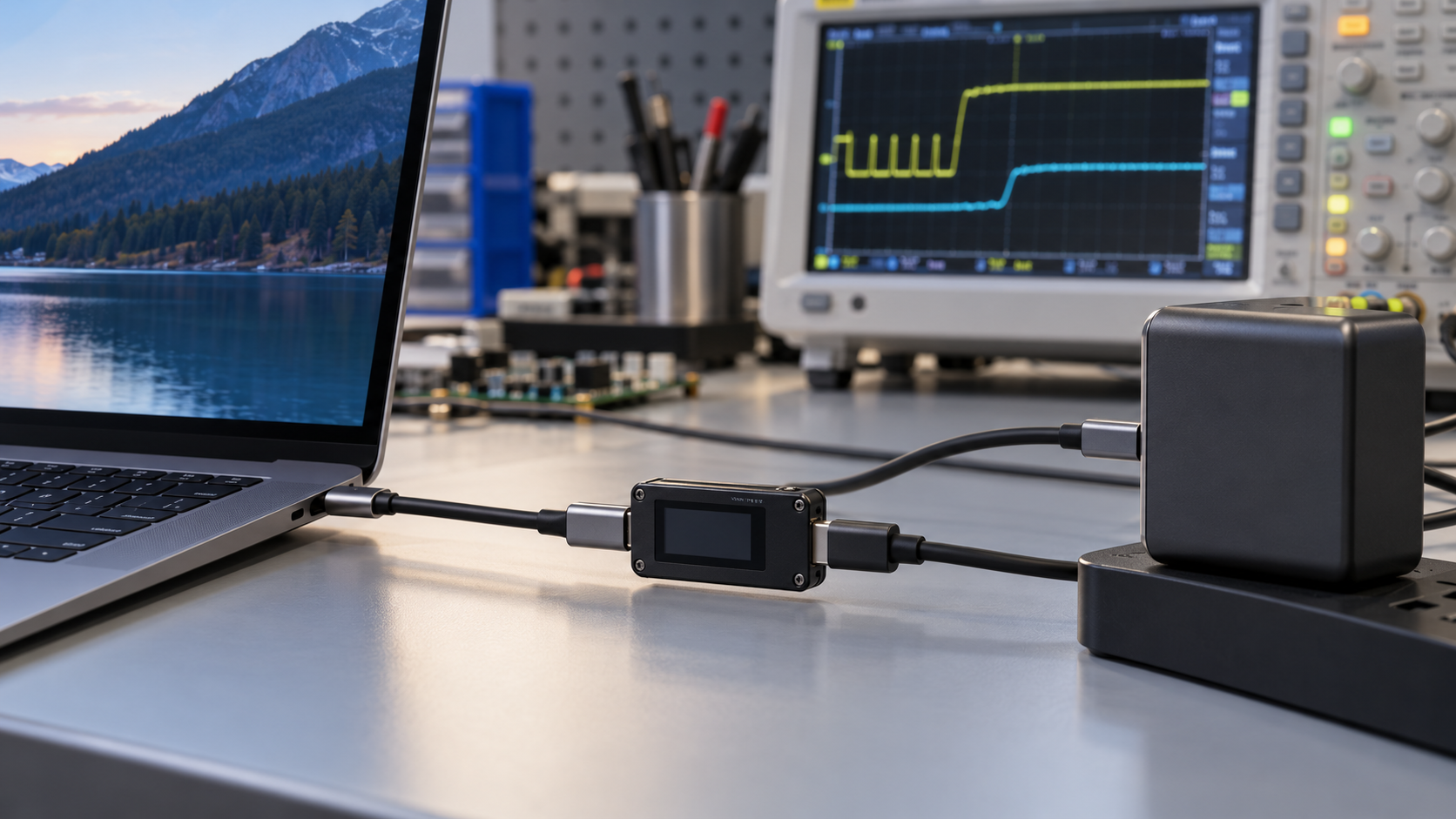
USB Power Delivery is the negotiation system that allows one USB-C connection to charge devices ranging from earbuds to laptops and high-power equipment. The oval connector does not place the maximum possible voltage on every cable. A newly connected source begins with a safe USB supply and communicates over the Configuration Channel pins. The source describes the power combinations it can provide, the receiving device requests one suitable combination, and the source confirms before changing its output. This controlled sequence prevents an ordinary low-power device from unexpectedly receiving a higher voltage.
Connection detection happens through resistors on the Configuration Channel, usually called CC. They reveal cable orientation and identify which port is acting as the source and which is the sink. A dual-role port may be able to swap those roles. The CC path also carries coded Power Delivery messages. Because USB-C is reversible, the port controller selects the active CC pin and maps high-speed lanes correctly. Basic USB-C current advertisement can work without the full Power Delivery protocol, but advanced voltage choices and role changes require the message exchange.
The source sends a list of capabilities expressed as power data objects. A fixed supply might offer several voltage and current pairs, while programmable modes can allow smaller voltage steps within a range. The sink evaluates its needs, thermal state, battery condition, and cable limits, then requests a particular operating point. If the source accepts, it transitions the bus and reports that the new supply is ready. The sink continues to monitor the connection and can request a different level as charging conditions change.
The cable can be part of the conversation. Higher currents and the Extended Power Range require a cable rated and electronically marked for the job. An e-marker chip tells the ports about current capacity and supported high-speed features. If the cable cannot prove that capability, the system must stay within safer limits. This is why two USB-C cables that look similar may support very different charging and data performance. The connector shape identifies the interface family, not a universal wattage guarantee.
Power Delivery can also reverse direction. A laptop may receive power from a dock, then supply a phone from another port. Devices negotiate power-role and data-role swaps so the direction is explicit. A dock can advertise one budget when lightly loaded and reduce what it offers if several downstream ports draw power. Protection circuits still enforce current, voltage, and temperature limits outside the protocol. If communication fails or a plug is removed, the source returns to a safe state rather than maintaining an unsupported contract.
Modern specifications extend the system beyond the earlier common voltage levels. Extended Power Range supports higher voltages and up to 240 watts with compatible sources, sinks, and cables. Programmable Power Supply modes let a device request finer voltage changes, which can move some conversion work into the charger and reduce heat in a phone. These capabilities are optional. Successful charging always falls back to the best contract supported by every component in the path, including hubs, docks, adapters, and the cable.
The visible result is automatic charging, but the engineering result is a continuously managed contract. CC resistors establish the connection, Power Delivery messages advertise choices, the sink requests power, the source transitions safely, and both sides supervise the link. Negotiation cannot make a weak charger or cable deliver more than it was built for. It lets a diverse set of devices discover a mutually safe operating point and change that point when roles, temperature, or battery needs change.
USB-C Power Delivery is a negotiation system that lets connected devices agree on a safe power level. The charger, cable, and receiving device communicate before higher voltages or currents are used.
The source advertises the power profiles it can provide, and the sink requests one that matches its needs. Controllers monitor the connection and can renegotiate if a device changes modes or needs less power.
Some USB-C cables can safely carry more current than others and report that capability electronically. Using the wrong or damaged cable can limit charging speed or prevent a higher-power profile from being selected.
Explore more "Explainers"
Discover additional explainers across politics, science, business, technology, and other fields. Each explainer breaks down a complex idea into clear, everyday language—helping you better understand how major concepts, systems, and debates shape the world around us.