

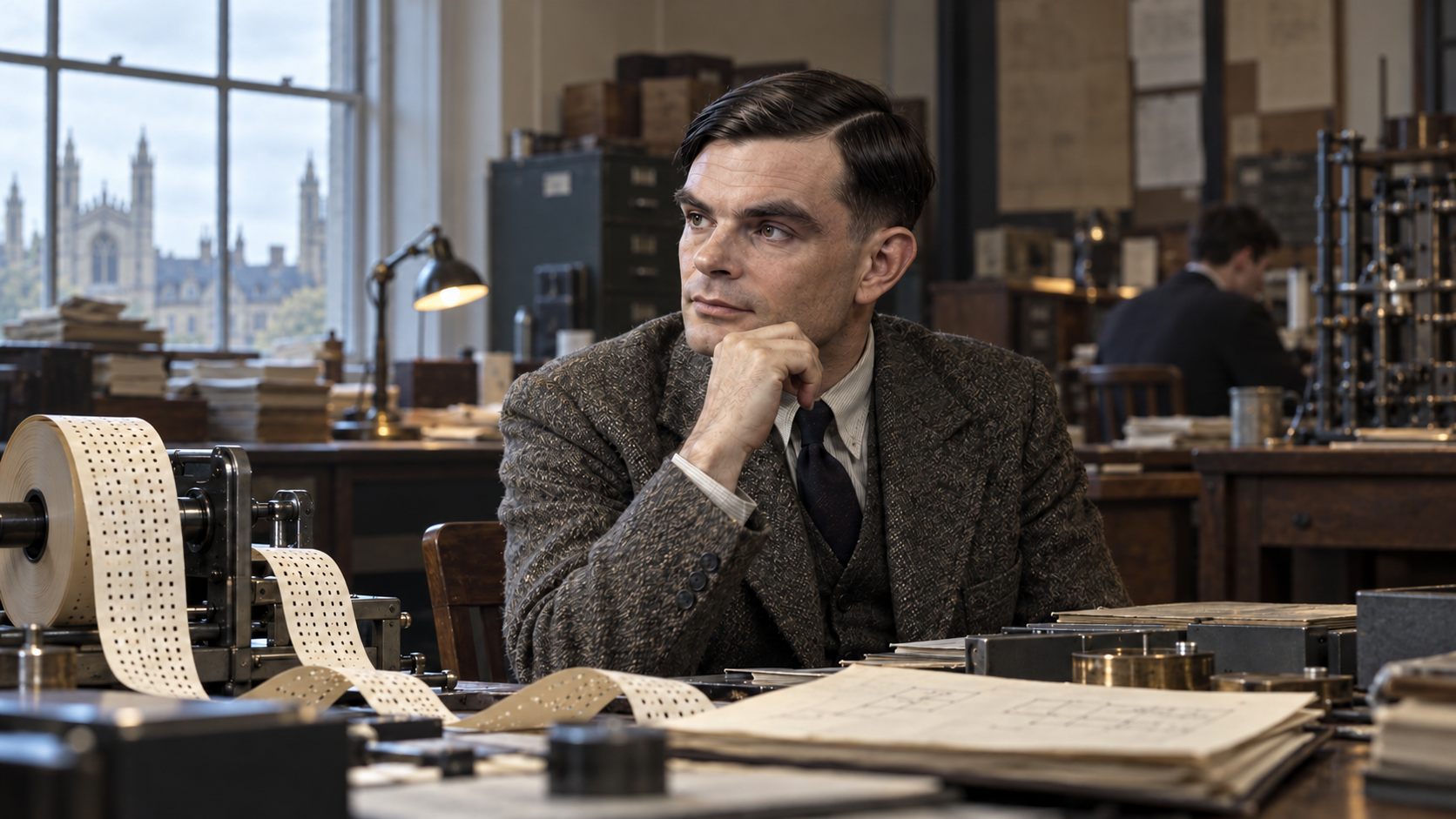
“We can only see a short distance ahead, but we can see plenty there that needs to be done.”
Alan Turing ended his 1950 paper “Computing Machinery and Intelligence” with a characteristically measured sentence: “We can only see a short distance ahead, but we can see plenty there that needs to be done.” The paper is famous for replacing the vague question “Can machines think?” with an operational imitation game. Turing did not claim that the game settled every philosophical problem. He offered it as a disciplined way to move from arguments about words toward observable performance. His final line acknowledged how little anyone could know about the long-range future while refusing to treat uncertainty as an excuse for paralysis.
That balance remains one of the strongest habits in serious AI work. Predictions about human-level intelligence often stretch far beyond the available evidence, yet immediate questions are concrete. Researchers can test whether a system generalizes beyond its training examples, whether its answers remain reliable under pressure, and whether people can understand when it fails. Institutions can examine who supplies data, who receives benefits, and who carries risk. Turing’s sentence directs attention away from theatrical certainty and toward the next answerable problem, where evidence can replace intuition and progress can be judged rather than merely announced.
The quote also changes how technological responsibility should be understood. A limited horizon does not eliminate obligation; it makes careful navigation more important. Developers cannot predict every use of a model, but they can document known limitations, invite independent evaluation, and create ways to stop or correct harmful behavior. Governments may not know which architecture will dominate a decade from now, but they can protect civil rights, require accountability in high-impact decisions, and support public research. The unknown future is not empty space. It is approached through choices made in laboratories, companies, classrooms, and public agencies today.
Turing’s closing thought is therefore neither optimism nor pessimism. It is a call for intellectual humility joined to purposeful work. Modern AI inspires sweeping claims about creativity, employment, science, and even the destiny of civilization. Some may prove accurate; many will not. The durable response is to keep asking precise questions, building meaningful tests, and widening the group of people who can challenge the answers. A short view can still reveal a demanding path: improve reliability, distinguish performance from understanding, distribute gains fairly, and make sure human judgment remains present wherever automated systems affect consequential parts of life. For readers, the sentence offers a practical habit: separate what can be tested now from what remains speculation. That habit supports ambitious research without confusing a forecast with evidence, and it keeps public attention on the concrete safeguards, experiments, and institutions that can actually be improved.
Turing’s paper appeared in the journal Mind and proposed the imitation game as a practical replacement for an argument over the definition of thinking.
He surveyed learning machines, objections, and possible experiments, making the closing line a summary of an open research program rather than a vague slogan.
The sentence admits that forecasts about machine intelligence are constrained by limited evidence and rapidly changing technical conditions.
It does not recommend waiting. It recommends concentrating effort on questions that can be tested, criticized, and improved now.
Today that agenda includes robustness, interpretability, privacy, security, labor effects, and the distribution of AI’s benefits and burdens.
Progress is more credible when capability claims are paired with transparent evaluation and clear responsibility for real-world consequences.
Explore more "Quotes of The Day"
Continue exploring how writers, thinkers, artists, and advocates have described the choices that shape an everyday life.