

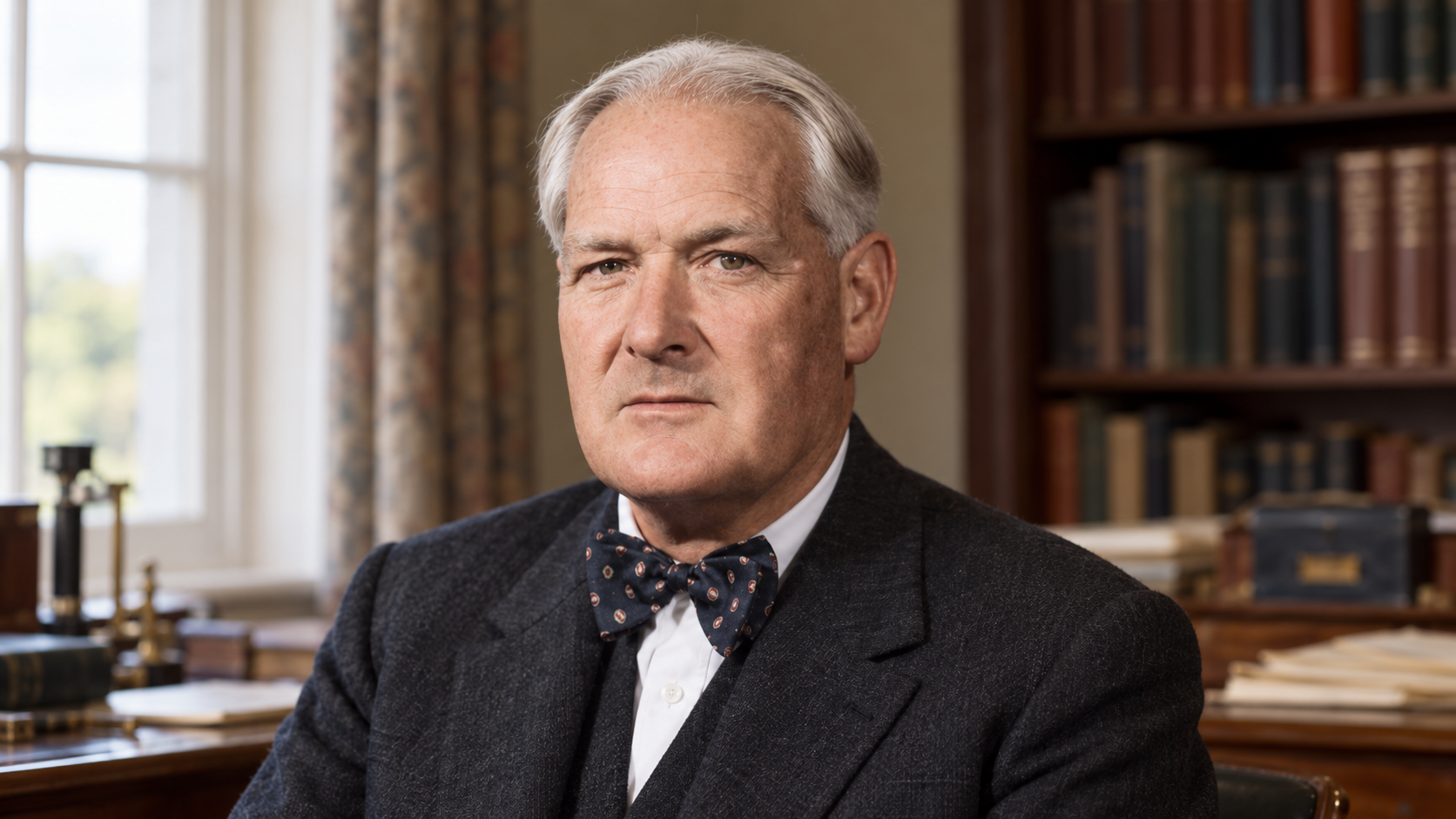
“All scientific work is incomplete – whether it be observational or experimental.”
Austin Bradford Hill made this observation near the end of his 1965 address about whether an observed association should be interpreted as causal. The Royal Society of Medicine reprinted the address in 2015, identifying its original publication in May 1965. Scholarly discussion also preserves the sentence and its continuation. Hill immediately explains that advancing knowledge can revise scientific conclusions, then rejects the idea that this permits people to disregard existing knowledge or indefinitely defer action. That continuation is essential to the meaning. The quoted sentence does not announce that research is worthless, nor does it authorize certainty where the evidence is weak. It acknowledges a permanent feature of inquiry while asking what responsible decisions require in the meantime. His subject was especially relevant to understanding environmental and occupational causes of disease, where waiting for an impossible level of proof can itself have consequences.
Observational studies and experiments contribute differently to an investigation, yet neither produces a final account immune to correction. Hill’s wording puts both within that condition. It therefore resists a simple division in which one method is entirely unreliable and another ends all uncertainty. The practical question is how findings fit together, what alternative explanations remain, and how strong the evidence needs to be for a proposed response. Hill discussed several viewpoints for thinking about causation, but he did not present them as a mechanical checklist that guarantees an answer. Judgment remains necessary. So does attention to what acting, or failing to act, would mean. Different decisions can require different levels of confidence because their burdens and consequences differ. This is an argument for careful reasoning under uncertainty, rather than a license to adopt whichever conclusion seems most convenient. The possibility of revision adds responsibility to the process; it does not remove it.
For readers encountering a health headline, the sentence can encourage patience with explanations that include limits. A result can be informative even when further work may change its interpretation. At the same time, saying that science is incomplete should not become a convenient reason to dismiss findings that are uncomfortable. The useful habit is to ask what the evidence supports now, how securely it supports it, and what would justify updating the conclusion. Public decisions also deserve an explanation of why a response is proportionate to the available knowledge. These questions leave space for correction without treating all claims as equally plausible. Hill’s closing argument connects intellectual humility with a willingness to decide. Its relevance rests in that connection: uncertainty must be described honestly, existing knowledge must receive serious attention, and action must be reasoned rather than endlessly postponed. A February 29 selection gives the thought a place in an annual series, without suggesting a historical connection between the address and leap day.
The sentence appears near the conclusion of Hill’s 1965 address on association and causation.
Its continuation explicitly rejects using incomplete knowledge as a reason to ignore evidence or defer action indefinitely.
Experiments and observational research can both inform decisions while remaining open to revision.
Hill’s causal viewpoints assist judgment; they do not form an automatic proof checklist.
Readers can ask what current findings support and what evidence would change the interpretation.
Honest uncertainty should accompany proportionate decisions rather than erase responsibility for acting on available knowledge.
Explore more "Quotes of The Day"
Discover more notable quotes from influential voices across politics, science, business, technology, sports, and culture. Each quote offers insight into how ideas, beliefs, and decisions shape the world around us.