

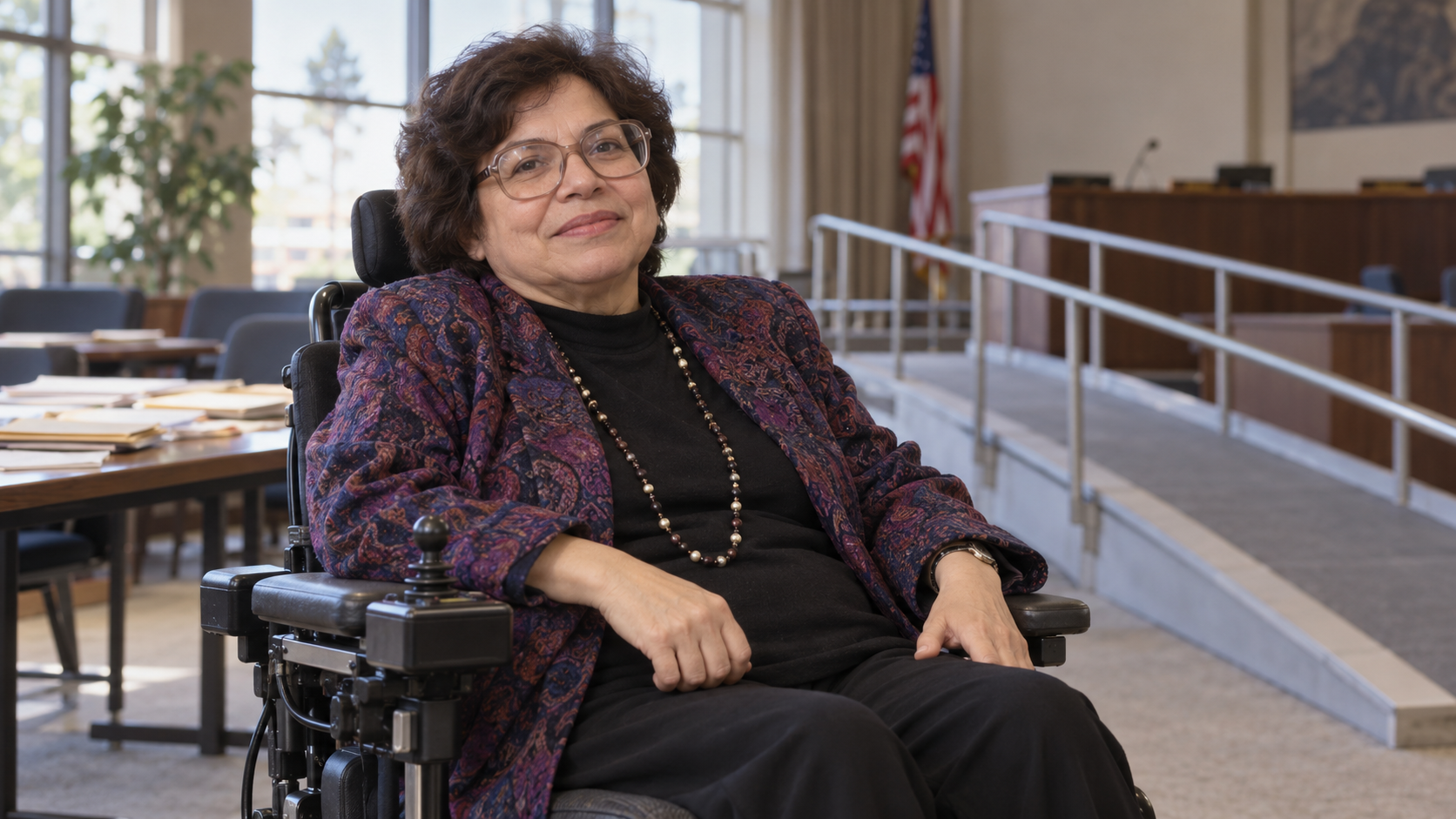
“Disability only becomes a tragedy when society fails to provide the things we need to lead our lives—job opportunities or barrier-free buildings, for example.”
Judith Heumann used this statement to explain a central principle of the disability-rights movement: exclusion is created when society designs work, buildings, transportation, education, and services for only part of the public. A lifelong organizer who helped lead the 1977 Section 504 sit-in and later worked in government and international disability policy, Heumann rejected the assumption that disability automatically makes a life tragic. Her examples are concrete. A staircase becomes disabling when no usable route exists; an employer’s closed expectation becomes disabling when skill is overlooked; a public program becomes disabling when information, communication, or support cannot be accessed. The quotation moves the location of the problem from the person alone to the relationship between a person and an environment. Heumann’s activism helped turn Section 504 of the Rehabilitation Act from statutory language into enforceable regulations after years of delay.
That social model does not require denying pain, fatigue, illness, or the need for medical care. Disabled people describe their bodies and experiences in different ways, and no single framework captures every need. The model changes who carries responsibility. Instead of asking only how an individual can overcome a barrier, it asks why the barrier was built and who can remove it. Accessibility also cannot be reduced to one ramp. Sensory, cognitive, communication, digital, and attitudinal barriers matter, and accommodations must be shaped with the people who use them. A feature that helps one person may not meet another’s requirements. The 1977 sit-in demonstrated that access policy changes when disabled people organize, negotiate, and insist on a seat at the table rather than wait for benevolence.
In health care, Heumann’s quote is a prompt to examine the entire path to service. Can a patient schedule an appointment, enter the building, transfer safely, communicate privately, use diagnostic equipment, and receive information in an accessible form? Are disabled professionals and patients involved in design before a renovation or technology purchase is complete? These questions reveal that access is a quality issue, not a special favor. Universal design can remove recurring obstacles, while individual accommodations address needs that a general design cannot anticipate. The goal is not to make disability disappear from public view. It is to make participation ordinary. Heumann’s wording keeps attention on choices that institutions can change and on the full lives those changes allow people to lead. A hospital or clinic follows that lesson when it pays disabled advisers for their expertise, tests designs with users, and fixes reported barriers through a visible accountability process.
Heumann’s examples show how buildings, jobs, and services can restrict participation through design and policy.
The problem is not confined to a person’s body; it is produced in the interaction with the environment.
Communication, sensory, cognitive, digital, equipment, and attitudinal barriers can all exclude.
Disabled people should help define solutions because access needs differ across individuals and settings.
Review scheduling, entry, equipment, communication, privacy, and follow-up from the patient’s perspective.
Universal design removes common obstacles, while individual accommodations meet needs the general design cannot cover.
Explore more "Quotes of The Day"
Discover more notable quotes from influential voices across politics, science, business, technology, sports, and culture. Each quote offers insight into how ideas, beliefs, and decisions shape the world around us.