

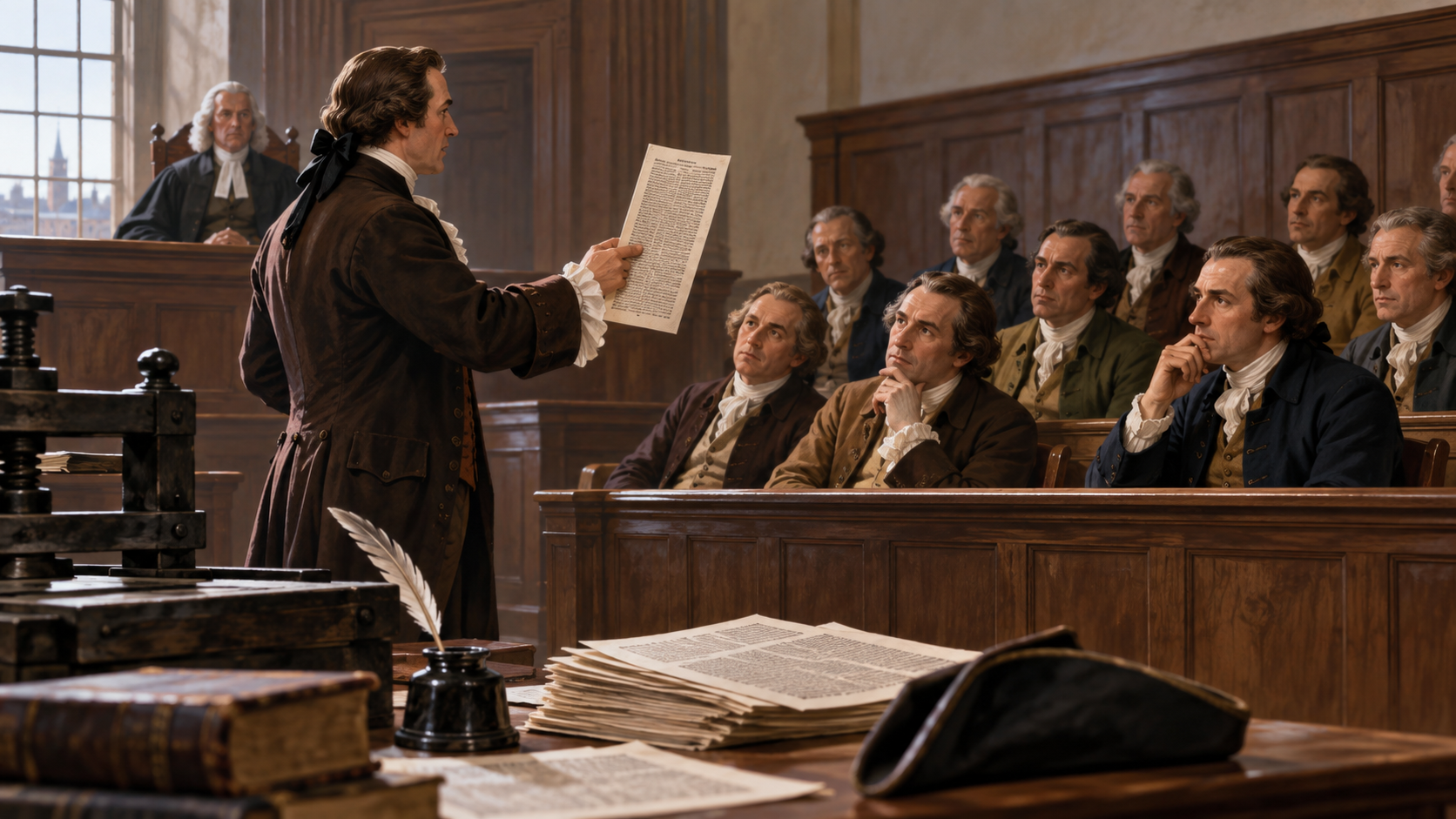
“The question before the Court and you, Gentlemen of the Jury, is not of small nor private concern.”
Hamilton addressed a New York jury defending printer John Peter Zenger, who had published attacks on the colonial governor. The prosecution treated publication itself as the central offense under the law of seditious libel. The historical setting gives the sentence its force. The original source—Andrew Hamilton, defense in the trial of John Peter Zenger, 1735—anchors the wording and prevents a memorable line from floating free of the argument around it. A responsible account begins there, then distinguishes the historical record from later uses of the quotation.
Hamilton enlarged the case from one printer’s fate to the public’s ability to criticize government. The trial later became an important American symbol of resistance to official control of the press. The central idea concerns how institutions produce public knowledge. That approach asks who had access to information, which institution made the consequential decision, and what evidence an independent reader could inspect. It also keeps a quotation from doing more work than the underlying facts can support.
The acquittal did not create modern First Amendment doctrine, and accounts often exaggerate its immediate legal effect. Colonial juries, law, and press practice remained different from later constitutional protections. The line is most useful when its limits remain visible. Newsrooms should test the appealing interpretation as seriously as the hostile one, seek knowledgeable disagreement, and state uncertainty in proportion to the record. Precision is especially important when a short sentence has become famous enough to circulate without its source.
The case remains useful when a prosecution presented as an ordinary dispute carries wider consequences for access to information or criticism of authority. Historical accuracy prevents commemoration from becoming myth. Reporters should separate the verdict, the lawyer’s argument, later legal developments, and the symbolic legacy rather than collapsing them into a single founding moment. Its modern relevance depends on connecting principle to verifiable consequences. A useful follow-up would revisit the underlying records after the immediate controversy has passed, compare promised action with measurable results, and make corrections or unresolved questions easy to find. For Andrew Hamilton, the principle gains force from the circumstances in which it was expressed; for a contemporary reader, it gains value only when reporting supplies comparable specificity. That continuing record matters because accountability is rarely settled by a single headline. Editors should therefore preserve links between the claim, the evidence that supports it, credible challenges, and later developments that confirm or revise the first account. Public understanding improves when claims stay connected to chronology, responsible institutions, primary evidence, and the people who live with the consequences. The quotation then serves as an opening for inquiry instead of a substitute for it.
Hamilton addressed a New York jury defending printer John Peter Zenger, who had published attacks on the colonial governor. The prosecution treated publication itself as the central offense under the law of seditious libel. The source is Andrew Hamilton, defense in the trial of John Peter Zenger, 1735.
Hamilton enlarged the case from one printer’s fate to the public’s ability to criticize government. The trial later became an important American symbol of resistance to official control of the press. The acquittal did not create modern First Amendment doctrine, and accounts often exaggerate its immediate legal effect. Colonial juries, law, and press practice remained different from later constitutional protections.
The case remains useful when a prosecution presented as an ordinary dispute carries wider consequences for access to information or criticism of authority. Historical accuracy prevents commemoration from becoming myth. Reporters should separate the verdict, the lawyer’s argument, later legal developments, and the symbolic legacy rather than collapsing them into a single founding moment.
Explore more "Quotes of The Day"
Discover more notable quotes from influential voices across politics, science, business, technology, sports, and culture. Each quote offers insight into how ideas, beliefs, and decisions shape the world around us.