

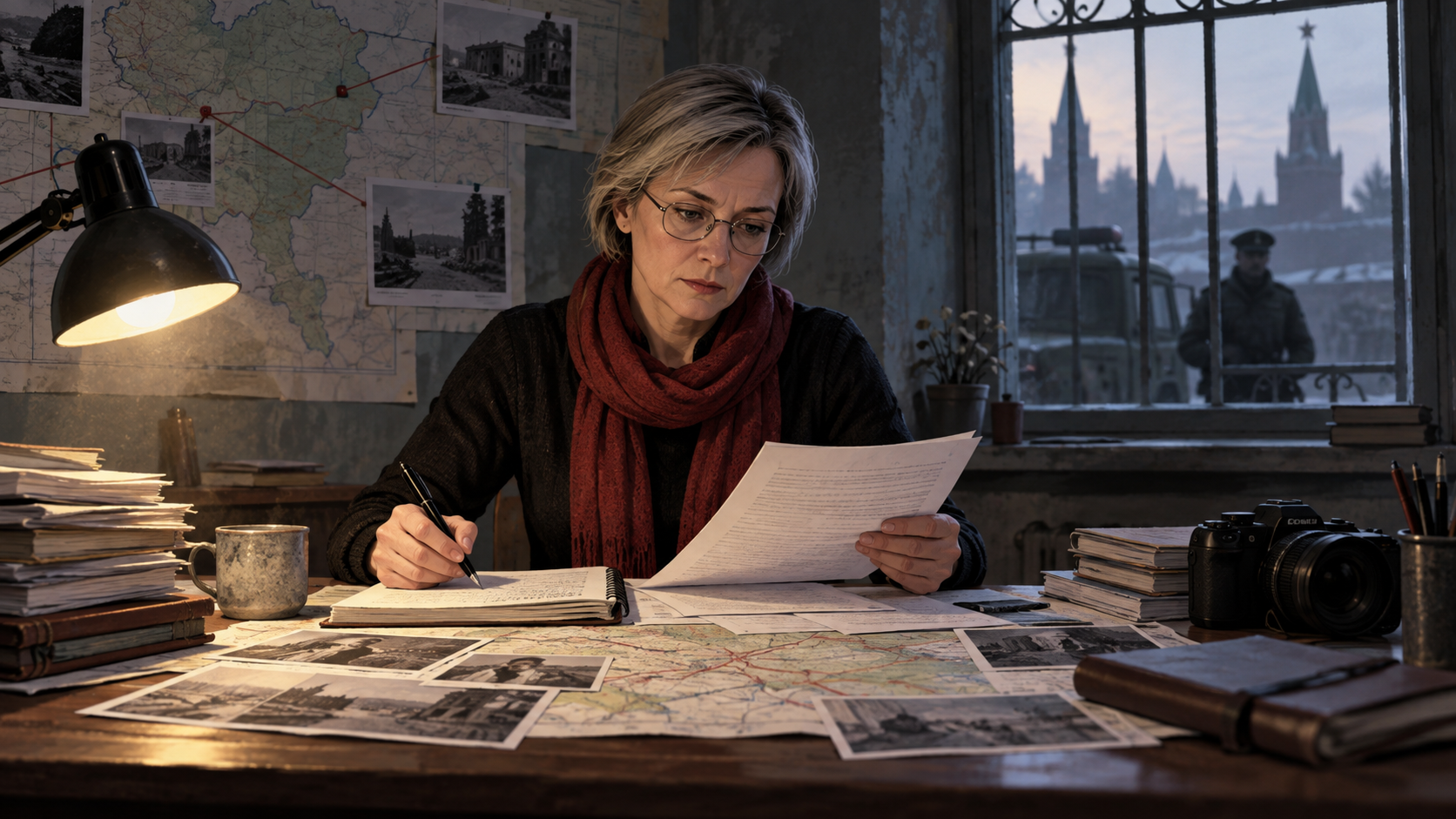
“What am I guilty of? I have merely reported what I have witnessed.”
Politkovskaya reported extensively on Chechnya, abuses by Russian forces and local authorities, corruption, and the experiences of civilians. She faced detention, threats, and attacks before her murder in 2006. This was not written for a modern social-media argument. The original source—Anna Politkovskaya, writing on her reporting and threats, collected in Is Journalism Worth Dying For?—anchors the wording and prevents a memorable line from floating free of the argument around it. A responsible account begins there, then distinguishes the historical record from later uses of the quotation.
The question exposes how witness-based reporting can be treated as an offense when documented facts threaten official narratives. Her work joined individual testimony to names, places, institutions, and repeated patterns. Even so, the underlying question remains recognizable. That approach asks who had access to information, which institution made the consequential decision, and what evidence an independent reader could inspect. It also keeps a quotation from doing more work than the underlying facts can support.
Witnessing does not remove the need for corroboration, and a reporter’s courage does not make every conclusion infallible. The strength of such work lies in transparent observation, additional sources, and records that others can examine. The challenge is to apply the principle without stripping away its original circumstances. Newsrooms should test the appealing interpretation as seriously as the hostile one, seek knowledgeable disagreement, and state uncertainty in proportion to the record. Precision is especially important when a short sentence has become famous enough to circulate without its source.
Local reporters covering war and authoritarian power often assume risks invisible to distant audiences. International coverage should credit their work, protect collaborations, and avoid reducing them to symbols after an attack. Editors can preserve threatened reporting through secure archives, shared investigations, careful source protection, and continued follow-up on both the documented abuses and the attack on the journalist. That bridge between eras must be argued, not assumed. A useful follow-up would revisit the underlying records after the immediate controversy has passed, compare promised action with measurable results, and make corrections or unresolved questions easy to find. For Anna Politkovskaya, the principle gains force from the circumstances in which it was expressed; for a contemporary reader, it gains value only when reporting supplies comparable specificity. That continuing record matters because accountability is rarely settled by a single headline. Editors should therefore preserve links between the claim, the evidence that supports it, credible challenges, and later developments that confirm or revise the first account. Public understanding improves when claims stay connected to chronology, responsible institutions, primary evidence, and the people who live with the consequences. The quotation then serves as an opening for inquiry instead of a substitute for it.
Politkovskaya reported extensively on Chechnya, abuses by Russian forces and local authorities, corruption, and the experiences of civilians. She faced detention, threats, and attacks before her murder in 2006. The source is Anna Politkovskaya, writing on her reporting and threats, collected in Is Journalism Worth Dying For?.
The question exposes how witness-based reporting can be treated as an offense when documented facts threaten official narratives. Her work joined individual testimony to names, places, institutions, and repeated patterns. Witnessing does not remove the need for corroboration, and a reporter’s courage does not make every conclusion infallible. The strength of such work lies in transparent observation, additional sources, and records that others can examine.
Local reporters covering war and authoritarian power often assume risks invisible to distant audiences. International coverage should credit their work, protect collaborations, and avoid reducing them to symbols after an attack. Editors can preserve threatened reporting through secure archives, shared investigations, careful source protection, and continued follow-up on both the documented abuses and the attack on the journalist.
Explore more "Quotes of The Day"
Discover more notable quotes from influential voices across politics, science, business, technology, sports, and culture. Each quote offers insight into how ideas, beliefs, and decisions shape the world around us.