

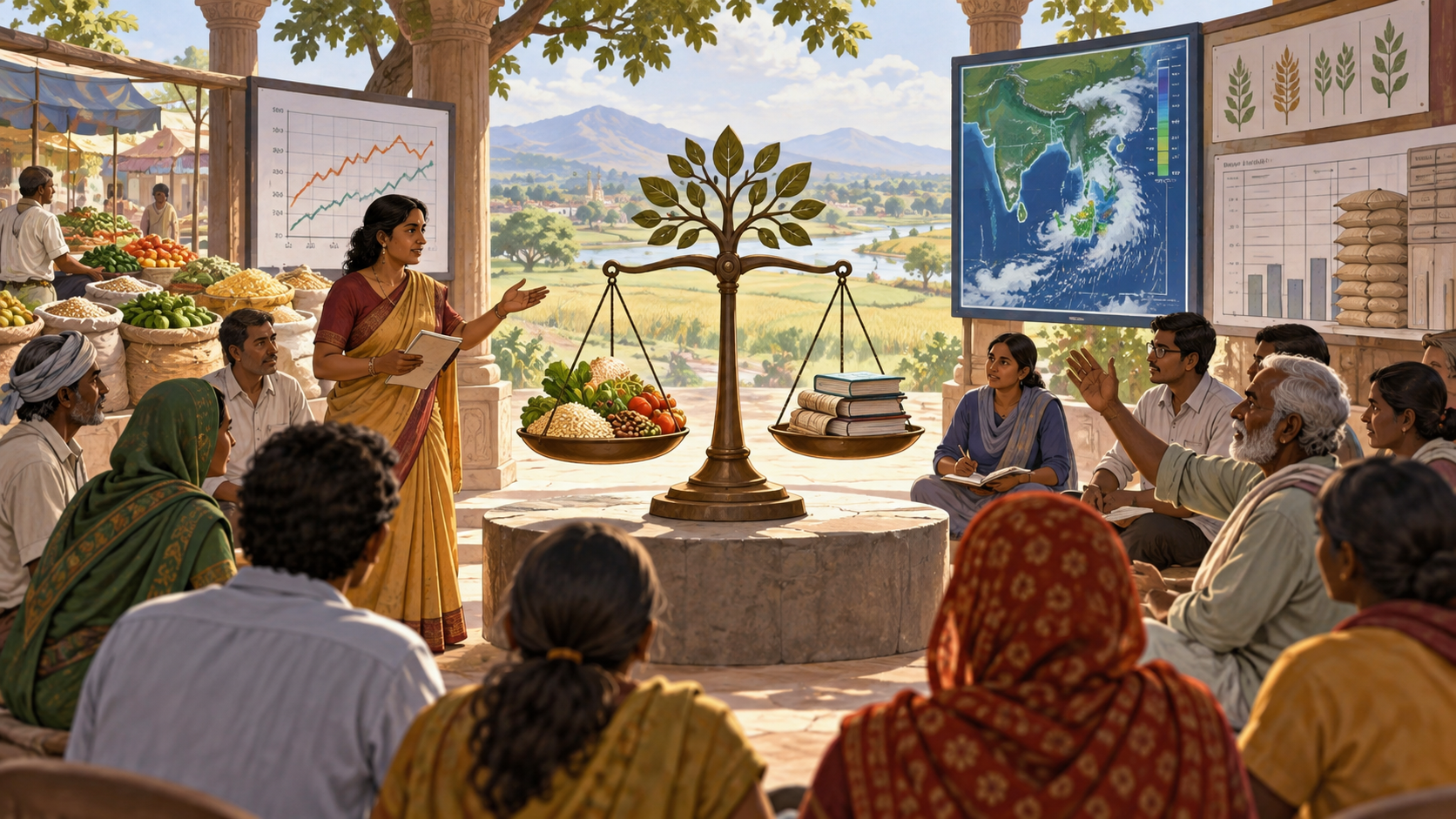
“No famine has ever taken place in the history of the world in a functioning democracy.”
Sen developed the claim through comparative research on famine, information, electoral pressure, and public action. He argued that food availability alone cannot explain famine; access, entitlement, and political accountability matter. This was not written for a modern social-media argument. The original source—Amartya Sen, Development as Freedom, 1999—anchors the wording and prevents a memorable line from floating free of the argument around it. A responsible account begins there, then distinguishes the historical record from later uses of the quotation.
A free press can expose shortages, price spikes, displacement, and administrative failure before catastrophe is undeniable. Competitive politics gives leaders incentives to respond to information that affected people can make public. Even so, the underlying question remains recognizable. That approach asks who had access to information, which institution made the consequential decision, and what evidence an independent reader could inspect. It also keeps a quotation from doing more work than the underlying facts can support.
The statement depends on what counts as famine and a functioning democracy, and it does not mean democracies eliminate hunger or malnutrition. Definitions, data quality, and subnational exclusion require careful examination. The challenge is to apply the principle without stripping away its original circumstances. Newsrooms should test the appealing interpretation as seriously as the hostile one, seek knowledgeable disagreement, and state uncertainty in proportion to the record. Precision is especially important when a short sentence has become famous enough to circulate without its source.
Food crises emerge from conflict, climate shocks, prices, logistics, and policy decisions. Restrictions on reporters and aid monitors can hide severity and delay response. Coverage should compare multiple indicators, disclose methodology, map access rather than supply alone, and follow whether warnings produce timely action. That bridge between eras must be argued, not assumed. A useful follow-up would revisit the underlying records after the immediate controversy has passed, compare promised action with measurable results, and make corrections or unresolved questions easy to find. For Amartya Sen, the principle gains force from the circumstances in which it was expressed; for a contemporary reader, it gains value only when reporting supplies comparable specificity. That continuing record matters because accountability is rarely settled by a single headline. Editors should therefore preserve links between the claim, the evidence that supports it, credible challenges, and later developments that confirm or revise the first account. Public understanding improves when claims stay connected to chronology, responsible institutions, primary evidence, and the people who live with the consequences. The quotation then serves as an opening for inquiry instead of a substitute for it.
Sen developed the claim through comparative research on famine, information, electoral pressure, and public action. He argued that food availability alone cannot explain famine; access, entitlement, and political accountability matter. The source is Amartya Sen, Development as Freedom, 1999.
A free press can expose shortages, price spikes, displacement, and administrative failure before catastrophe is undeniable. Competitive politics gives leaders incentives to respond to information that affected people can make public. The statement depends on what counts as famine and a functioning democracy, and it does not mean democracies eliminate hunger or malnutrition. Definitions, data quality, and subnational exclusion require careful examination.
Food crises emerge from conflict, climate shocks, prices, logistics, and policy decisions. Restrictions on reporters and aid monitors can hide severity and delay response. Coverage should compare multiple indicators, disclose methodology, map access rather than supply alone, and follow whether warnings produce timely action.
Explore more "Quotes of The Day"
Discover more notable quotes from influential voices across politics, science, business, technology, sports, and culture. Each quote offers insight into how ideas, beliefs, and decisions shape the world around us.