

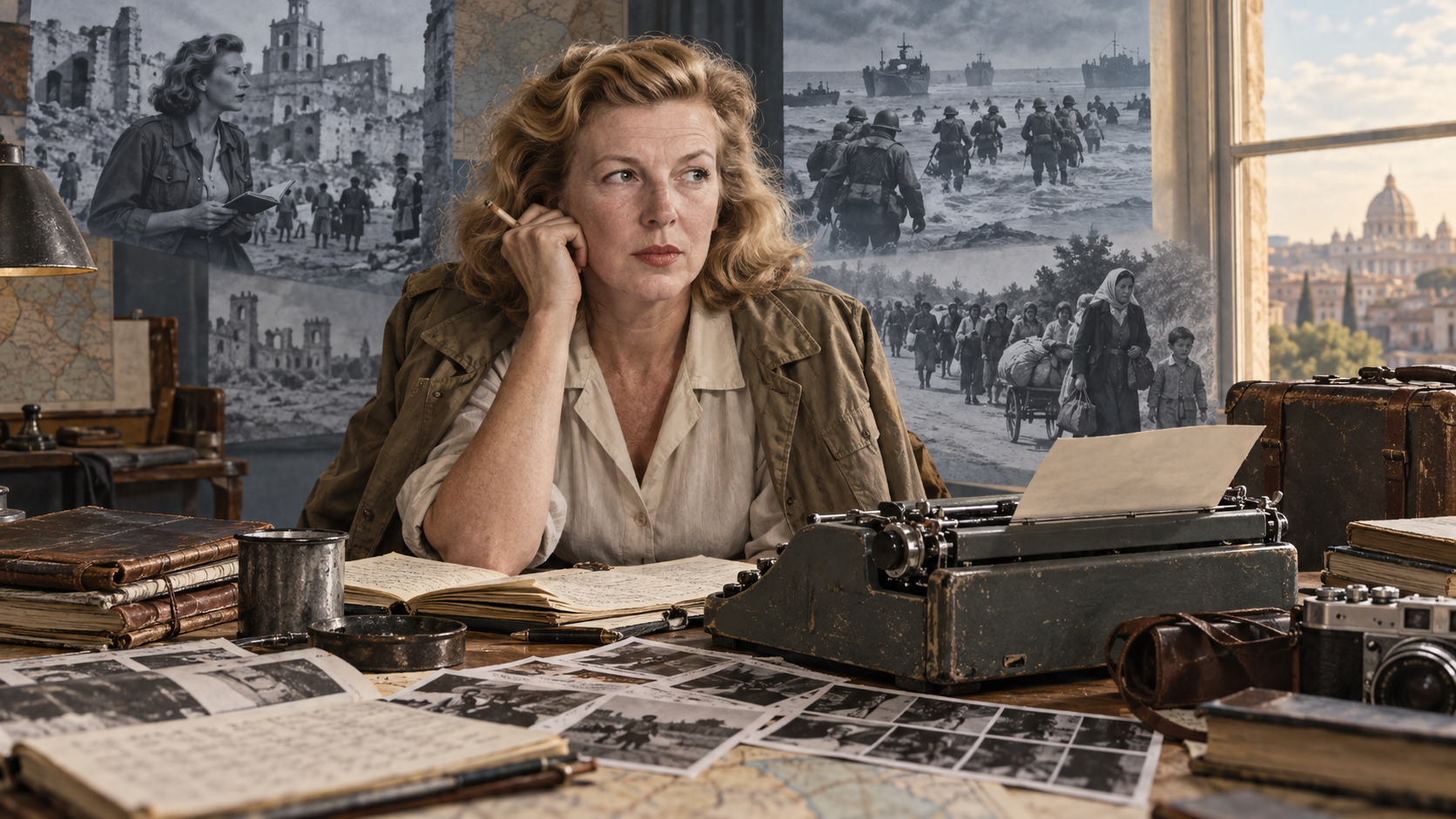
“I gave up trying to think or judge, and turned myself into a walking tape recorder with eyes.”
Martha Gellhorn used this image in the 1959 introduction to The Face of War, reflecting on reporting that stretched from the Spanish Civil War through World War II and later conflicts. The phrase describes a survival strategy as much as a professional method. Faced with destruction too large to absorb at once, she concentrated on sights, sounds, gestures, and testimony. Recording particulars let her preserve what grand military narratives often excluded: civilians waiting, soldiers enduring, families displaced, and ordinary routines broken by organized violence.
Eyewitness reporting is powerful because it anchors abstraction in observed detail. A correspondent can describe the distance between a briefing and a hospital ward, or between a map and the people moving across it. Notes made close to the event preserve language and sequence that memory later smooths. Yet observation must be joined to verification. A reporter sees from one position, under pressure, with incomplete knowledge. Names, casualty figures, weapons claims, and responsibility may require documents, specialists, additional witnesses, and time.
The tape-recorder metaphor has limits. Journalists are not neutral machines; they choose where to stand, whom to quote, and which detail leads. Trauma can affect perception, while access controlled by a military or armed group narrows the available scene. Reporting should disclose those constraints. It should avoid images that expose victims unnecessarily, distinguish witnessed facts from later reconstruction, and resist making suffering beautiful for its own sake. Empathy strengthens journalism when it prompts accuracy and care, not when it replaces evidence.
Gellhorn’s discipline matters in a news cycle saturated with live streams, satellite images, and posts from participants. Verification remains necessary even when footage feels immediate and persuasive. More footage does not automatically create a fuller account. Editors must authenticate origin, locate the image, establish time, and ask what lies outside the frame. They should preserve first-person evidence while building a broader chronology from many sources. Newsrooms also owe correspondents and local partners safety planning, trauma support, credit, and transparent decisions about disturbing material. Care for the witness protects both people and the reliability of the record. When possible, follow-up interviews should let subjects correct names, sequences, or translations without giving any source control over the final story. That safeguard improves accuracy while preserving editorial independence. The enduring lesson is to look closely before imposing a theory, then test what the eye recorded against the larger record. Witness becomes journalism when attention, corroboration, context, and responsibility travel together.
Gellhorn wrote the phrase while reflecting on years of war correspondence in The Face of War, first published in 1959. It described intense attention to lived detail under extreme conditions.
An eyewitness is never a recording device. Position, access, stress, selection, and memory shape every account, so observation must be corroborated and its limits disclosed.
Live video and participant posts multiply possible witnesses. Authentication, geolocation, chronology, consent, and attention to what lies outside the frame remain essential.
Explore more "Quotes of The Day"
Discover more notable quotes from influential voices across politics, science, business, technology, sports, and culture. Each quote offers insight into how ideas, beliefs, and decisions shape the world around us.