

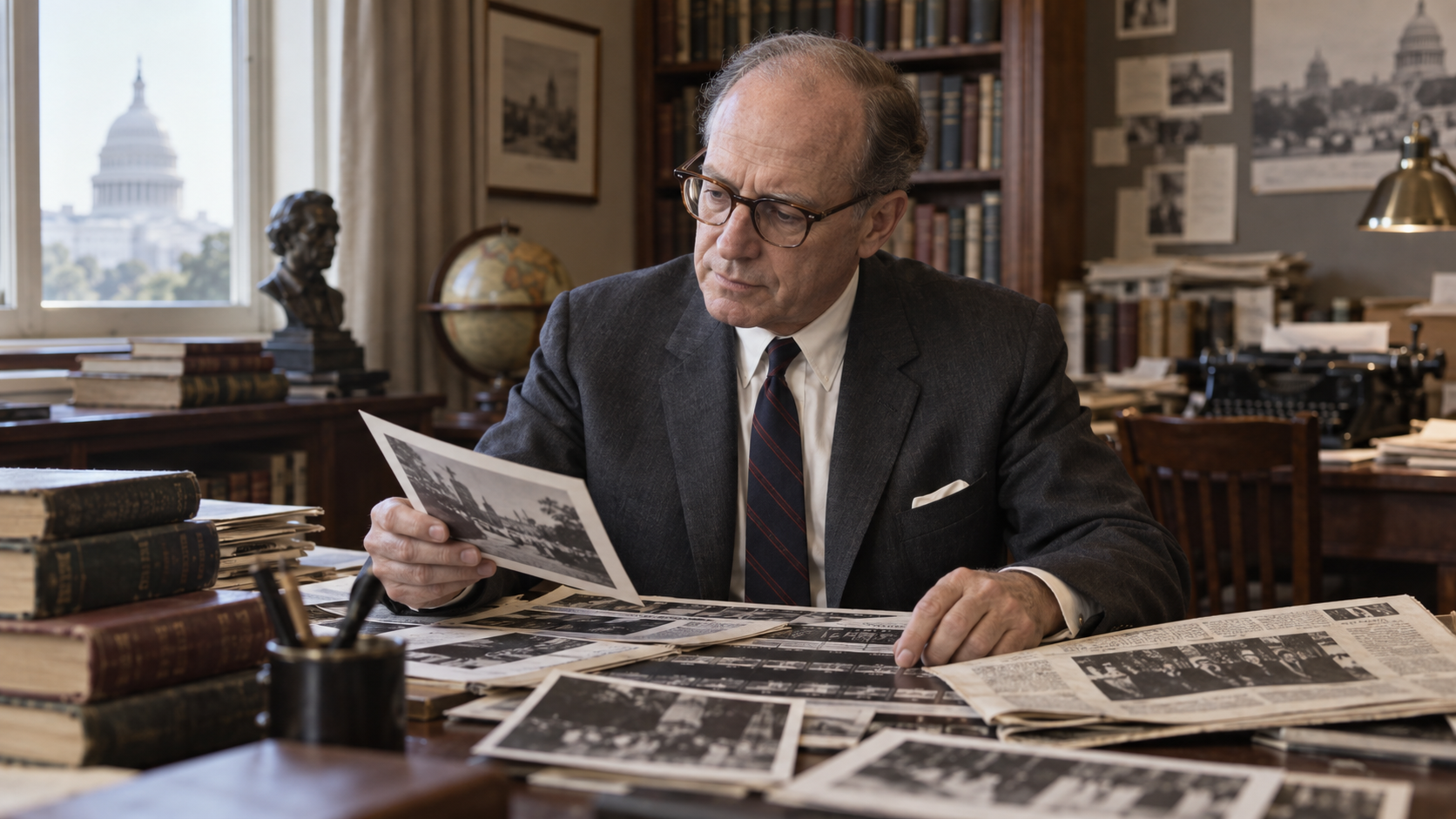
“The image is more interesting than its original.”
Daniel J. Boorstin published this observation in The Image, his 1961 study of what he called pseudo-events: occasions planned mainly so they can be reported, photographed, and repeated. He saw a culture learning to prefer a polished representation to the complicated reality behind it. The line does not mean that every image is false. It identifies an incentive problem. Public figures, institutions, and advertisers can design scenes that satisfy the needs of cameras and headlines while concealing the conditions that matter. For journalism, the task is therefore not merely to record what was presented, but to ask who arranged it, for what audience, and what remained outside the frame.
A strong newsroom treats spectacle as a starting point rather than proof. Reporters should compare a staged announcement with budgets, contracts, timelines, independent witnesses, and measurable outcomes. Photo captions should say when an image is a handout, reenactment, file photograph, or composite. Editors should resist letting a dramatic visual outrun the evidence in the story. When a press conference, product launch, or viral clip dominates attention, the reporting should explain how the moment was produced and whose interests it serves. Transparency about access and sourcing helps readers distinguish an observed event from a performance supplied for publication.
Boorstin’s sentence can be taken too far if it encourages blanket suspicion of visual journalism. Photographs and video can document abuse, preserve testimony, and reveal facts that power would prefer to hide. The danger lies not in imagery itself but in treating appearance as self-interpreting. A truthful photograph can still be cropped misleadingly, stripped of time and place, or paired with an inaccurate caption. Conversely, a carefully produced image may contain genuine information. Verification must examine provenance, sequence, editing, and context without assuming that polish proves deception or that roughness proves authenticity.
The warning has intensified in an era of influencer politics, synthetic media, livestreamed conflict, and algorithmic promotion. A scene can be designed for a vertical screen, distributed through coordinated accounts, and remembered more vividly than any correction. News organizations need visual-forensics routines, original-file requests, reverse-image checks, clear labels, and follow-up reporting on what happened after the cameras left. They should also show readers the documents and testimony that support or complicate the picture. Reporters can revisit celebrated announcements months later, compare promised results with actual outcomes, and give affected communities room to describe what the original performance omitted. That follow-through turns skepticism into evidence rather than attitude. Boorstin’s lasting insight is that journalism earns trust by moving past the compelling image to the reality that produced it—and by making that investigative path visible.
Boorstin developed the idea in The Image (1961), describing pseudo-events created largely to attract coverage. His concern was that planned appearances could become more memorable than the underlying reality.
The quote is not an argument against photography. It is a warning to verify provenance, staging, captions, sequence, and omitted context before treating a visual as complete evidence.
Synthetic media and algorithmic feeds reward striking representations. Newsrooms can respond with visual forensics, transparent sourcing, original files, and reporting that looks beyond the staged moment.
Explore more "Quotes of The Day"
Discover more notable quotes from influential voices across politics, science, business, technology, sports, and culture. Each quote offers insight into how ideas, beliefs, and decisions shape the world around us.