

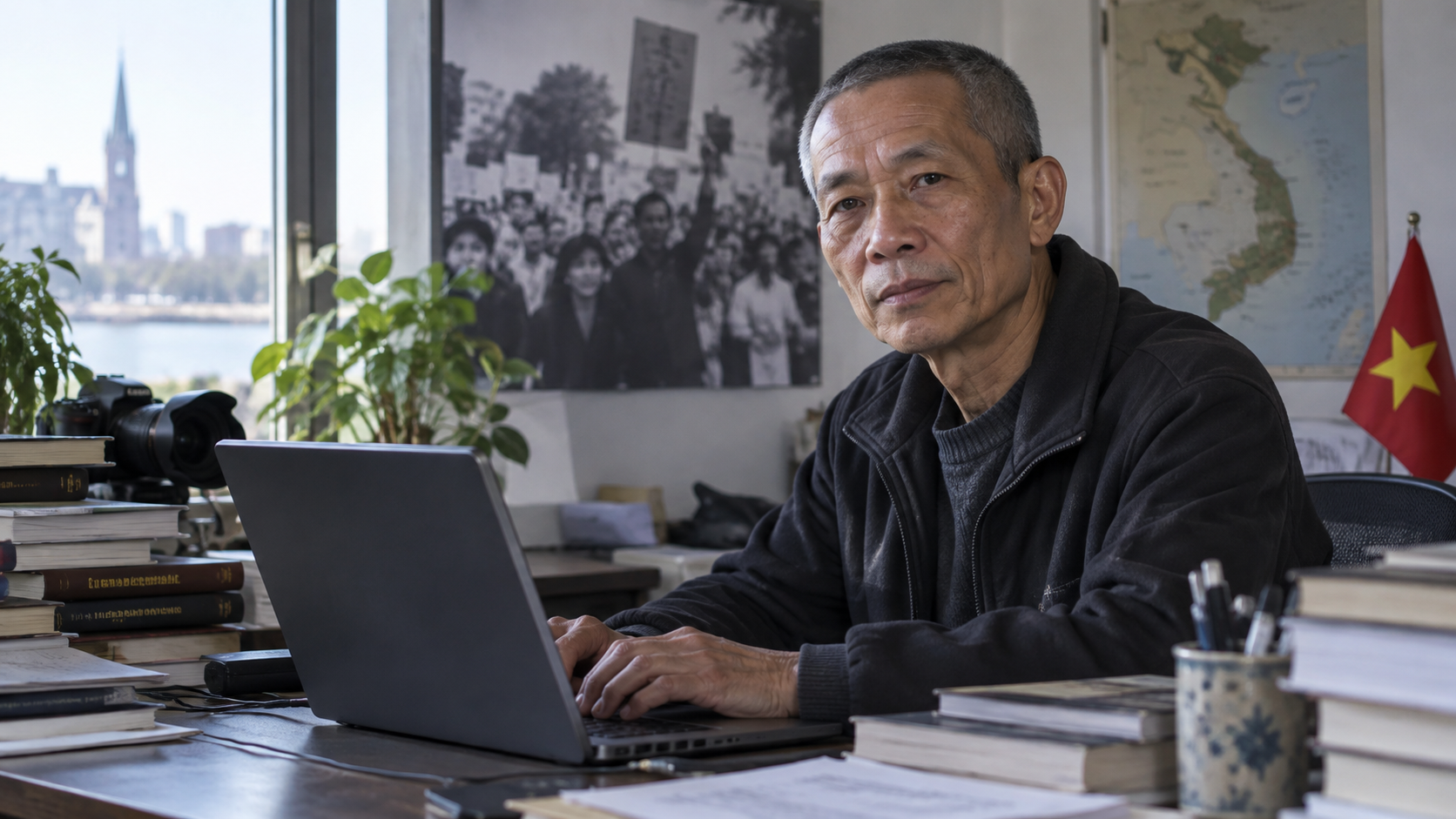
“I must continue my struggle so that one day they all will also be free.”
Vietnamese blogger Nguyen Van Hai, also known as Dieu Cay, delivered this promise after his release from prison and forced exile in 2014. He had co-founded the Free Journalists Club of Vietnam and written about corruption, protests, and other politically sensitive subjects. Authorities imprisoned him on tax charges criticized as a pretext and later imposed a long sentence under an anti-state law. In his Committee to Protect Journalists speech, Hai acknowledged the international campaign that supported his release while emphasizing that colleagues remained behind bars. Freedom, in his formulation, created a responsibility to keep attention on people whose voices authorities still sought to isolate.
Advocacy for imprisoned journalists must be accurate as well as urgent. Reports should identify the law used, the court, sentence, detention history, health information, access to counsel, and the connection between the case and journalistic work. Claims from relatives, lawyers, officials, and advocacy groups should be attributed and updated as circumstances change. Small factual errors can give authorities an excuse to dismiss a wider pattern. A carefully maintained case record helps audiences, diplomats, and legal organizations understand both the individual harm and the system that produced it.
Digital journalists and bloggers may work without the institutional protection available to traditional newsrooms. Secure account recovery, encrypted communication, distributed archives, and trusted contacts become essential before a crisis. Platforms and editors should minimize retained identifying data and explain the limits of anonymity honestly. When a person is detained, colleagues should preserve their published work, avoid exposing confidential sources, and coordinate publicity with family and counsel. More attention is not always safer; the people closest to the case should help judge timing and risk.
Hai’s words also address a tension within exile. International visibility can protect a released journalist and expand the reach of their advocacy, but distance can make verification harder and place contacts at home in danger. Responsible exile reporting uses multiple sources, states uncertainty, and avoids presenting one person’s experience as the whole country. Solidarity becomes durable when it supports local journalists with resources, translation, legal assistance, and credit while respecting their security decisions. The quote remains a reminder that release is not the end of the story. It should lead to careful documentation of those still detained, sustained pressure for fair treatment, and preservation of the work officials attempted to suppress. One journalist’s freedom matters most when it widens the space for others to report, question, and speak without punishment. Newsrooms can reinforce the practice by timestamping updates, preserving visible correction notes, and assigning verification roles during major events. Those routines turn candor about uncertainty into a repeatable production standard instead of leaving it to an individual reporter’s confidence under pressure.
Hai made the promise in 2014 after release and forced exile, while fellow bloggers and journalists remained imprisoned in Vietnam for peaceful expression.
Credible prisoner advocacy records laws, proceedings, sentences, health, counsel access, and the link to journalism, while attributing claims and updating changes precisely.
Secure accounts, distributed archives, family-led risk decisions, legal coordination, and careful exile verification protect both detained journalists and sources who remain inside the country.
Explore more "Quotes of The Day"
Discover more notable quotes from influential voices across politics, science, business, technology, sports, and culture. Each quote offers insight into how ideas, beliefs, and decisions shape the world around us.