

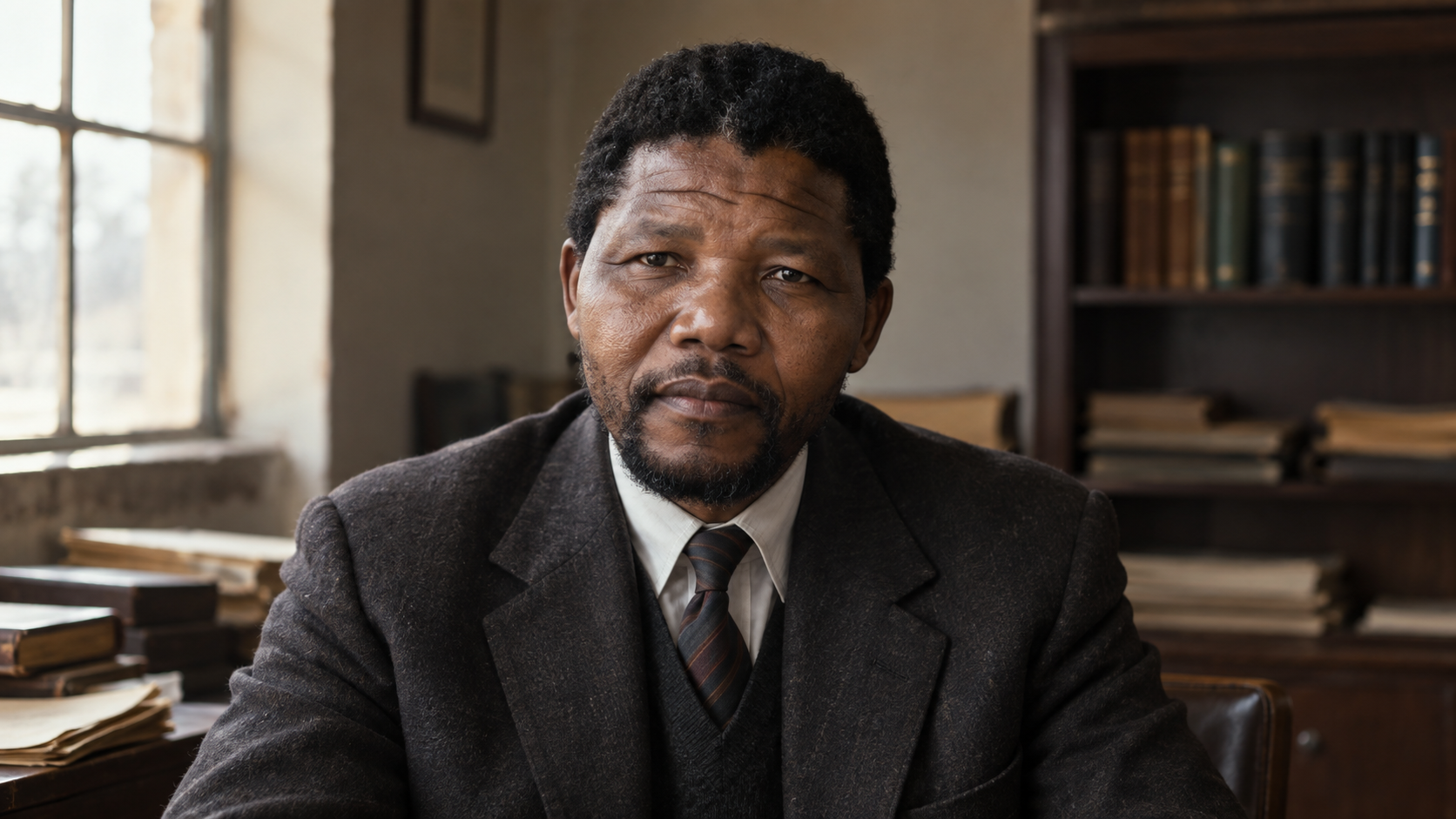
“I have fought against white domination, and I have fought against black domination.”
Nelson Mandela spoke these words from the dock at the Rivonia trial in 1964. His statement addressed the struggle against apartheid and explained the political convictions behind his actions. The selected sentence belongs to the closing passage, where he described an ideal of a democratic society in which people could live together with equal opportunities. Its two clauses matter together. Opposition to white domination named the actual racial order that denied the majority equal political standing. Opposition to black domination described a limit on the society he wanted to build in its place. The sentence did not make the two situations historically interchangeable. It set out a principle that the removal of an oppressive system should create common citizenship rather than establish another racial claim to rule. The setting was a criminal trial with grave consequences, giving the statement a seriousness that can disappear when it is reproduced as a detached inspirational quotation.
The political distinction is between obtaining power for a previously excluded group and designing a government in which race does not determine entitlement to power. Those aims can intersect, but they are not identical. A group may need organization and representation to challenge its exclusion; the resulting institutions still require standards that protect everyone. Mandela’s closing argument links freedom with democracy and equal opportunity, so it should be read as a description of a desired public order. It is not a claim that reconciliation can substitute for confronting apartheid, or that an appeal to unity makes existing inequality irrelevant. Nor does this single sentence settle every question about the means used in the liberation struggle. The full statement discusses those questions at length. Keeping the excerpt attached to its source lets readers distinguish the ideal being defended from every action undertaken in pursuit of it, without erasing either the oppressive circumstances or the responsibilities of those seeking change.
A useful contemporary question follows: what would stop a victorious movement from treating political authority as permanent possession? Elections, equal rights, open criticism, and institutions that can review official decisions all influence whether a promise of common citizenship has practical force. The quotation gives readers a standard for examining those arrangements, but no automatic certificate of success to a party or leader who invokes it. People who suffered exclusion must have a meaningful voice, while membership in a favored group must not become a substitute for accountable conduct. That balance requires attention to actual rules and outcomes. Mandela’s sentence remains significant because it places a boundary on the goal of liberation itself. Freedom is incomplete if a new government merely changes the identity of those entitled to dominate. The aspiration is a shared political community in which dignity and opportunity are protected across racial boundaries. January 28 is the date assigned to this series entry, rather than the anniversary of the Rivonia statement.
Mandela delivered his statement from the dock during the Rivonia trial in 1964. The quotation comes from its closing passage.
He described a democratic society with equal opportunities as the political ideal for which he had struggled.
The sentence opposes apartheid while refusing racial domination as a principle for a future government.
Its two clauses do not imply that white and black domination were equivalent historical conditions in apartheid South Africa.
The ideal invites scrutiny of whether institutions create equal citizenship and hold those in power accountable.
Invoking Mandela does not establish that a policy meets his stated standard. Rules, access, and outcomes must be examined.
Explore more "Quotes of The Day"
Discover more notable quotes from influential voices across politics, science, business, technology, sports, and culture. Each quote offers insight into how ideas, beliefs, and decisions shape the world around us.