

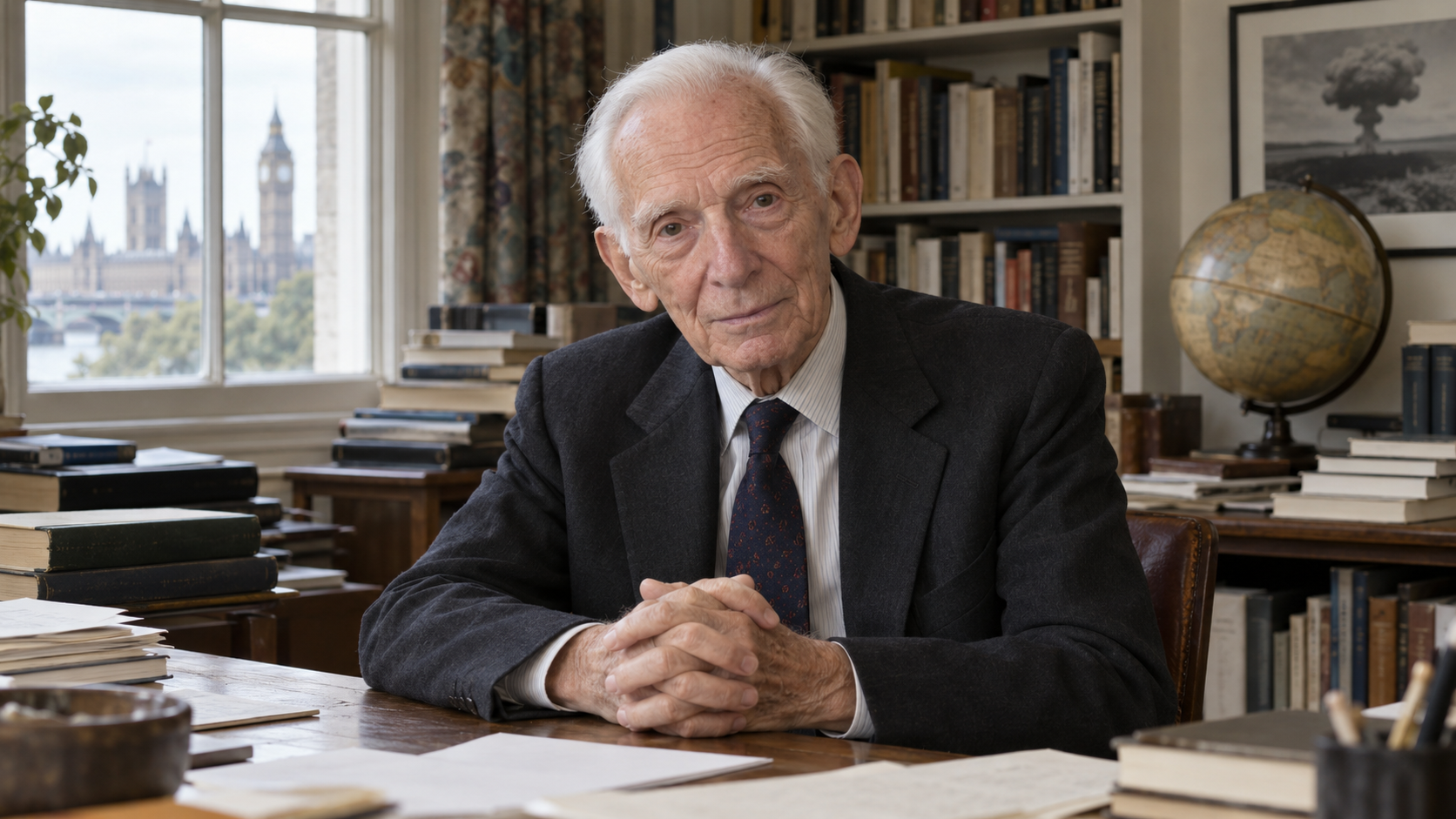
“The quest for a war-free world has a basic purpose: survival.”
Joseph Rotblat included this statement near the conclusion of his 1995 Nobel lecture, Remember Your Humanity. The physicist shared the Peace Prize with the Pugwash Conferences on Science and World Affairs for their work toward nuclear disarmament. His lecture joined scientific responsibility with a political appeal to protect humanity. The short sentence gives that appeal a clear foundation: avoiding war is a matter of continued human existence. It asks readers to judge security arrangements by whether they preserve the future that every other public ambition depends upon.
Survival can sound like a minimal objective, but it changes the scale of political reasoning. A government ordinarily answers to a particular population, while the consequences of certain decisions can reach far beyond its borders. The quotation draws attention to that mismatch. When an action can place many societies at risk, national advantage alone becomes an inadequate measure of success. Leaders need to consider whether their choices leave room for everyone to continue living and making choices. That responsibility does not erase legitimate disagreements. It establishes a common interest that should remain visible while those disagreements are managed.
Rotblat’s argument also makes prevention a continuing task. A disaster avoided once may remain possible if the conditions that could produce it stay in place. Public institutions therefore need reliable communication, careful verification, and opportunities for cooperation that survive moments of tension. Specialists have a role in explaining what is known and what remains uncertain. Citizens have a role in asking whether official assurances depend on assumptions that deserve scrutiny. A promise of safety becomes stronger when the reasons behind it can be examined and when procedures are designed to handle mistakes, rather than requiring everyone to behave perfectly under pressure.
The statement’s enduring value lies in its ability to bring distant consequences into a present decision. Survival is not an issue that can be postponed until every other policy dispute has been settled. It is the condition that allows future generations to inherit institutions, cultures, and opportunities at all. Readers can use that perspective when considering arms policy, international dialogue, or research with potentially destructive applications. The quotation is a broad ethical claim, not a detailed plan for resolving every conflict. Its contribution is to insist on the purpose against which such plans should be measured: a world in which people can continue to live, cooperate, and build something better. That purpose provides a demanding standard for political judgment.
Rotblat’s 1995 Nobel lecture linked nuclear disarmament with the responsibilities of scientists, governments, and citizens.
He shared the prize with Pugwash, the international network through which scientists worked across political divisions.
The quotation identifies shared survival as a foundation that national security policies should preserve.
Its meaning extends beyond avoiding a single crisis to the continuing work of reducing the conditions that make catastrophe possible.
Reliable communication, verification, and careful public scrutiny can turn concern about distant risks into practical prevention.
The statement supplies an ethical purpose for policy rather than a complete prescription for resolving every international dispute.
Explore more "Quotes of The Day"
Discover more notable quotes from influential voices across politics, science, business, technology, sports, and culture. Each quote offers insight into how ideas, beliefs, and decisions shape the world around us.