

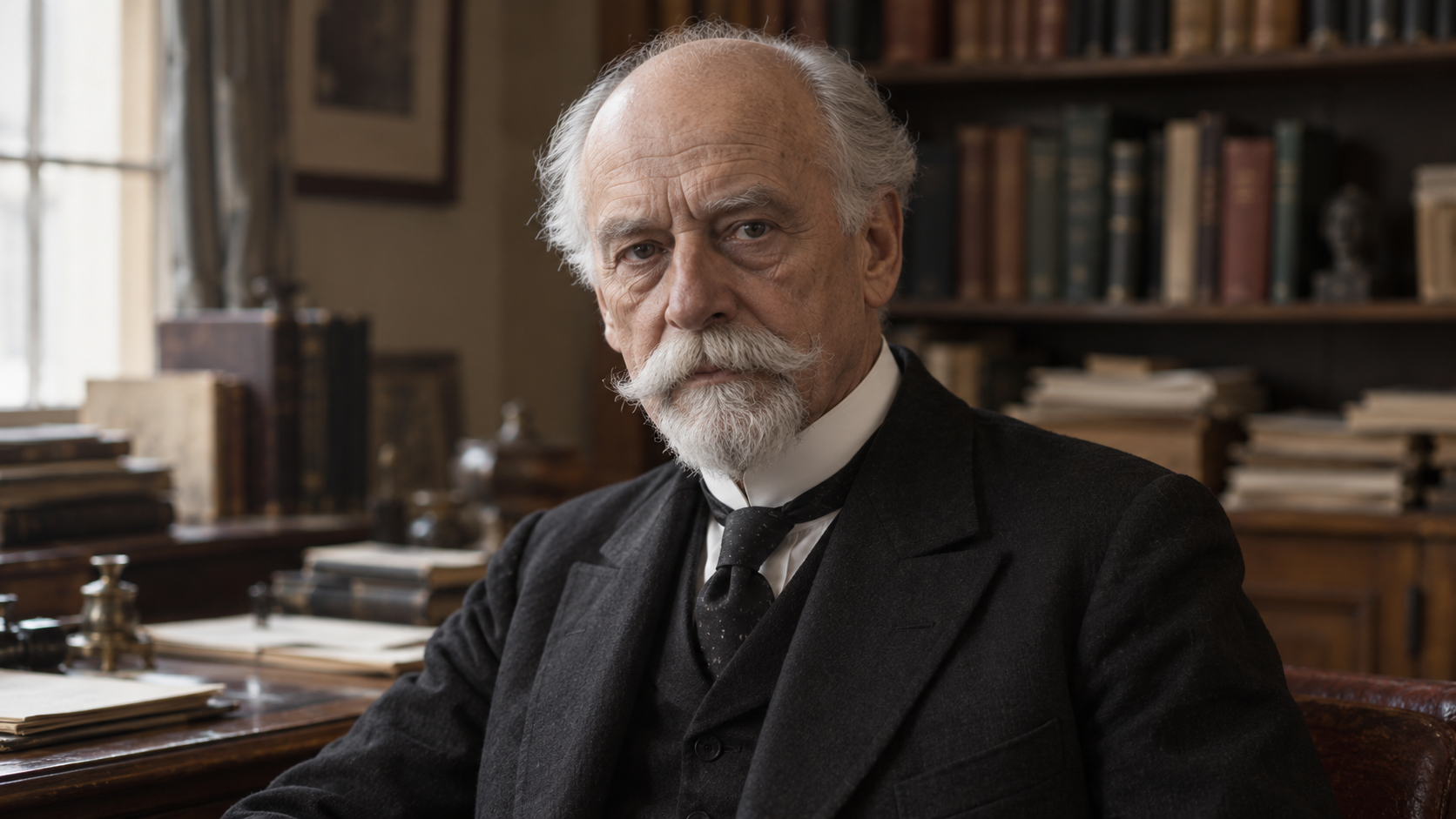
“In life, particularly in public life, psychology is more powerful than logic.”
Ludwig Quidde made this observation while considering why governments hesitate to reduce armaments. It appears in the English translation of Security and Disarmament, an essay published in German in April 1931. The essay drew on his 1927 Nobel lecture but included later material; the Nobel Foundation’s editorial note explains that distinction. Using 1931 here identifies the published text rather than claiming every sentence belongs to a preserved transcript of the earlier speech. Quidde’s immediate example was a proposal for simultaneous, proportionate reductions. If all countries reduced equally, the reasoning went, their relative military position could remain unchanged while the financial burden became smaller.
Quidde accepted the logic of that example and then pointed to its political weakness: governments that distrust one another may refuse it. A calculation can describe the outcome if every participant does what was agreed, while leaving unresolved the fear that another participant will cheat or gain an advantage. His sentence directs attention to that gap between a proposed arrangement and the willingness to accept it. Psychology here concerns expectations, suspicion, and the perception of danger. It is not a claim that irrationality should guide policy or that evidence is useless. A successful proposal must address the conditions under which people believe its promises, as well as the reasoning that supports them.
The larger essay treated security and disarmament as connected problems. Quidde resisted the notion that simply removing weapons would eliminate the causes of war. He also rejected the opposite conclusion that limiting weapons was pointless until perfect peace existed. Military expenditure burdened social and economic life, and an arms race could itself intensify fear. An agreement that reduced those pressures could demonstrate a willingness to cooperate. His analysis therefore made progress reciprocal: a greater sense of security might permit reductions, while successful reductions might strengthen confidence. That sequence describes a possible political process, not a mathematical law or a prediction that interwar institutions were certain to succeed.
The distinction remains useful wherever a negotiated reform asks participants to accept a shared risk. A policy designer may see an efficient arrangement; affected people may see a promise whose reliability has not been established. Explaining the arithmetic again does not necessarily answer that concern. Clear procedures, credible oversight, ways to resolve disagreements, and evidence of consistent performance can matter to acceptance. These are applications of Quidde’s argument rather than a ready-made design for any present arms agreement. They also impose a discipline on appeals to trust: reassurance should be connected to arrangements that others can examine. Taking psychology seriously can improve the work of reason by identifying which doubts a proposal still needs to answer.
The published essay dates to April 1931 and was based on a lecture delivered in December 1927. The official editorial note warns that revisions and additions separate the two versions.
The quotation follows a discussion of equal proportional reductions in armaments. Quidde contrasted their apparent logical balance with governments’ unwillingness to act under distrust.
His observation concerns the credibility of commitments. An agreement’s expected benefits may depend on conduct that participants do not yet trust others to perform.
Quidde linked disarmament and security without insisting that either must be completed before the other begins. Limited progress in one could support progress in the other.
Negotiation requires attention to how people understand risk, alongside the proposal’s formal reasoning. Unanswered fears can obstruct an otherwise coherent plan.
Trust can be supported by observable conduct and procedures for disputes. Invoking it without such support may leave the central political problem untouched.
Explore more "Quotes of The Day"
Discover more notable quotes from influential voices across politics, science, business, technology, sports, and culture. Each quote offers insight into how ideas, beliefs, and decisions shape the world around us.