

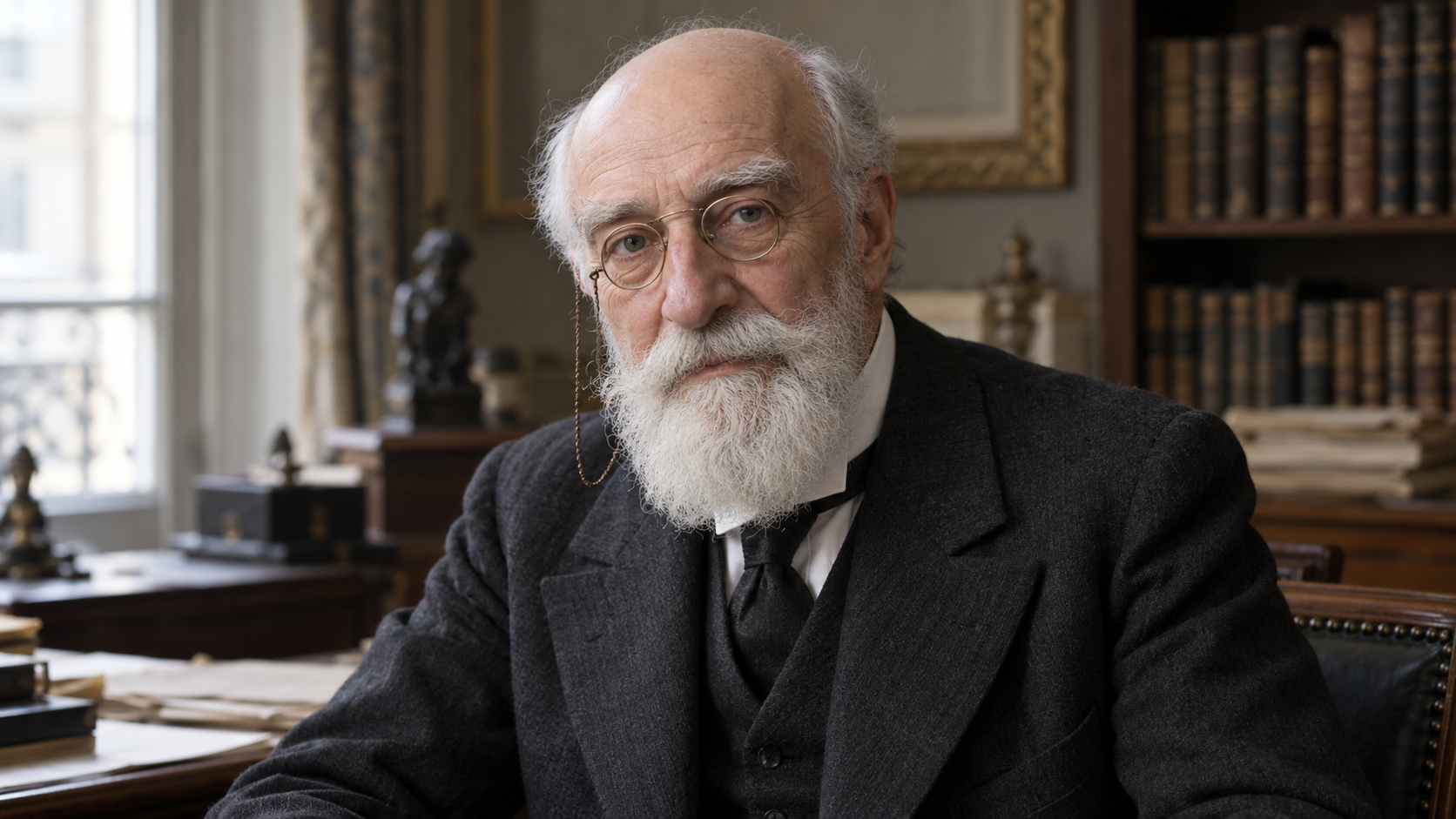
“The concept of patriotism is not incompatible with that of humanity”
Léon Bourgeois wrote these words in a communication sent to the Nobel Committee in December 1922. Illness prevented him from delivering the lecture associated with his 1920 Peace Prize. His text, The Reasons for the League of Nations, defended international organization after the destruction of the First World War. The displayed passage is an excerpt from the official English translation, compared with the French original. Bourgeois addressed a central objection to cooperation: that loyalty to one’s nation must conflict with obligations toward people beyond its borders. He argued instead that a nation could express its independence through agreements that helped sustain a common peace.
His reasoning began with the state as the basic participant in international organization. He did not propose dissolving countries into a government imposed from outside. Rather, he compared agreement among states with a contract freely accepted by individuals. Accepting an obligation could be an exercise of freedom, provided the parties understood it and consented to it. This comparison explains the quotation’s place in the essay. A country could retain its identity while recognizing that its security depended on relationships with other countries. Patriotism, in that account, could include work to prevent wars that would damage both its own population and the wider human community.
The essay offered three conditions for an effective organization: enough common understanding to agree on principles, voluntary acceptance of the rules and any associated sanctions, and an impartial tribunal to interpret them. Those conditions were aspirations, not proof that the League had achieved equal treatment. Bourgeois’s account also used colonial hierarchies and assumptions about which peoples were ready to govern themselves. These sit uneasily beside his claim to universal humanity and must be recognized as limits of the argument. His optimism about the postwar settlement similarly should not be confused with knowledge of its later results. A careful reading separates his proposed relationship between consent and cooperation from the inequalities present in the world he described.
The passage can help frame a political disagreement without deciding it in advance. When people debate an international commitment, useful questions include what obligations it creates, who accepts them, how disputes are judged, and whether the rules apply fairly. Supporting cooperation does not remove the need to scrutinize those details. Defending national independence also does not establish that isolation serves a country’s interests. Bourgeois’s contribution is the possibility of considering both commitments together. A government may judge that a freely accepted rule protects its people more effectively than unrestricted discretion would. Whether that judgment is sound depends on the agreement’s actual terms and operation, rather than on a slogan about either patriotism or humanity.
Bourgeois submitted the text in December 1922 because illness prevented his planned appearance. The quotation’s year therefore differs from his 1920 Nobel award.
The English passage is a short excerpt checked against the corresponding French discussion of patriotism and humanity.
His analogy treats an international agreement as a deliberate use of sovereignty. He rejected an imposed superstate in favor of consent among participating states.
His universal language coexisted with colonial assumptions in the essay. That contradiction limits how the argument can be presented as a model of equal humanity.
The proposal makes consent, impartial adjudication, and shared principles central to cooperation. Each requires examination in practice.
A debate about an international obligation can ask whether it serves national interests and wider welfare at the same time. The quotation makes those aims compatible, without guaranteeing any particular agreement succeeds.
Explore more "Quotes of The Day"
Discover more notable quotes from influential voices across politics, science, business, technology, sports, and culture. Each quote offers insight into how ideas, beliefs, and decisions shape the world around us.