

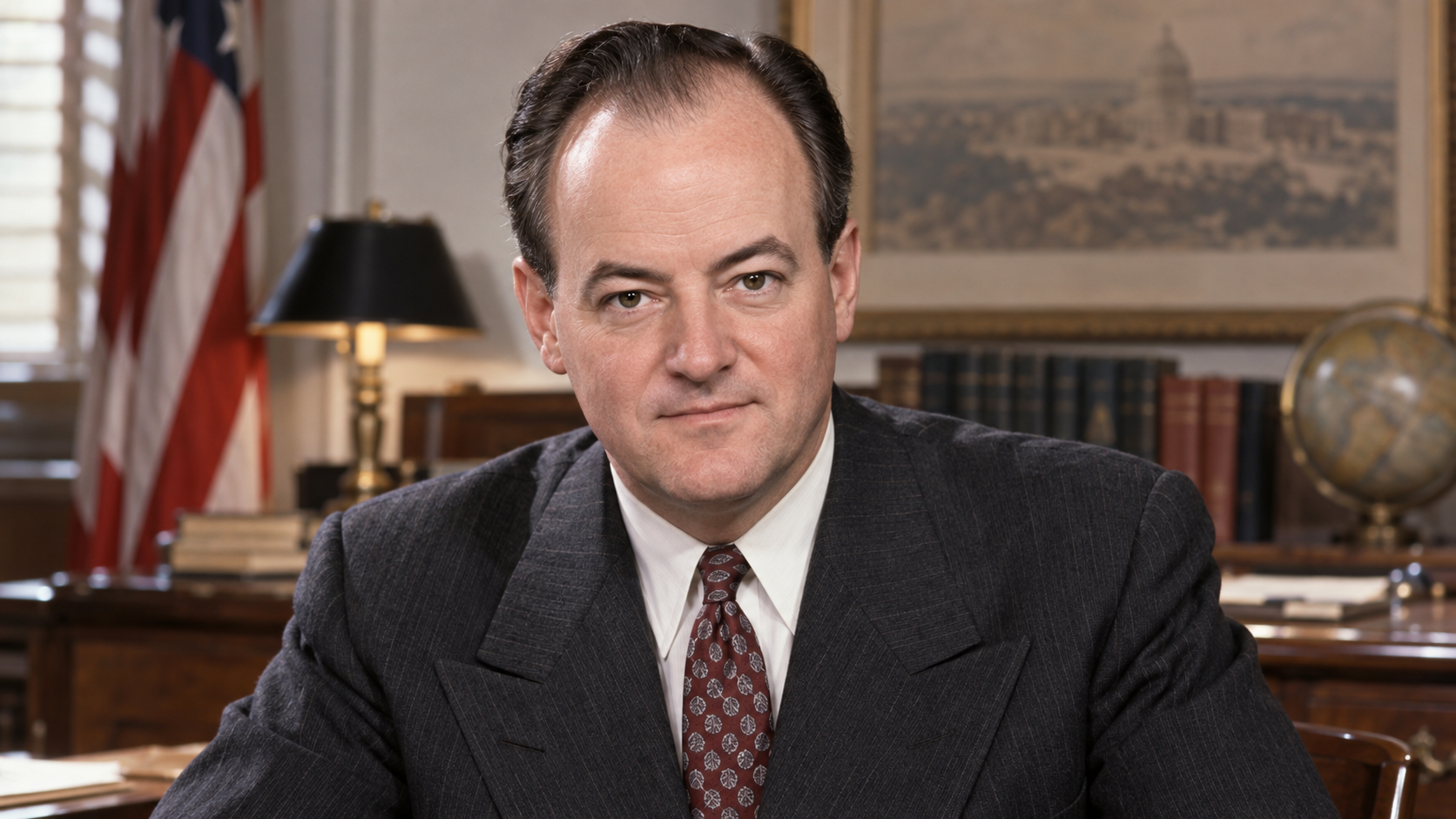
“Our demands for democratic practices in other lands will be no more effective than the guarantee of those practices in our own country.”
Hubert Humphrey was mayor of Minneapolis when he addressed the Democratic National Convention in Philadelphia on July 14, 1948. He urged delegates to support a stronger civil-rights commitment in the party platform. In a speech about Americans' rights, he also raised a question of international credibility: what authority could the United States claim when asking other countries to practice democracy while tolerating discrimination within its own borders? The quotation connects foreign policy to domestic conduct without treating either as a separate moral universe. It comes from the convention address, not from an event associated with the calendar date assigned to this post.
Humphrey's word guarantee gives the argument its force. A government can endorse democratic ideals in a platform or diplomatic statement without securing their exercise in daily life. The test is whether people can actually participate in public affairs and receive equal protection. His convention argument concerned concrete civil-rights commitments, including political participation and equal treatment, rather than a vague appeal to national kindness. Seen in that setting, the passage makes credibility an outcome of institutions and behavior. The rights a country demands elsewhere are persuasive only to the extent that its own citizens can rely on them at home.
The speech also reveals the political cost of applying a declared principle consistently. Humphrey's intervention challenged Democrats who resisted a stronger civil-rights plank, and the convention's adoption of that position contributed to a party rupture. The Minnesota Historical Society describes the address as a decisive step into national politics for him. Yet the quotation should not be expanded into a claim that domestic reform immediately removes every international obstacle. Other governments have their own interests, and even a country improving its record may struggle to persuade them. His point was that a double standard weakens an argument before that wider contest has even begun.
For readers, the passage provides a useful discipline when assessing claims of leadership. Compare the standard being promoted with the arrangements maintained by the speaker. A demand for fair elections, equal citizenship, or accountable government carries more weight when it is accompanied by scrutiny of one's own institutions. That comparison need not become an excuse to abandon democratic principles whenever their advocates fall short. It can instead identify work required to make the advocacy credible. Humphrey placed responsibility where national rhetoric often places reassurance: inside the country doing the speaking. A democratic example has to be built through the treatment of actual people, not simply announced to the world.
The speaker was Minneapolis mayor Hubert Humphrey, not yet a United States senator or vice president. The setting was the 1948 Democratic National Convention's debate over its civil-rights platform.
The passage sits beside a rejection of double standards. Humphrey linked equal political participation at home to the credibility of American democratic leadership abroad.
Guarantee here points beyond a declaration of sympathy. It asks whether democratic rights are sufficiently protected to be exercised by the people entitled to them.
The convention adopted a stronger civil-rights position amid resistance from segregationist Democrats. The resulting division shows why consistent standards can demand a real political choice rather than a harmless statement of shared values.
The argument can guide scrutiny of any government that champions rights internationally. Its conduct toward its own citizens remains relevant to how that advocacy is received.
Credibility is not the same as automatic diplomatic success. Humphrey's claim identifies an avoidable weakness in democratic advocacy; it does not suggest that a better domestic record eliminates conflict between countries.
Explore more "Quotes of The Day"
Discover more notable quotes from influential voices across politics, science, business, technology, sports, and culture. Each quote offers insight into how ideas, beliefs, and decisions shape the world around us.