

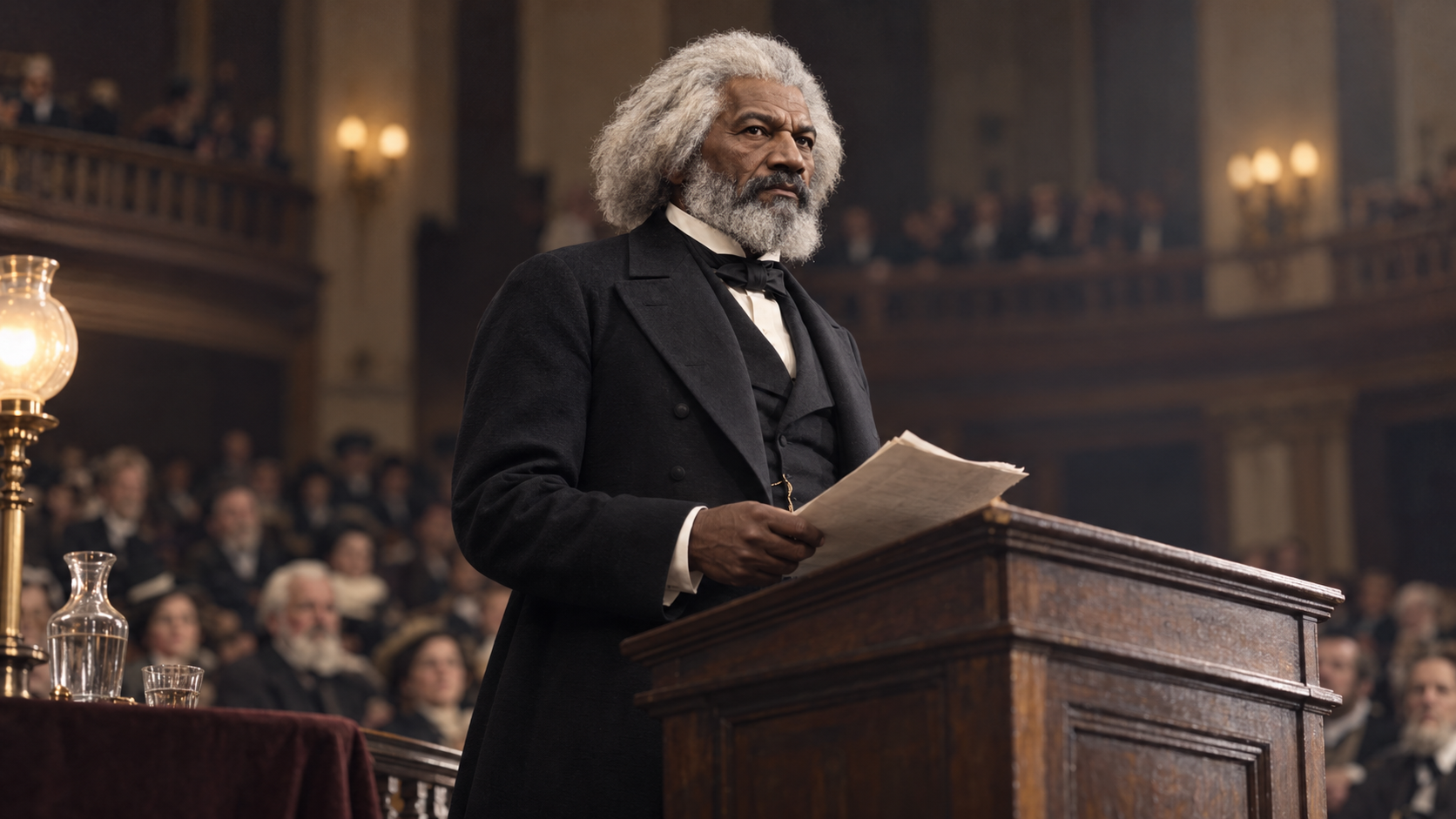
“I would unite with anybody to do right and with nobody to do wrong.”
The featured words from Frederick Douglass come from Life and Times of Frederick Douglass, published in 1881 and expanded in 1892. Douglass used the line to explain why he rejected a politics that made moral purity depend on refusing cooperation with imperfect allies. After emancipation, he continued to press for Black citizenship, voting rights, education, women's suffrage, and federal protection against racial violence while navigating disagreements within reform movements. The quotation reads: 'I would unite with anybody to do right and with nobody to do wrong.' October 2 is its calendar assignment in this series; the historical date is given here so the words are not mistaken for a statement made on this day.
The sentence joins coalition building to a firm ethical boundary. Partnership is justified by the right being pursued, while loyalty ends when participation would advance a wrong. The phrasing compresses a larger political argument into a memorable standard, but its force depends on the relationships it names: between citizen and state, principle and practice, or power and accountability. Read in context, it asks who can act, whose experience becomes visible, and what institutions must do. This approach moves attention beyond admiration for a speaker and toward the rules, incentives, and distribution of practical power that made the statement necessary.
The formula does not settle every dispute about what counts as right or how much compromise a coalition should accept. Those judgments still require evidence, accountability, and attention to who bears the cost. That qualification does not erase the quotation; it defines the work required to use it responsibly. Historical reputation cannot settle the issue. A serious reading keeps achievement beside contradiction and later outcomes, while distinguishing the claim's strongest principle from uses the record cannot support. The words should open examination rather than close disagreement, especially where translation, transcription, institutional position, or unequal risk affects what an audience hears.
Modern movements often need broad alliances without surrendering their purpose. Douglass's rule asks participants to evaluate conduct and goals continuously instead of treating either cooperation or separation as an automatic virtue. Applied now, the quotation becomes a method rather than an ornament. Readers can compare official ideals with law, budgets, enforcement, access, representation, and lived results, then decide what repair or restraint the evidence requires. That judgment should include people most affected by the policy at issue and should remain open to revision when facts change. Political memory has value when it sharpens public responsibility in the present instead of turning a complicated figure or moment into a harmless slogan.
Douglass used the line to explain why he rejected a politics that made moral purity depend on refusing cooperation with imperfect allies.
After emancipation, he continued to press for Black citizenship, voting rights, education, women's suffrage, and federal protection against racial violence while navigating disagreements within reform movements.
The sentence joins coalition building to a firm ethical boundary. Partnership is justified by the right being pursued, while loyalty ends when participation would advance a wrong.
The featured wording is part of a larger argument, so its political meaning depends on the institution, audience, and conflict surrounding it rather than on the isolated sentence alone.
The formula does not settle every dispute about what counts as right or how much compromise a coalition should accept. Those judgments still require evidence, accountability, and attention to who bears the cost.
Modern movements often need broad alliances without surrendering their purpose. Douglass's rule asks participants to evaluate conduct and goals continuously instead of treating either cooperation or separation as an automatic virtue.
Explore more "Quotes of The Day"
Discover more notable quotes from influential voices across politics, science, business, technology, sports, and culture. Each quote offers insight into how ideas, beliefs, and decisions shape the world around us.