

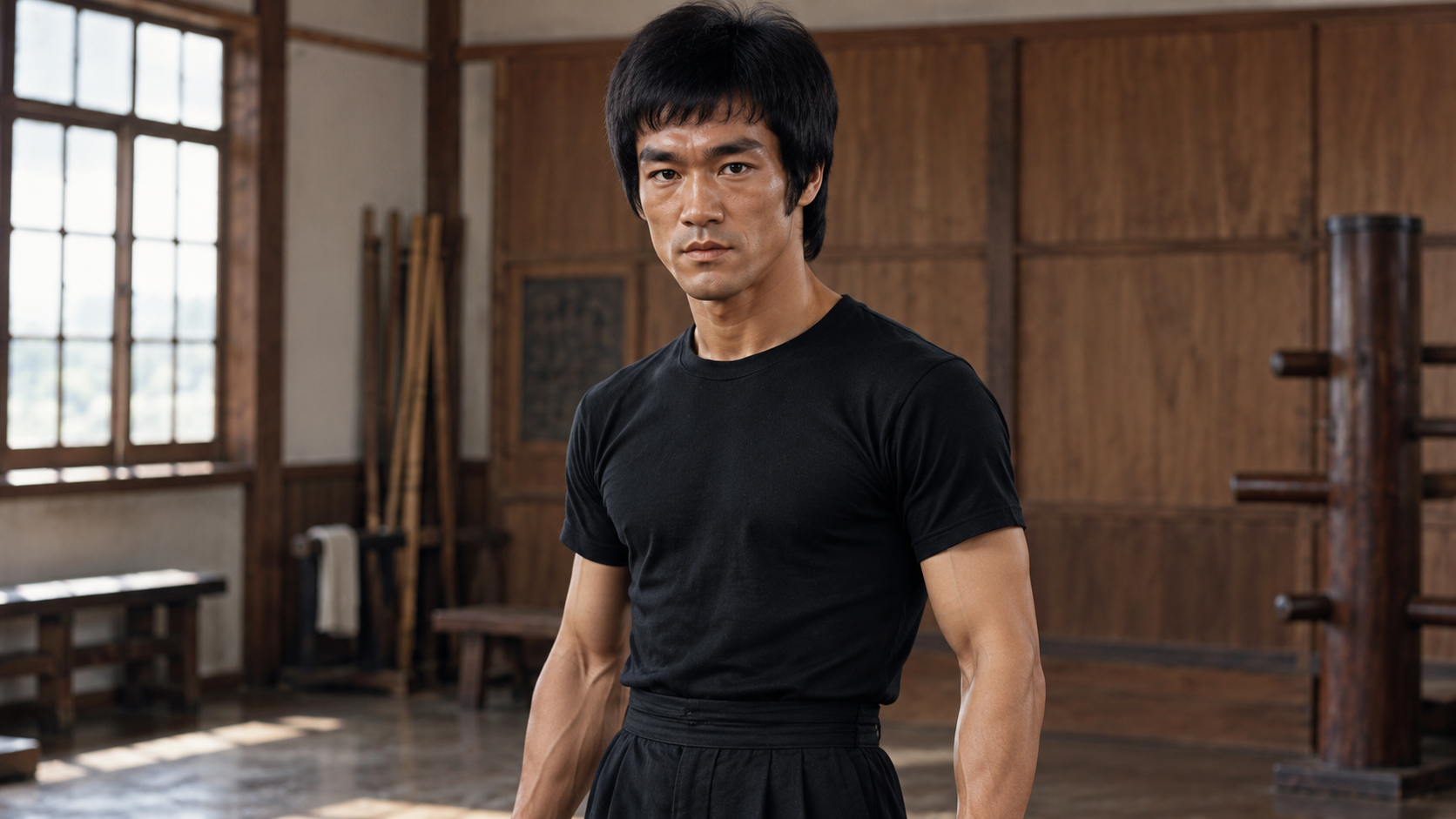
“Absorb what is useful. Reject what is useless. Add what is essentially your own.”
Bruce Lee’s official estate preserves the instruction, “Absorb what is useful. Reject what is useless. Add what is essentially your own,” among the core philosophies drawn from his notes and practice. The idea also appears in accounts of his martial thinking published after his death, including the 1975 Tao of Jeet Kune Do. Lee resisted rigid loyalty to a style when that loyalty replaced observation. His method was comparative and practical: study widely, test ideas against experience, and let the result become an honest expression rather than an imitation of the teacher.
The sequence of verbs is important. Absorb comes before reject; criticism should follow genuine attention rather than reflexive dismissal. Reject then protects a learner from collecting techniques simply because they carry prestige or tradition. Add completes the movement by making originality a responsibility. In Lee’s films and martial arts, that philosophy joined physical economy with theatrical clarity. The result looked distinctive not because it had no influences, but because influences had been examined, combined, and transformed by a particular body, temperament, and artistic purpose.
Eclecticism can become shallow if “useful” means only immediately comfortable. Difficult methods often reveal their value slowly, and a beginner may not yet understand why a constraint exists. Lee’s principle therefore requires practice, not casual sampling. It also does not mean stripping ideas from their history or taking credit for another culture’s work. Adding what is your own should include transparent acknowledgment of teachers and sources. Personal expression gains credibility when it shows both independence and respect for the lineages that made experimentation possible.
The quotation maps neatly onto modern creative work, where tutorials, references, styles, and tools are available in overwhelming abundance. Instead of copying an entire workflow, choose one technique, define what problem it should solve, and test it in a small project. Record what improved, what became awkward, and what unexpected choice felt recognizably yours. Repeat with another influence, keeping the evidence rather than the brand name. Over time, the archive of tested decisions becomes a voice. Lee’s sentence rejects the fantasy that originality appears from nowhere. It describes originality as disciplined selection: learning deeply enough to know what to carry forward, what to leave behind, and what only you can contribute next. The practice grows personal when choices are tested under pressure, credited honestly, and repeated until they become instinct rather than pose. That is adaptation with memory and direction.
The line belongs to Bruce Lee’s documented philosophy of independent inquiry and is preserved by his official estate. Related versions appear in his notes and in posthumous collections of his martial and philosophical writing, including Tao of Jeet Kune Do.
Lee advocates testing influences rather than obeying or dismissing them automatically. The nuance is that a learner needs enough practice to judge usefulness, and ethical adaptation should acknowledge teachers, traditions, and sources instead of erasing them.
Select one technique from an admired creator, define the problem it is meant to solve, and test it in a small project. Keep notes on the result. Your voice develops through repeated, evidence-based choices—not through copying a complete style.
Explore more "Quotes of The Day"
Discover more notable quotes from influential voices across politics, science, business, technology, sports, and culture. Each quote offers insight into how ideas, beliefs, and decisions shape the world around us.