

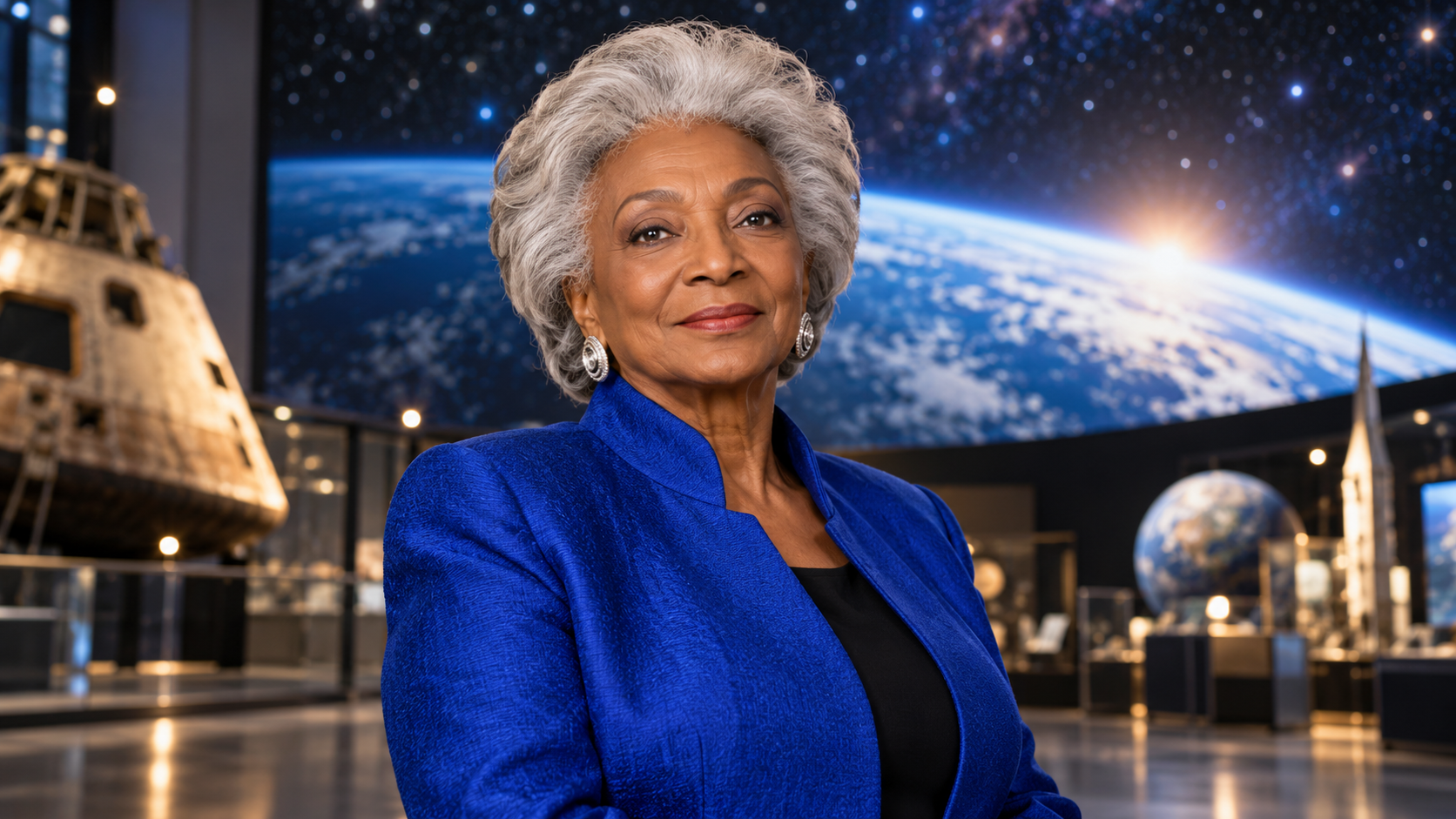
“I stayed, and I never looked back.”
During a 2012 visit to NASA’s Goddard Space Flight Center, Nichelle Nichols recalled the weekend she decided not to leave Star Trek. She had intended to return to theater after the first season. At an NAACP event, Martin Luther King Jr. urged her to recognize what Lieutenant Uhura’s presence meant to Black viewers and to the future he was working toward. Nichols returned to the show and, as she told the Goddard audience, “I stayed, and I never looked back.” The sentence closes a story in which a personal career decision became inseparable from public representation.
Staying changed the meaning of the role. Uhura was not a servant, stereotype, or visitor; she was a skilled officer who belonged on the bridge. That image did not end discrimination, but it made a different future visible during prime-time television. Nichols later carried that symbolic work into a direct relationship with NASA, helping a recruiting campaign encourage women and people of color to apply to the astronaut corps. Popular culture and institutional change were not identical, yet in her career they formed a relay: fiction expanded imagination, and advocacy converted some of that imagination into applications.
The story can sound inevitable in retrospect, which risks hiding the sacrifice inside it. Nichols had artistic ambitions beyond one character and worked in an industry that offered Black women few complex roles. Asking someone to remain for the sake of representation can place a public burden on an individual who is also entitled to change course. Her choice was powerful because it remained a choice. The lesson is not that people from underrepresented groups must accept every symbolic assignment; it is that understanding the possible reach of a decision can change how its costs and opportunities are weighed.
Her words still matter whenever a creative role becomes a reference point for people who rarely see themselves treated as ordinary participants in the future. The practical question for producers is not only who appears, but who belongs, speaks with expertise, and remains important after the promotional moment. For performers and creators, Nichols’s example suggests asking what a platform can become before dismissing it as smaller than the next ambition. Staying is not always courage, and leaving is not failure. The meaningful choice is the one made with a clear view of both personal purpose and public consequence. Nichols stayed, then used the visibility of the role to help widen a real institution’s idea of who could fly.
Nichols recounted the decision at NASA Goddard in February 2012. After telling Gene Roddenberry she planned to leave Star Trek, she met Martin Luther King Jr., who explained the cultural importance of Uhura’s visible, professional presence. She returned and remained with the series.
The choice joined personal ambition with representational impact. It should not become a demand that underrepresented performers carry every public burden. Nichols’s agency matters: she weighed the role’s limits against a newly understood opportunity and made the decision herself.
Evaluate representation beyond casting. Ask whether a character has expertise, continuity, and influence inside the story, and whether creators from that community hold authority behind the camera. Visibility becomes durable when it is connected to belonging and power.
Explore more "Quotes of The Day"
Discover more notable quotes from influential voices across politics, science, business, technology, sports, and culture. Each quote offers insight into how ideas, beliefs, and decisions shape the world around us.