

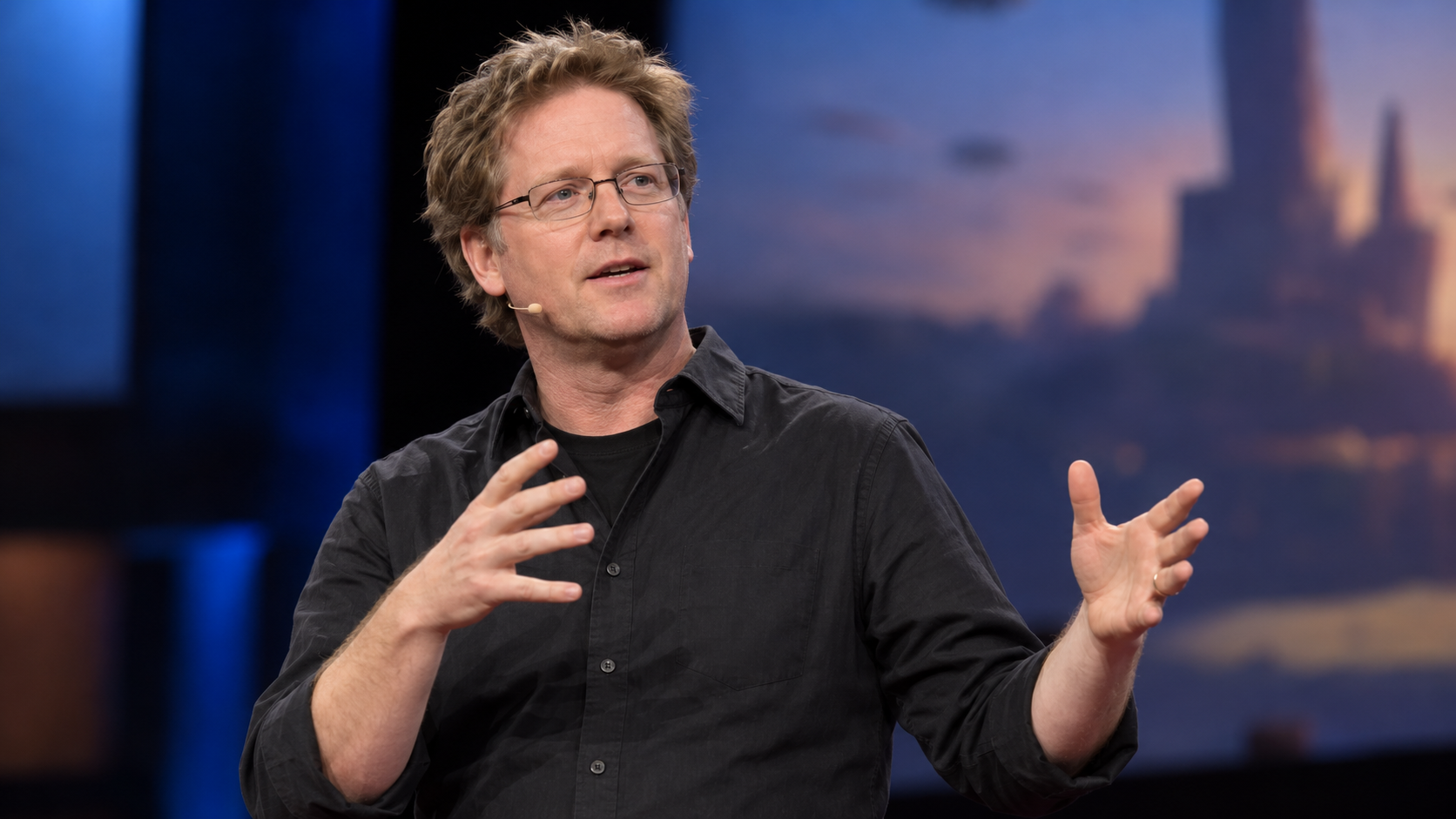
“Storytelling is joke telling.”
Andrew Stanton said, “Storytelling is joke telling.” in 2012. Stanton opened his TED talk with a long joke before explaining that storytelling works through a similar sequence of setup and payoff. The Pixar writer and director asked audiences to make connections rather than receive every answer. His comparison emphasized timing, anticipation, and the carefully managed information that allows a conclusion to feel both surprising and earned. Read in full, the line belongs to a specific public moment rather than a floating piece of motivational language. That setting matters because it shows what problem the speaker was naming and which audience was being asked to respond.
The quotation’s force lies in the way it compresses a larger creative argument. A joke fails when the teller explains the punch line before the audience can participate. Stories also need space for inference. A clue, contradiction, or unanswered desire invites viewers to lean forward and assemble meaning. Stanton’s sentence does not reduce narrative to comedy; it identifies a shared architecture in which order and omission shape emotional response as strongly as the events themselves. In popular culture, a short sentence travels farther than its original speech, but its value depends on keeping the work, relationships, and history around it visible. The line becomes more useful when it changes how a decision is made rather than merely decorating an image.
The useful reading also needs limits. Withholding information can create engagement, but confusion is not automatically mystery. A story owes the audience enough orientation to understand what kind of question is being asked. Different genres and cultures also use timing differently. The principle is not a universal formula. It is a reminder that exposition, revelation, and payoff should be designed around the audience’s experience rather than the creator’s private outline. Context protects the quotation from becoming a slogan that asks individuals to solve every structural problem alone. It also preserves room for disagreement, revision, and circumstances the original stage could not contain. A durable lesson should increase agency without simplifying the lives to which it is applied.
For a practical application, Take one scene and mark what the audience knows before it begins, what new question appears, and what information changes the meaning at the end. Remove one explanation that arrives too early, then test the scene with a reader who lacks your background knowledge. Stanton’s analogy becomes practical when the creator can feel the rhythm of discovery and distinguish a productive gap from a missing piece. The aim is a repeatable behavior, not a burst of inspiration that disappears by tomorrow. A quotation earns its place in daily life when it sharpens observation, creates a better question, or supports a more responsible next choice. That is how a famous line can remain alive after the applause and the headline have passed.
Stanton opened his TED talk with a long joke before explaining that storytelling works through a similar sequence of setup and payoff. The Pixar writer and director asked audiences to make connections rather than receive every answer. His comparison emphasized timing, anticipation, and the carefully managed information that allows a conclusion to feel both surprising and earned.
Withholding information can create engagement, but confusion is not automatically mystery. A story owes the audience enough orientation to understand what kind of question is being asked. Different genres and cultures also use timing differently. The principle is not a universal formula. It is a reminder that exposition, revelation, and payoff should be designed around the audience’s experience rather than the creator’s private outline.
Take one scene and mark what the audience knows before it begins, what new question appears, and what information changes the meaning at the end. Remove one explanation that arrives too early, then test the scene with a reader who lacks your background knowledge. Stanton’s analogy becomes practical when the creator can feel the rhythm of discovery and distinguish a productive gap from a missing piece.
Explore more "Quotes of The Day"
Discover more notable quotes from influential voices across politics, science, business, technology, sports, and culture. Each quote offers insight into how ideas, beliefs, and decisions shape the world around us.